
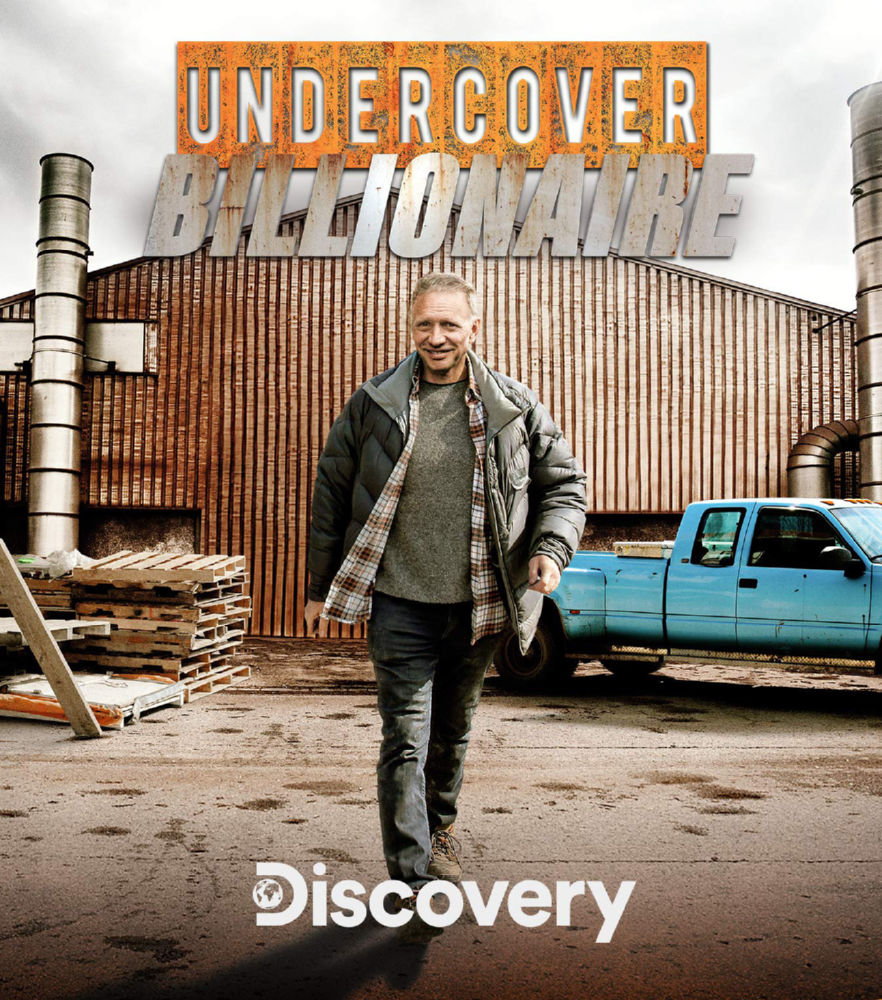



 TV · 2019
Undercover Billionaire
A successful entrepreneur is dropped into a remote community with little resources and has 90 days to create a successful company.
Glenn Stearns is a self-made billionaire. He grew up poor in the sticks of Maryland and was just 14 years old when he became a father. A few years ago he sold his company for $2.2 billion. He believes if he can do it, anyone can.
Now, Glenn is putting his money where his mouth is - in 90 days, he's going to partner with an unsuspecting but deserving candidate to help make them $1 million.
Oops! Is this show WOKE?
Only an account holder or member can file. Cite a scene, a line, or a pattern. Other account holders +1 or −1 that argument, once each. The show is not IS WOKE until enough of them have given a +1. Enough −1s remove the write-up, and it is no longer shown.
Sign in to file a woke label. One of each criterion per member.
Comments and reviews
Report a mistake
Same rule as woke labels: one report, a written reason, and the community +1 or −1 it — once per member. A net +5 applies the change. Editors can hold it for review, or apply it immediately.
No mistake reports yet.
Sign in to report a mistake. One report per field, per member.
Member review
Omar Quill Member
Oct 19, 2026
★★★★★★★★★★Undercover Billionaire hit me in a way I did not expect from a business show. I mostly stick to games with long grind loops and tight time windows, the kind where you drop into a fresh save with almost nothing and have to stand something up before the clock wrecks you. That is basically the whole premise here, and it kept me watching episode after episode even when I had other stuff queued.
Glenn Stearns gets dumped in a city he does not know with a tiny pile of cash and ninety days to build a real company worth a million. No safety net, no name drop, cameras rolling the whole time. He has to figure out a market, talk people into joining him, lock down space and suppliers, and actually move product. The undercover part matters because the people he recruits treat him like any other broke founder who might flame out next week. You feel that pressure in the early stretch when ideas keep dying and the money is basically gone. It is messy in a way that feels honest instead of staged for a big reveal.
What I liked is how much of it sits on the day-to-day grind. Finding the right partners, convincing someone to take a risk on a guy with no track record they can see, chasing cash flow instead of just vibes. I have spent way too many hours in games where you start with scrap and have to decide whether to push a risky build or play it safe for the next boss. This show runs on that same nervous energy. You watch him pivot, eat bad days, and keep the thing moving because the deadline does not care about excuses. When a product finally starts to land or a hire clicks, it lands harder because you sat through the failed attempts.
I am not going to pretend every scene is edge-of-seat stuff. Some of the middle stretches slow down while they chase leases or suppliers, and you can feel the edit trying to keep the tension up. Still, the core loop held me. It is not a slick how-to lecture. It is one guy who already made it once, choosing to prove he can do it again without the bankroll or the Rolodex. That choice alone is more interesting than most scripted drama I have tried lately. You see the real cost of recruiting help when you have almost nothing to offer except a plan and long hours. You see how fast a small mistake eats the runway. And you see him stay in character so the team never gets the billionaire shortcut.
The ninety-day clock does a lot of work. It forces decisions that would drag forever in a normal startup story. He cannot wait for perfect conditions. He has to ship, fix, and ship again. That reminded me of those speedrun-adjacent challenge runs where the timer is the real enemy and every resource has to pull double duty. I caught myself thinking about my own half-finished projects the same way. How many times have I sat on an idea because the setup was not clean enough? This show makes that habit look expensive.
There is also something clean about the stakes being money and time instead of some overcooked personal backstory. The series stays fixed on whether the company can stand on its own. Can it generate real revenue? Can the people he brought in keep it alive without him propping it up forever? Those questions are simple and they land. I do not need a speech about destiny. I need to see the numbers move and the team hold together when things get ugly. Most of the time the show delivers that without dressing it up.
I gave it four stars because the concept is strong and the execution stays closer to the grind than to reality-TV noise. It is not perfect. A couple of threads feel stretched and I wanted tighter cuts in places where the paperwork scenes stack up. But the overall shape works. You get the scramble, the first hires, the product launches, the near-misses, and the constant math of staying alive on almost no capital. For someone who burns evenings on builds that can collapse if you mis-time a resource pull, that rhythm is easy to lock onto.
Would I rewatch whole seasons the way I rewatch certain game campaigns? Probably not cover to cover. Would I recommend it to a friend who likes watching people solve hard problems under real pressure? Yeah. It scratches the same itch as watching a clean hardcore run where the player has to earn every upgrade the hard way. No free legendaries, no infinite money glitch, just decisions and hours. Glenn puts in the hours. The cameras catch enough of the ugly parts that it does not feel like a commercial for entrepreneurship. It feels like work. That is rarer than it should be on TV, and it is why this one stuck with me past the first couple of episodes.
If you have ever started something from zero and felt the clock in your neck, you will recognize the look on his face when a deal slips or a hire almost walks. That recognition is what carried the rating for me. Solid four. Worth the time if you care about the build more than the victory lap.