
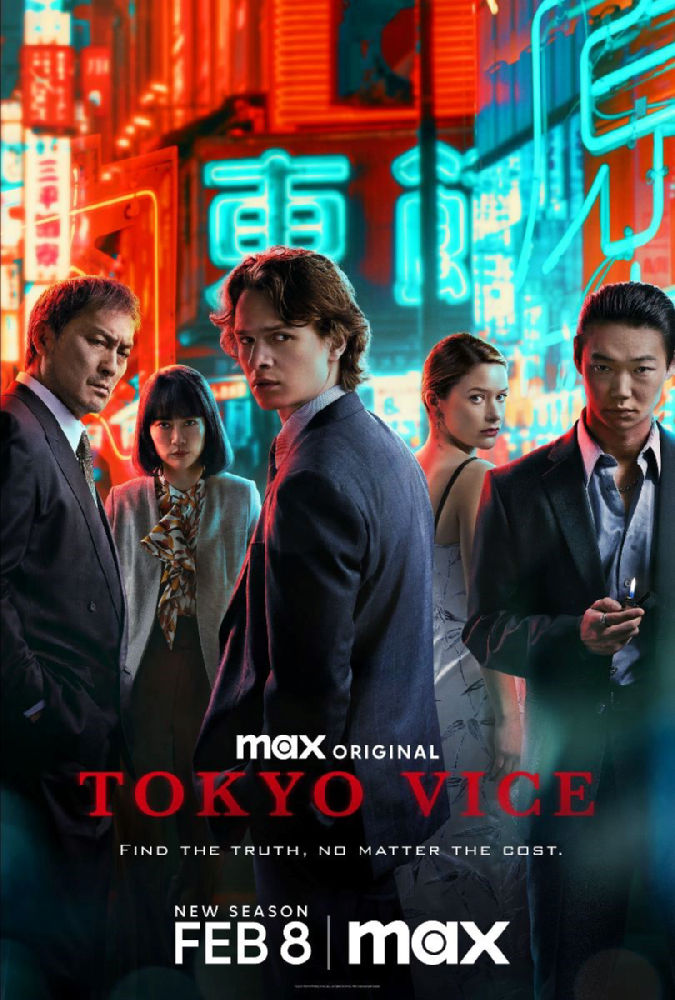



 TV · 2022
Tokyo Vice
American journalist Jake Adelstein embeds with Tokyo’s vice squad to expose yakuza power and police corruption in 1990s Japan. The series follows his high-stakes reporting and the personal costs of chasing stories others leave alone.
Tokyo Vice follows Jake Adelstein, an ambitious American reporter who lands a rare staff job at a major Tokyo newspaper and pushes onto the crime beat. He partners with Detective Hiroto Katagiri of the Metropolitan Police organized-crime unit, learning the unwritten codes that govern both journalism and the yakuza. Jake’s early stories pull him into hostess clubs, loan-shark networks, and the families that control them, while language and cultural barriers constantly test him. His growing tie to Samantha, an American working the nightlife circuit, mixes personal attachment with professional risk. As sources dry up or turn hostile, Jake discovers how deeply crime families and institutions protect one another. Katagiri steers him through raids, interrogations, and quiet warnings that the wrong byline can end a career—or a life.
Later investigations force Jake to confront bosses who operate in plain sight and officers who look the other way, raising the price of every scoop. Samantha’s own entanglements with the same underworld tighten the circle around both of them and leave fewer safe exits. Katagiri balances loyalty to the badge against pressure from above while Jake weighs publication against the safety of sources and friends. Raids, betrayals, and retaliatory violence escalate as the reporter refuses to drop stories Japanese colleagues often avoid. The partnership between the outsider journalist and the veteran detective becomes the axis of the hunt, even as each man pays for the truths they surface. Their choices keep drawing them back into the same clubs, offices, and back rooms where the city’s real power is brokered.
Creator: Anthony Mandler
Oops! Is this show WOKE?
Only an account holder or member can file. Cite a scene, a line, or a pattern. Other account holders +1 or −1 that argument, once each. The show is not WOKE until enough of them have given a +1. Enough −1s remove the write-up, and it is no longer shown.
Sign in to file a woke label. One of each criterion per member.
Comments and reviews
Report a mistake
Same rule as woke labels: one report, a written reason, and the community +1 or −1 it — once per member. A net +5 applies the change. Editors can hold it for review, or apply it immediately.
No mistake reports yet.
Sign in to report a mistake. One report per field, per member.
Member review
Stu Kline Member
Oct 20, 2026
★★★★★★★★★★Tokyo Vice hooked me faster than I expected. An American kid lands a real desk at a big Tokyo paper in the nineties and forces his way onto the crime beat. That setup alone is enough. What keeps it going is how hard the show works at the grind of getting a story when every door is half-closed and half-dangerous.
Jake is not a superhero reporter. He is hungry, clumsy with the language at first, and stubborn enough to keep walking into rooms where he is not wanted. The partnership with Detective Katagiri is the spine. You watch a foreigner learn the codes that actually run the city—the ones that never make it into the official briefings. Hostess clubs, loan sharks, the quiet families behind them. None of it feels like tourist Japan. The streets look lived-in and a little worn, which is exactly right for that period.
I liked that the personal cost is not abstract. Sources dry up. People get leaner with the truth. Jake’s tie to Samantha, the American working the nightlife circuit, adds weight without turning into a soap. It is attachment mixed with risk, and the show mostly lets that sit instead of overplaying it. You feel the language barrier and the cultural one every day he is on the job. That friction is the point.
Pacing is steady rather than flashy. Some episodes breathe more than others, and a couple stretch the procedural side longer than I needed. Still, the atmosphere holds. The yakuza material is handled with a cool distance—power, money, the unwritten rules—without turning every scene into pure menace theater. Police corruption is there too, not as a sermon but as the water everyone swims in. Jake keeps pushing stories other people leave alone, and you see why that habit can wreck a person.
What sold me is the texture. Newsrooms that feel busy and under pressure. Nights that run long. Conversations that circle around what can and cannot be said out loud. I never felt the show was explaining Japan to me like a guidebook. It just dropped me in and let the friction do the work. That is rarer than it should be.
Ansel Elgort’s Jake is ambitious without being charming in a cheap way. He makes mistakes that cost him. Ken Watanabe as Katagiri brings the kind of quiet authority that makes the whole partnership believable. The supporting faces around the clubs and the desks feel specific rather than stock. I did not need every subplot to land perfectly. A few threads thin out, and once or twice the show leans a little hard on the “outsider sees what locals won’t” angle. But it recovers because the reporting itself stays front and center.
I rated it four because it does the hard parts well and only stumbles on the easy ones. It respects the material enough to let silence and small gestures carry weight. It does not rush the relationships or pretend Jake becomes fluent overnight. You watch him earn scraps of access and then watch those scraps get expensive. That feels honest.
If you want pure adrenaline every episode, look elsewhere. This one is about the long game—chasing a story when the city has already decided how much truth it will tolerate. The nineties setting helps. Cell phones are not magic yet. Information still moves through people and paper and favors. That slower machinery makes the stakes clearer.
I kept thinking about how rare it is to see a newsroom show that actually cares about the mechanics of the beat instead of just the big scoop montage. Tokyo Vice gets the daily cost right. The late nights, the dry sources, the moment you realize the story is bigger than the byline. It also gets the personal bleed: once you start seeing the machine, you cannot unsee it, and the people closest to you pay part of the bill.
A few choices feel safe when they could have cut deeper, and the second half of the season sometimes circles familiar ground. Even so, the core holds. The relationship between the American reporter and the Japanese detective never turns into a buddy cartoon. It stays professional, wary, and necessary. That restraint is what makes the high-stakes stretches land harder when they arrive.
I would watch it again for the atmosphere alone—the clubs, the alleys, the way power sits just out of frame. It is not perfect television, but it is solid, specific, and grown-up in a way a lot of crime shows forget to be. Four stars feels fair. It earned them by refusing to make the job look easier than it is, and by letting the city feel larger than any single story Jake chases.
That is the version of Tokyo I wanted to sit with for a while. Not the postcard, not the lecture. Just the work of trying to write the truth when the truth has muscle behind it. The show mostly delivers on that promise without dressing it up.