




 MOVIE · 1988
They Live IS WOKE
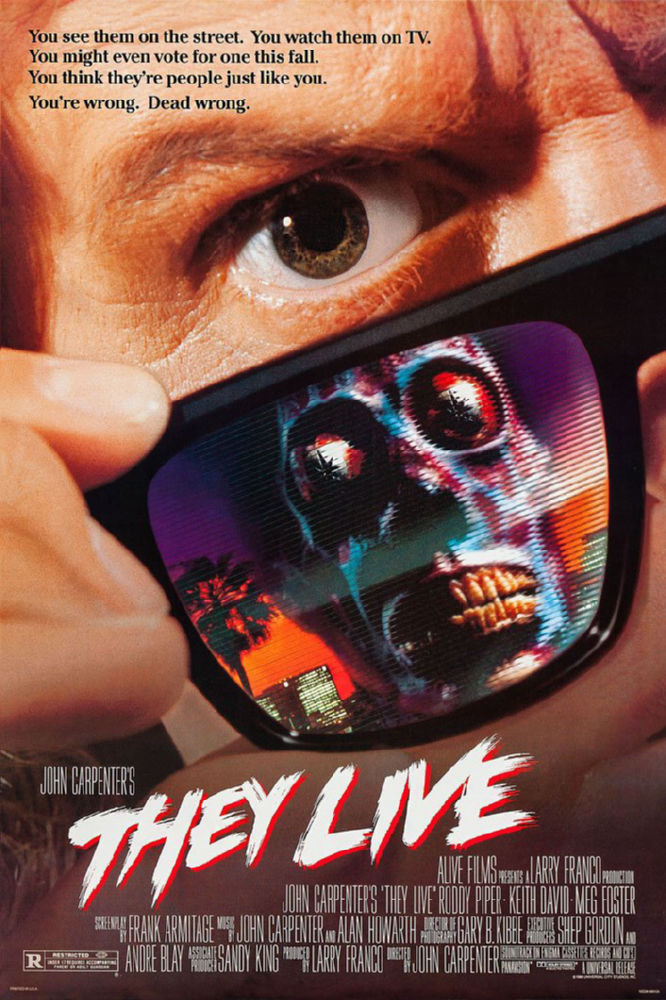
Aliens are systematically gaining control of the earth by masquerading as humans and lulling the public into submission.
They influence our decisions without us knowing it. They numb our senses without us feeling it. They control our lives without us realizing it. They live. Horror master John Carpenter directs this heart-pounding thriller. Aliens are systematically gaining control of the earth by masquerading as humans and lulling the public into submission.
Humanity's last chance lies with a lone drifter who stumbles upon a harrowing discovery - a unique pair of sunglasses that reveal the terrifying and deadly truth.
WHAT CRITERIA MAKES IT WOKE?

Oops! Is this show WOKE?
Only an account holder or member can file. Cite a scene, a line, or a pattern. Other account holders +1 or −1 that argument, once each. The show is not WOKE until enough of them have given a +1. Enough −1s remove the write-up, and it is no longer shown.
Sign in to file a woke label. One of each criterion per member.
Comments and reviews
Report a mistake
Same rule as woke labels: one report, a written reason, and the community +1 or −1 it — once per member. A net +5 applies the change. Editors can hold it for review, or apply it immediately.
No mistake reports yet.
Sign in to report a mistake. One report per field, per member.
Member review
Wes Calder Member
Sep 24, 2026
★★★★★★★★★★They Live is one of those late-eighties Carpenter pictures that still feels like it was shot between coffee and a payday. Roddy Piper’s Nada drifts into Los Angeles looking for work and a corner to sleep in, lands a construction gig, and ends up with a pair of sunglasses that strip the city bare. Billboards stop selling and start ordering. Money reads THIS IS YOUR GOD. A good number of the people who own the place turn out to be skull-faced things living off the rest of us. The setup is clean and the execution stays mostly lean.
I first saw it on a late cable run years ago and what stuck was how ordinary the world looked until the glasses went on. Piper is not doing Shakespeare, but he is right for the part: quiet, a little blank, then suddenly finished with the polite version of things. Keith David as Frank gives him someone worth arguing with, and their alley fight has become the thing people remember longest. It goes on past the point of reason, long enough that you start wondering whether they will settle it with rock-paper-scissors next. The length is both a joke and a commitment. Carpenter lets it play because the movie is about two working guys who cannot agree on what is real until one of them forces the issue with knuckles.
The social angle on ads, television, and the class split was already sharp in 1988 and has not gone soft. You can still feel the same pressure in the signals now, only the screens are smaller and always on. Carpenter and the source short story keep the aliens as a ruling class that prefers subliminal orders to open force, which gives the paranoia a practical edge. It is not a thesis paper. Once Nada starts carrying a gun and walking into shops, the film shifts into something closer to a standard chase-and-shoot loop, and the resistance side never quite thickens out. Meg Foster shows up with those pale eyes that could stop traffic, yet her role stays thin. The church hideout and the shantytown raid have more texture than most of the later set pieces.
Music by Carpenter and Howarth does the familiar low pulse without begging for attention. Gary Kibbe’s photography keeps Los Angeles looking like dirt, concrete, and cheap apartments, which helps more than fancy effects would have. The creatures themselves are just men in suits with faces like melted bone; low-budget and effective. Piper’s bubblegum line gets quoted more than half the dialogue, and it fits the dry delivery. He is not playing a chosen one so much as a guy who saw the wire and decided the quiet option was finished.
I land at 3.5 because the first hour still grabs and the central idea stays clean, but the back half settles for motion when it could have stayed stranger. The film can feel didactic if you come in looking for a sermon, yet the message mostly rides on the images rather than speeches. It is ahead of a lot of louder genre work from the same years simply by refusing to dress the idea up. You put on the glasses, the world changes, and the rest is what follows from that. Not deep philosophy. A solid B-picture that stumbled into staying power. Worth putting on when the mood for something plain and pointed arrives, and easy to leave on the shelf the rest of the time without feeling you missed a masterpiece. Carpenter made tighter films and he made messier ones. This one sits in the middle, still readable, still a little mean about the people who sell you the dream while living off the labor underneath it.