




Oops! Is this show WOKE?
Only an account holder or member can file. Cite a scene, a line, or a pattern. Other account holders +1 or −1 that argument, once each. The show is not WOKE until enough of them have given a +1. Enough −1s remove the write-up, and it is no longer shown.
Sign in to file a woke label. One of each criterion per member.
Comments and reviews
Report a mistake
Same rule as woke labels: one report, a written reason, and the community +1 or −1 it — once per member. A net +5 applies the change. Editors can hold it for review, or apply it immediately.
No mistake reports yet.
Sign in to report a mistake. One report per field, per member.
Member review
Peg Harlan Member
Oct 16, 2026
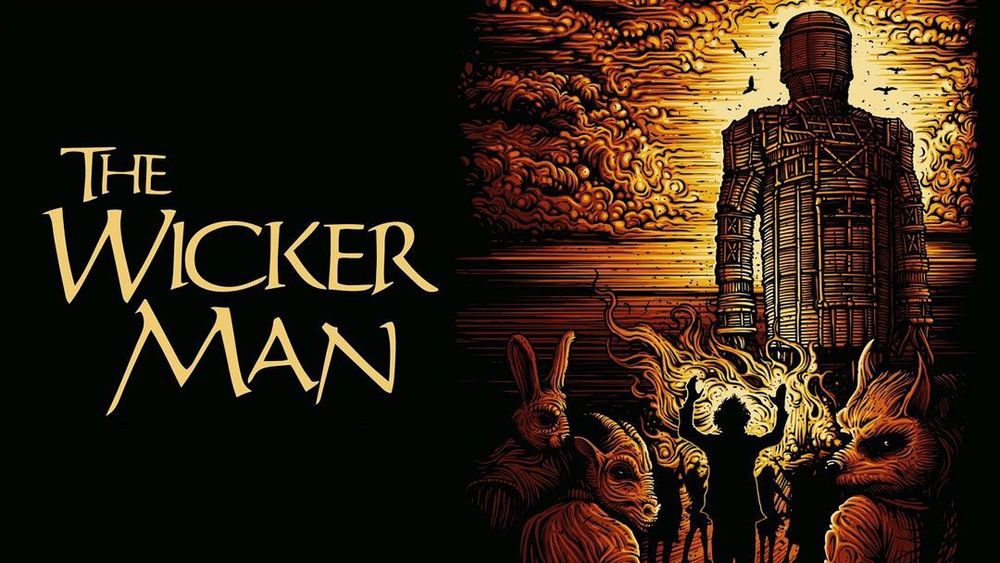
★★★★★★★★★★The Wicker Man from 1975 still sits with me in a way most modern scare pictures don’t. I put it at four stars because it earns that without needing jump cuts or a big effects budget. You get a police sergeant who thinks he knows the world, sent out to a Scottish island over a missing girl, and the place looks peaceful enough at first glance. Green fields, smiling faces, songs in the air. That setup used to be enough. They trusted the audience to feel the wrongness creep in instead of spelling every beat out with a loud score.
What works is how ordinary the island people seem while they are doing things that slowly stop making sense to an outsider. Sergeant Howie arrives full of duty and a pretty rigid faith, and the film never winks at you about whether that rigidity is a flaw or a strength. It just lets him collide with a community that has its own rules and doesn’t care much for his. I like that the story doesn’t rush to the big reveal. You spend time in the schoolroom, at the pub, walking those roads, and the unease builds because nothing is quite right even when everyone is polite. Christopher Lee is in full command without chewing scenery, and Edward Woodward plays the straight man so cleanly you almost root for him to keep his footing even as the ground shifts.
I keep coming back to how the film treats belief. Howie’s Christianity isn’t painted as the automatic villain costume, and the island’s older ways aren’t automatically noble either. Both sides have their certainties, and the movie lets that friction do the work. You don’t get a lecture about which system is pure. You get people living inside their own logic until it closes around the visitor. That feels rarer now. Plenty of newer films would pick a side early and start scoring points. This one stays colder than that and is better for it.
The songs stuck with me more than I expected. They aren’t background decoration. They feel like part of how the place holds itself together, passed around the way other towns might pass around gossip or recipes. Britt Ekland’s turn has that odd mix of invitation and distance that fits the whole island mood. Nothing is overplayed. The camera stays steady, the daylight looks real, and the final stretch still lands hard because you have been allowed to watch the net tighten without a lot of cheap tricks. I won’t rehash the ending; if you know it, you know why it stays with people. If you don’t, better to meet it clean.
They used to make them like this more often: patient, a little cruel in the best sense, interested in what happens when one man’s order meets a closed circle that has already decided what it needs. I don’t need every horror movie to chase the same feeling, but I miss the ones that trust silence and faces and landscape. The island itself is almost a character without anyone needing to say so. You feel the isolation without constant reminders. The animals, the crops, the talk of harvest—it all sits there as texture instead of symbolism dumped in your lap.
A few spots drag if you’re restless. The middle stretches longer than some modern viewers will like, and Howie’s shock can read as stubbornness past the point of usefulness. I didn’t mind much. His stubbornness is the point. He is a man who believes the badge and the Book will hold, and the film tests that belief without turning him into a cartoon prude or a secret monster. That balance is harder than it looks. A lesser script would have made him either the pure fool or the secret hero. Here he is mostly just a man out of his depth who keeps walking forward anyway.
I rated it four because the craft holds up and the tone never goes soft. It isn’t perfect. Some of the supporting business feels a touch theatrical now, and the music can tip into folk-pastiche if you’re not in the mood. Still, the core is solid. It understands that real dread comes from people who are perfectly calm about what they are doing. No need for fog machines or monster makeup when the community itself is the engine. I rewatched it last winter on a quiet night and it still worked the same way—slow tightening, then the drop. That’s the kind of picture that doesn’t need updating. It already knew how to leave you thinking about what you would do if the friendly faces stopped being friendly and the rules you carried with you suddenly didn’t apply.
If you want loud and bloody, look elsewhere. If you want something that treats its ideas with a straight face and lets the landscape and the people carry the weight, this one still holds. Four stars feels right. It isn’t a five for me only because a couple of scenes land softer than the best stretches, but the overall thing stays honest and sharp in a way I respect. They don’t make many like it anymore, and when I find one that does, I tend to keep it on the shelf.