
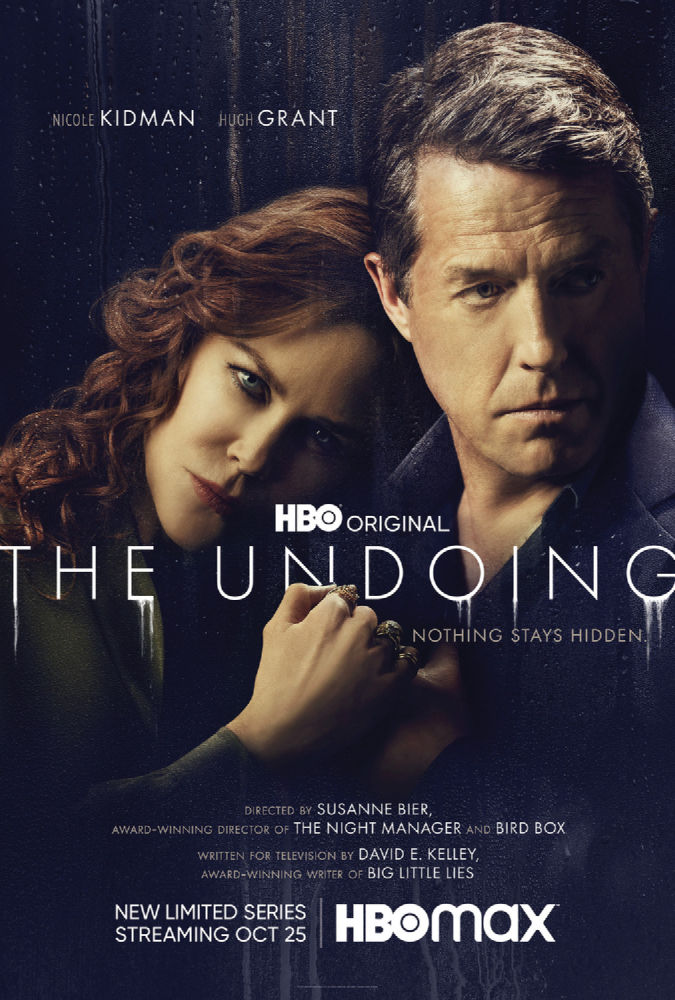



 TV · 2020
The Undoing
A Manhattan therapist's polished life collapses overnight when a brutal murder exposes her husband's secrets and drags their family into a public scandal. Grace Fraser must protect her son while dismantling the marriage and status she thought she knew.
The Undoing follows Grace Fraser, a successful couples therapist on New York's Upper East Side who shares an enviable life with pediatric oncologist Jonathan and their son Henry. When Elena Alves, a young mother connected to Henry's elite private school, is found violently killed, the Fraser household is pulled into the investigation. Jonathan vanishes after the crime, and detectives treat him as a prime suspect while Grace struggles to separate loyalty from mounting evidence. School fundraisers, therapy sessions, and society friends become stages for suspicion and rumor. Grace's wealthy father Franklin offers money and hard counsel as the media turns private catastrophe into spectacle. She begins to confront signs of Jonathan's double life and the fragile foundations of the world she built.
As the case advances, Grace races to shield Henry and salvage a future while police pressure and legal strategy close in. Revelations about Jonathan's affair and possible violence force her to reexamine her own judgment and the performances of privilege around her. Allies and rivals at the school and in the family circle offer conflicting versions of events, and Grace's professional insight into deception becomes both weapon and liability. Courtroom stakes rise as she chooses how much truth she can bear and what she will sacrifice. The story tracks her dismantling of one carefully curated life and the painful construction of another for herself and her child amid wreckage, publicity, and broken trust.
Click any of the following icons below to rent or stream it!
Oops! Is this show WOKE?
Only an account holder or member can file. Cite a scene, a line, or a pattern. Other account holders +1 or −1 that argument, once each. The show is not WOKE until enough of them have given a +1. Enough −1s remove the write-up, and it is no longer shown.
Sign in to file a woke label. One of each criterion per member.
Comments and reviews
Report a mistake
Same rule as woke labels: one report, a written reason, and the community +1 or −1 it — once per member. A net +5 applies the change. Editors can hold it for review, or apply it immediately.
No mistake reports yet.
Sign in to report a mistake. One report per field, per member.
Member review
Stu Kline Member
Oct 20, 2026
★★★★★★★★★★The Undoing sat with me for a while after I finished it. Not because it reinvented the crime drama, but because it keeps circling the same ugly question: how much of a polished life is just performance until the wrong night knocks it over. Grace Fraser is a couples therapist living the Upper East Side version of success with her oncologist husband and their kid. One brutal murder later, that surface cracks and the show spends its time watching her try to hold the pieces while the investigation treats her husband like the obvious answer.
I rated it 3.5 because the setup works and the performances mostly carry the weight, yet the whole thing never quite earns the length it takes. Nicole Kidman plays Grace with that controlled tightness that makes you lean in. You see her calculating loyalty against the drip of new facts. Hugh Grant as Jonathan is the right kind of slippery; he knows how to make charm look like a defense mechanism. Their scenes together have heat even when the dialogue turns circular. The kid, Henry, gets pulled into the mess in ways that feel grounded instead of cute. Donald Sutherland as the wealthy father brings the cold practicality the story needs when everyone else is spinning.
What lands is the atmosphere of moneyed New York under pressure. School events, therapy offices, and dinner tables become places where people measure each other instead of connecting. Rumors travel faster than facts. Grace keeps trying to protect her son while the marriage she thought she understood turns into a liability. The show is good at letting small details do the work— a missing phone, a changed story, the way friends suddenly need distance. You feel the social cost before the legal one fully hits.
The murder itself is nasty and the investigation has enough real friction to keep you watching. Detectives treat Jonathan as prime suspect once he disappears, and Grace has to decide what she owes him versus what she owes her own eyes. That tension is the engine. Some nights I was locked in. Other nights I wanted the writers to stop restating the same suspicion and just move. The middle stretch repeats its beats. A revelation arrives, Grace absorbs it, the circle of friends tightens or loosens, then we do a version of it again. For a limited series that should feel tight, it starts to coast on mood.
I never bought every twist as fully earned. A couple of late turns feel like they exist to keep the audience guessing rather than growing out of character. The show wants you off-balance, which is fine, but it sometimes confuses withholding with depth. When the final stretch arrives you can see the machinery. Still, the central relationship holds interest even when the plot gets busy. Grace dismantling the status she relied on is more interesting than the courtroom-adjacent theatrics that eventually take over.
Visually it looks expensive without screaming about it. The apartments, the clothes, the quiet streets at night all sell the world these people inhabit. That world is the real pressure cooker. Once scandal attaches itself, the same people who smiled at fundraisers start calculating risk. Franklin’s offers of money and hard counsel feel true to a certain class of parent who believes problems can be managed if you just apply enough resources. The show never fully romanticizes that attitude or condemns it in a speech; it just lets it sit there and look practical and cold at the same time.
I kept thinking about how ordinary the self-deception feels. Grace is trained to spot cracks in other marriages and still misses the ones in her own until force makes them visible. That is not a new idea, but Kidman sells the slow realization without big speeches. Grant’s Jonathan stays readable even when you distrust every word out of his mouth. Their history has weight. You understand why she stayed and why leaving is not simple once the public version of events takes over.
Pacing is the main drag. Six episodes could have been tighter. Some side characters exist mainly to deliver doubt or gossip and then fade. The elite school setting gives texture but also becomes a stage for the same conversations on loop. When the show trusts its leads and the central marriage, it works. When it stretches to keep the mystery inflated, it loses air.
I am not someone who needs every prestige drama to reinvent the form. A solid thriller about trust collapsing under public scrutiny is enough if the people feel real. Here they mostly do. The violence that starts everything is ugly enough to matter, and the fallout hits the family in ways that feel personal rather than purely procedural. You watch Grace try to shield her son while the ground under her own identity keeps shifting. That part stuck with me longer than the solution to the crime.
Would I call it essential? No. Would I recommend it on a night when you want something stylish that still has teeth? Yes, with the caveat that you may check your watch once or twice in the back half. The cast elevates material that sometimes settles for handsome repetition. The core idea— that a life can look complete until one night proves it was always contingent— is strong enough to carry the weak spots. I landed at 3.5 because the good outweighs the padding without erasing it. It held my attention, frustrated me in places, and left a clear aftertaste of how fragile the polished version of a marriage can be. That is more than enough for me to finish it and not feel like I wasted the time.