
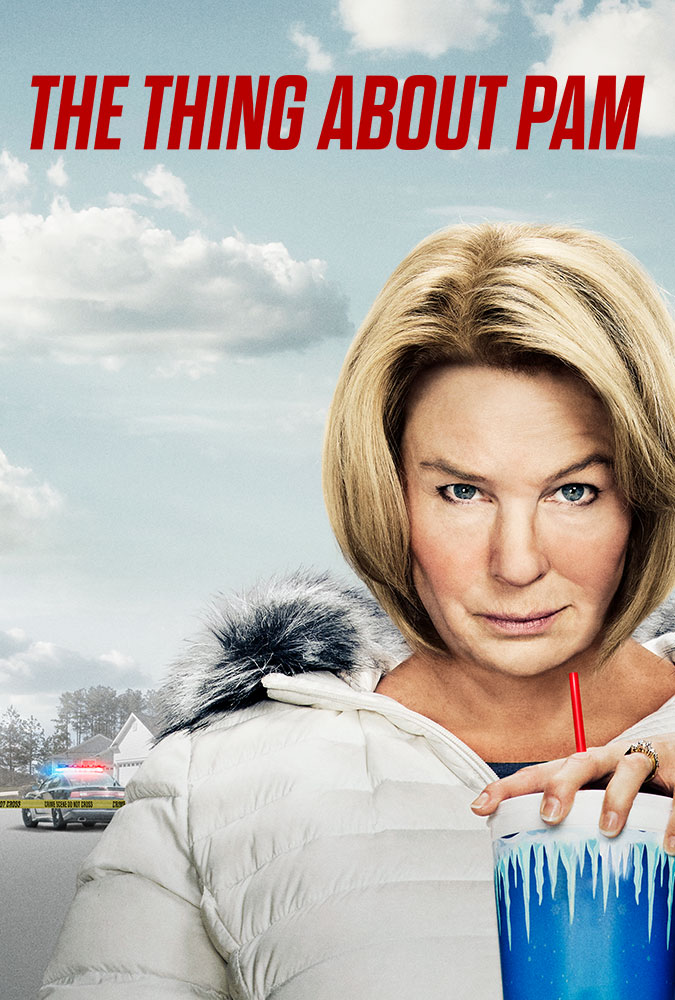



 TV · 2022
The Thing About Pam
Pam Hupp’s friendship with Betsy Faria collapses into murder, a wrongful conviction, and a long trail of lies. The series tracks how one brutal crime unravels into a larger scheme centered on Pam.
The Thing About Pam follows Pam Hupp, a Missouri woman whose close friendship with cancer patient Betsy Faria ends the night Betsy is found stabbed to death in her home. Betsy’s husband Russ insists he is innocent even as police and prosecutors lock onto him, and Pam’s account of the evening helps steer suspicion his way. Defense attorney Joel Schwartz fights the case while prosecutor Leah Askey pushes hard for a conviction that will stick. Pam stays in the picture as a helpful neighbor and beneficiary of Betsy’s life-insurance change, offering details that keep the investigation pointed at Russ. The early episodes stay close to the night of the killing, the trial, and the personal ties that make Pam seem indispensable to everyone involved.
After Russ is convicted, new evidence and dogged legal work reopen the case and begin to expose cracks in the story that put him away. Attention shifts toward Pam’s financial motives, her movements that night, and later crimes that investigators link back to the same pattern of deceit. Leah Askey’s handling of the prosecution comes under scrutiny as Schwartz and others push to free Russ and reframe who actually benefited from Betsy’s death. Pam keeps maneuvering through interviews, relationships, and cover stories while the circle of people around her shrinks. The series closes on the unraveling of the scheme that started with one murder and spread through insurance money, courtroom theater, and Pam’s relentless self-preservation.
Click any of the following icons below to rent or stream it!
Oops! Is this show WOKE?
Only an account holder or member can file. Cite a scene, a line, or a pattern. Other account holders +1 or −1 that argument, once each. The show is not WOKE until enough of them have given a +1. Enough −1s remove the write-up, and it is no longer shown.
Sign in to file a woke label. One of each criterion per member.
Comments and reviews
Report a mistake
Same rule as woke labels: one report, a written reason, and the community +1 or −1 it — once per member. A net +5 applies the change. Editors can hold it for review, or apply it immediately.
No mistake reports yet.
Sign in to report a mistake. One report per field, per member.
Member review
Peg Harlan Member
Oct 20, 2026
★★★★★★★★★★The Thing About Pam sat with me longer than I expected, which is not the same as saying I loved every minute of it. I gave it a 3.5 because it gets a lot right about how ordinary people talk themselves into believing something convenient, and then it sort of runs out of road. You already know the bones: Pam Hupp is the helpful friend to Betsy Faria, Betsy ends up stabbed to death, Russ takes the fall, and Pam keeps hovering with her helpful little details and that life-insurance change that should have set off more alarms than it did. The series stays close to that night and the trial early on, which works. You feel the small-town pressure and the way a prosecutor can decide a story and then make the evidence fit it.
What held me was the way Pam just keeps showing up. She is not a mastermind in a cape. She is the neighbor who brings the casserole and remembers everyone’s middle name and somehow always has a reason to be in the middle of things. That part felt true to life. I have known people who operate like that—always available, always slightly too interested, always ready with a version of events that puts them in a good light. Watching her steer suspicion without raising her voice was more unsettling than any big monologue would have been. They used to make true-crime stories that trusted the audience to sit with that kind of quiet wrongness. This one mostly does, at least for the first stretch.
Where it loses me is in the middle stretch when the show starts explaining itself more than it needs to. Once Russ is locked up and the defense attorney starts digging, the series keeps circling the same handful of facts—the insurance, the timeline, Pam’s little inconsistencies—until the air goes out of the room. I do not need every beat underlined. A few scenes with the prosecutor leaning hard on the conviction felt accurate to how cases can get locked in, but they also started to feel like the show was more interested in the machinery of the trial than in the people grinding through it. Joel Schwartz fighting the case has real weight, yet the writing sometimes treats him like a function instead of a person who has to live with the results.
Renée Zellweger’s Pam is the reason I stuck with it. She plays the helpfulness without winking at the camera every two minutes, which is harder than it looks. You catch yourself almost rooting for her to keep getting away with the next small lie because she seems so reasonable about it. That is the trick of the real story, and the performance understands it. The supporting work is uneven. Some of the law-enforcement and family scenes land with the right exhaustion; others feel staged so we will notice a clue. I never needed the show to make me hate anyone on sight. The facts are already ugly enough.
I kept thinking about how long these things drag in real life. Years go by. People move on or dig in. The series tries to cover that stretch without turning into a pure procedural, and it half succeeds. There are stretches where you feel the weight of a wrongful conviction and the stubbornness of a system that does not like to reverse itself. Then it will cut back to Pam doing something small and calculated and the tension snaps back into place. Those moments are why the rating sits at 3.5 instead of lower. When it trusts the audience, it works. When it starts arranging the furniture so we will not miss the next revelation, it feels like television doing its homework out loud.
The larger scheme centered on Pam is the part that should have been the engine, and sometimes it is. Other times the show seems almost nervous about letting her sit in the frame without a reaction shot telling us how to feel. I did not need the moral scorecard. Most adults watching already understand that a friendship collapsing into murder and a trail of lies is not a puzzle with a tidy prize at the end. It is just ugly and slow and hard to walk away from once you have started looking.
Would I recommend it? With the usual caveats. If you can handle true crime that does not rush every beat and you are curious about how one person’s version of helpfulness can wreck several lives, it is worth the time. If you want tight pacing and no repeated notes, you will get impatient in the middle. I finished it, thought about it the next day, and did not feel cheated, which is more than I can say for a lot of these limited series. They used to make them a little leaner. This one is close enough that I stayed, and far enough that I marked it right in the middle-high range. Not a waste of evenings. Not something I will rewatch soon either. Just a solid, slightly over-explained look at how a brutal crime can keep expanding until half a town is caught in the mess Pam left behind.