
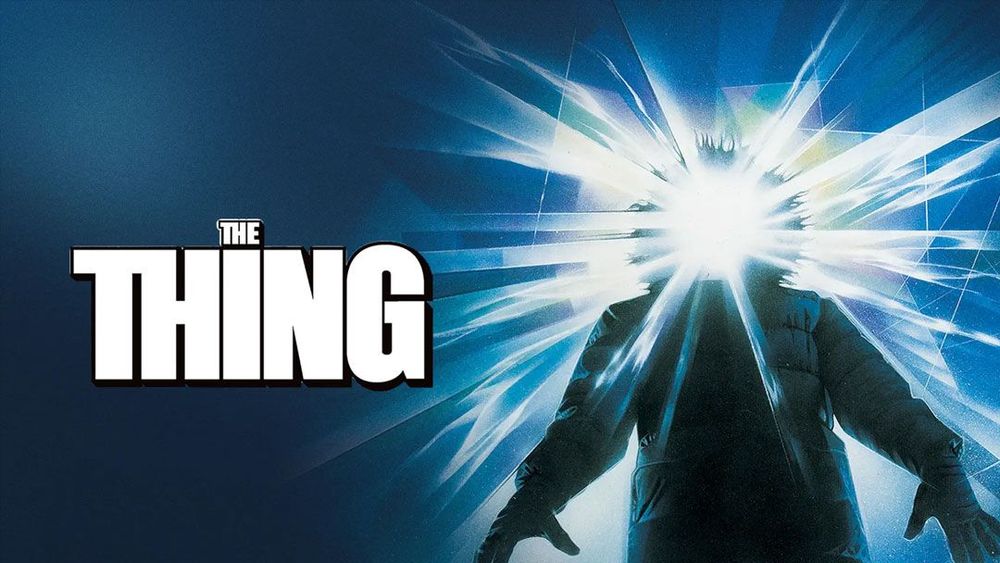



 MOVIE · 1982
The Thing (1982)
In the winter of 1982, a twelve-man research team at a remote Antarctic research station discovers an alien buried in the snow for over 100,000 years. Once unfrozen, the form-changing alien wreaks havoc, creates terror and becomes one of them.
Oops! Is this show WOKE?
Only an account holder or member can file. Cite a scene, a line, or a pattern. Other account holders +1 or −1 that argument, once each. The show is not WOKE until enough of them have given a +1. Enough −1s remove the write-up, and it is no longer shown.
Sign in to file a woke label. One of each criterion per member.
Comments and reviews
Report a mistake
Same rule as woke labels: one report, a written reason, and the community +1 or −1 it — once per member. A net +5 applies the change. Editors can hold it for review, or apply it immediately.
No mistake reports yet.
Sign in to report a mistake. One report per field, per member.
Member review
Toni Briggs Member
Oct 16, 2026
★★★★★★★★★★The Thing from 1982 still works on me in a way most modern horror refuses to. I put it at four stars because it earns every minute of that cold, grinding dread without ever begging for sympathy or explaining itself to death. You get a dozen men stuck at the bottom of the world, snow piling up outside, and something that can look like any one of them. That setup is simple and it is vicious. Once the thing starts copying people, trust dies faster than the temperature drops, and the movie never softens that blow.
What holds it together is how ordinary the crew feels before everything goes sideways. These are not superheroes or carefully balanced identity checklists. They are tired researchers and roughnecks who drink coffee, play cards, and argue about whose turn it is to check the dogs. Kurt Russell’s MacReady is the closest thing to a center, but even he is just a guy who would rather stay half-drunk in his helicopter than run a democracy. When the paranoia sets in, nobody gets a heroic speech about unity. They get flamethrowers, blood tests, and the ugly realization that the person next to them might already be gone. That absence of comfort is the point. The film treats isolation and suspicion as facts of the situation, not as metaphors for whatever lecture someone wants to deliver later.
The practical effects still look better than most digital piles of goo I have seen in the last ten years. When a head sprouts legs or a chest opens into a mouth full of teeth, it feels heavy and wet and wrong. You can tell someone actually built those things and lit them so the camera could sit there and stare. That physicality matters. It makes the threat feel present in the room with the characters instead of floating in some effects house after the fact. I rewatched it last winter during a real cold snap and the sound design alone— the wind, the radio static, the wet tearing noises— kept me checking the locks on my own place. That is rare.
I like that the movie does not waste time making the men apologize for being men. They are competent or they are not, they hold it together or they crack, and the story does not pause to scold anyone for traditional toughness. In a remote station with limited gear, you need people who can swing a tool, keep a fire going, and make a hard call without a committee. The film just shows that. No one is framed as the root of the problem for existing. The alien is the problem. Everything else is survival under pressure. That clarity is refreshing when so many newer stories feel obligated to invent extra villains inside the group.
The blood-test scene remains one of the cleanest pieces of suspense I know. No jump scares required. Just a room full of guys watching a petri dish and realizing the next second might end them. Carpenter and the cast play it straight. You can feel the air leave the room. Same with the ending. It does not tidy itself up. Two men left in the snow, maybe human, maybe not, sharing a bottle while the station burns. The movie trusts you to sit with that uncertainty. It does not flash a title card or a hopeful montage. It just ends, cold and unfinished, the way real disasters often do.
I have seen people try to turn this into pure nostalgia bait or claim it is only about 1980s excess. That misses it. The Thing is about what happens when you cannot verify the person across the table. That fear does not expire. You can set it in Antarctica or in any closed system where one bad copy ruins the rest. The 1982 version stays sharp because it never confuses style with substance. The clothes and the computers look dated; the dread does not. I still catch myself wondering, during quiet stretches, whether anyone else in the room has already changed. That is the mark of something that got under the skin and stayed there.
Four stars feels right. It is not perfect— a couple of the supporting characters blur together if you are not paying close attention, and the pacing in the middle can feel a little deliberate if you came expecting constant set pieces. But those are small complaints next to how completely it commits. No lectures. No sudden soft landings. Just a sealed environment, a perfect mimic, and men trying to stay themselves while the walls close in. I will keep coming back to it when the weather turns ugly and I want something that respects the cold instead of explaining it away.