



 MOVIE · 1956
The Ten Commandments
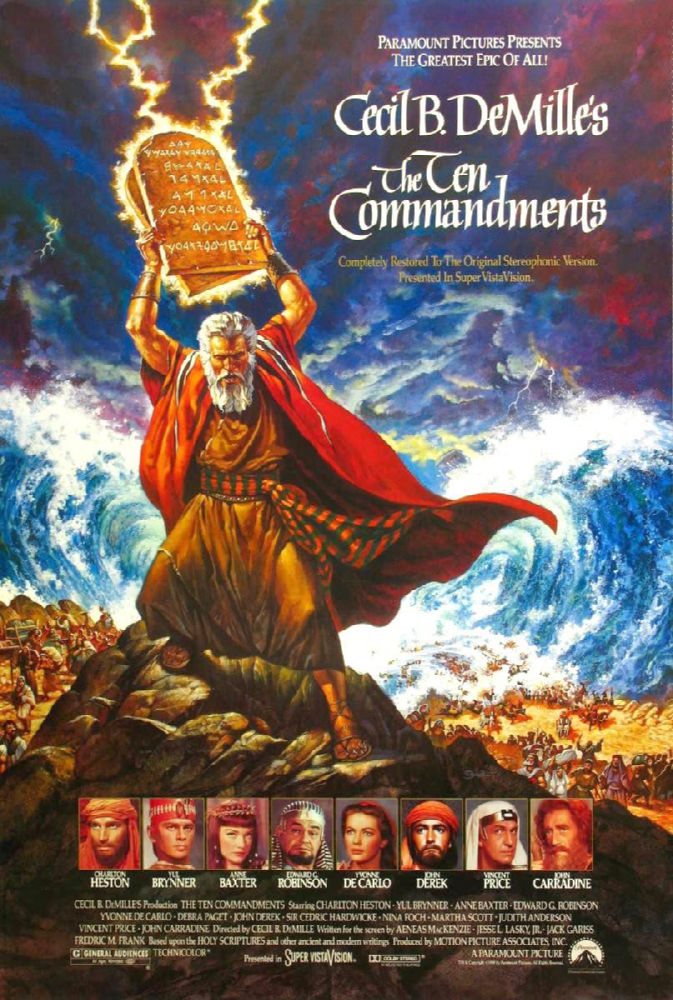
The life of Moses (Charlton Heston), once favoured in the Pharaoh’s (Yul Brynner) household, who turned his back on a privileged life to lead his people to freedom.
Oops! Is this show WOKE?
Only an account holder or member can file. Cite a scene, a line, or a pattern. Other account holders +1 or −1 that argument, once each. The show is not WOKE until enough of them have given a +1. Enough −1s remove the write-up, and it is no longer shown.
Sign in to file a woke label. One of each criterion per member.
Comments and reviews
Report a mistake
Same rule as woke labels: one report, a written reason, and the community +1 or −1 it — once per member. A net +5 applies the change. Editors can hold it for review, or apply it immediately.
No mistake reports yet.
Sign in to report a mistake. One report per field, per member.
Member review
Ray Okonkwo Member
Oct 2, 2026
★★★★★★★★★★I put this on a rainy afternoon and let it run straight through, something I’d never managed before. The Ten Commandments is long enough that you notice the furniture in your own living room more than once, yet certain stretches still lock you in. The early Egyptian court is where it holds me best. Charlton Heston as Moses the prince moves with that square-shouldered confidence that later turns into something heavier, and Yul Brynner’s Rameses is already watching him like a rival who has measured every inch. Their shared history under Sethi feels real enough before the story tips into destiny. Sir Cedric Hardwicke gives Sethi a dry, tired authority that makes the palace scenes classier than what follows; once he’s gone the picture becomes more of a two-man contest in gold paint and sand.
Anne Baxter’s Nefretiri is pure calculation wrapped in silk. There’s a moment after everything has soured where she tells Rameses to bring the sword back stained with Moses’ blood and he answers that he’ll mingle it with her own. It’s pure DeMille swagger, overcooked on purpose, and both of them sell it without flinching. That kind of open enmity, started as something like brotherly competition, drives more of the film than the plagues do for me. You watch two men who once shared a future now locked into opposite sides of the same story, and the costumes and sets never let you forget the scale of the stage they’re standing on.
When Moses learns who he is and walks into the brick pits, the tone shifts. The labor is grinding, the overseers ugly, and Edward G. Robinson’s Dathan slides through it all as the perfect opportunist, always sniffing for advantage. Vincent Price as Baka has that soft-spoken cruelty that makes you lean forward. These scenes don’t need speeches; the heat and the dust do most of the work. Later, out in Midian, there’s a quieter stretch with Sephora that actually lets Moses breathe before the burning bush claims him. The bush itself is simple—fire, voice, the decision that changes everything—but Heston’s face carries the weight. You believe the call lands on a man who already knows what it will cost.
The set pieces still have punch. The Red Sea sequence, built with the tools of 1956, looks better than a lot of digital water I’ve sat through in the last ten years. Practical work, mattes, the sheer size of the crowd moving between those walls of water—it holds. Same with the plague effects and the final judgment on the golden calf. DeMille loads the frame with bodies and color and doesn’t apologize for the moral thunder. The dialogue can feel carved rather than spoken, and after a while the pageantry starts to stack on itself until the picture feels staid and over-egged in the middle reels. You get beautiful fabrics and processions and still wish someone would cut a few of the announcements so the action could move.
I rated it four stars because the central clash and the craft keep winning. Heston has the granite presence the part needs; Brynner matches him beat for beat as the man who will not bend. The film never pretends the story is small or private. It treats the Exodus as both history and miracle, puts every dollar on the screen, and trusts the audience to sit with the length. Some of the secondary plotting is hokum and the script loves its own cadence too much, but the images stick after the credits. I don’t need it leaner or more modern. The old Hollywood muscle is still there, the effects still impress for their age, and the rivalry between those two leads gives the whole thing a human pulse under the spectacle. It’s a big, sincere machine that mostly works, and I’m glad I finally stayed until the end.