



 MOVIE · 1994
The Shawshank Redemption
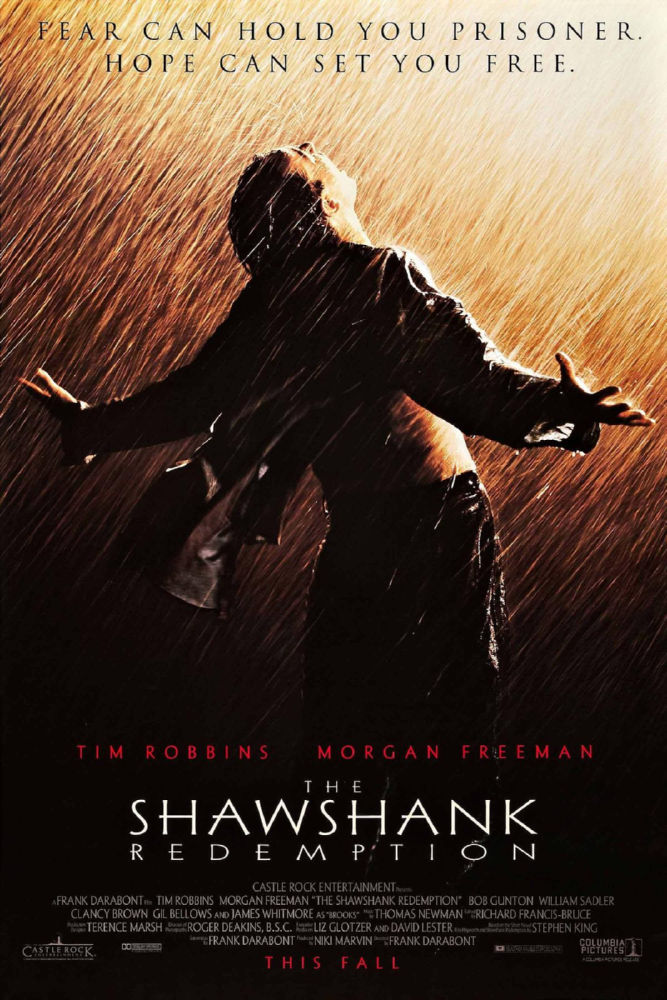
A Maine banker convicted of the murder of his wife and her lover in 1947 gradually forms a friendship over a quarter century with a hardened convict, while maintaining his innocence and trying to remain hopeful through simple compassion.
Imprisoned in the 1940s for the double murder of his wife and her lover, upstanding banker Andy Dufresne begins a new life at the Shawshank prison, where he puts his accounting skills to work for an amoral warden.
During his long stretch in prison, Dufresne comes to be admired by the other inmates -- including an older prisoner named Red -- for his integrity and unquenchable sense of hope.
Oops! Is this show WOKE?
Only an account holder or member can file. Cite a scene, a line, or a pattern. Other account holders +1 or −1 that argument, once each. The show is not WOKE until enough of them have given a +1. Enough −1s remove the write-up, and it is no longer shown.
Sign in to file a woke label. One of each criterion per member.
Comments and reviews
Report a mistake
Same rule as woke labels: one report, a written reason, and the community +1 or −1 it — once per member. A net +5 applies the change. Editors can hold it for review, or apply it immediately.
No mistake reports yet.
Sign in to report a mistake. One report per field, per member.
Member review
Toni Briggs Member
Oct 6, 2026
★★★★★★★★★★The Shawshank Redemption is one of those movies that settles in your head and stays there. I first saw it years ago on a late broadcast when I had nothing better to do, and I still remember sitting forward when Andy started carving that chess set. It is not flashy. It does not beg for attention. It just keeps working on you long after the credits.
What gets me is how ordinary the defiance feels. Andy is not a tough guy. He is a banker who got railroaded, and the prison does everything it can to grind that out of him. The beatings, the isolation, the daily petty humiliations—they are all there, and the film never softens them for comfort. Yet he keeps a private line of hope running that never turns into speeches. That is the part that feels honest. Most stories about locked-up men either turn them into saints or monsters. This one lets him stay a person who simply refuses to let the place rewrite who he is.
Red is the one who makes it land. Morgan Freeman’s narration could have been syrup, but it never is. He talks like a man who has already accepted the walls and then has to watch someone else refuse that acceptance. Their friendship is not built on big declarations. It is built on small trades, shared silences, and the kind of loyalty that grows when two people realize they are the only ones who still see each other clearly. I have known people like that in real life—quiet, steady, not performing toughness. The movie gets that right without dressing it up.
The corruption around them is drawn with a steady hand. The warden’s brand of piety is especially cold. He quotes scripture while running a racket and crushing anyone who might expose it. The film does not need to lecture about hypocrisy; it just shows the daily mechanics of it. Same with the guards. Some are thugs, some are just men collecting a paycheck and looking the other way. That mixture feels truer than a cartoon villain in every frame.
I will not pretend the movie is perfect. The final stretch leans a little hard on coincidence and tidy payoff. Real life is messier, and a few of the later developments feel engineered to give the audience the exact release it has been waiting for. That is why I land at 4.5 instead of a clean five. The emotional math works almost too cleanly at the end. Still, the long middle years—the library, the rock hammer, the slow accumulation of small wins—are so carefully observed that I forgive the polish. Those stretches are where the movie earns its keep.
What stays with me most is the patience. Andy does not win by exploding. He wins by outlasting, by keeping his mind sharp when everything around him is designed to dull it. In a culture that often treats endurance as a secondary virtue, that focus feels almost radical. Hope here is not a slogan. It is a daily discipline, and the film shows the cost of maintaining it. You feel the years. You feel the dirt under the fingernails. You feel how rare it is for anyone inside those walls to keep a private interior life intact.
I have rewatched it enough times that certain images have become permanent: the rooftop beer, the opera playing over the yard, the way the camera sits with Red on the bus. None of them are loud. They just register. That quiet confidence is what separates this from a dozen other prison dramas that try harder and say less. It trusts the audience to sit with the slow burn instead of demanding constant spikes.
People sometimes treat this movie like sacred text, and that can get tiresome. It is still a Hollywood film with Hollywood rhythms. But the core of it—two men refusing to let a corrupt system define the shape of their remaining years—holds up under repeated viewing. I keep coming back because it never confuses toughness with noise. Andy’s strength is almost invisible until you realize how much pressure it has been absorbing the whole time.
If you only know it by reputation, sit with it properly. Let the early brutality land. Let the friendship grow at its own pace. Do not skip ahead to the famous parts. The real work is in the middle, in the years that look the same from the outside and are completely different on the inside. That is where the movie does its best work, and that is why I still rate it high even after the shine has worn off a little. It is not flawless. It is simply durable in a way most films never manage to be. Four and a half stars feels right: strong enough to keep, honest enough to leave a little room for the places it smooths the edges.