
Find a mistake?
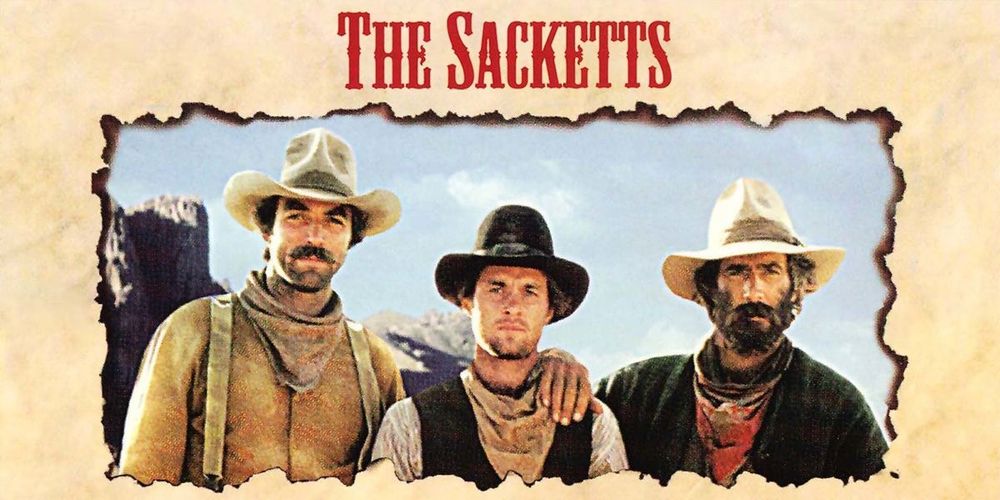



 MOVIE · 1979
The Sacketts
8
8/10Community rating
Label it
IS WOKE
Louis L'Amour's epic Western saga of brothers who blazed a name across the untamed post-Civil War New Mexico frontier.
Oops! Is this show WOKE?
Only an account holder or member can file. Cite a scene, a line, or a pattern. Other account holders +1 or −1 that argument, once each. The show is not WOKE until enough of them have given a +1. Enough −1s remove the write-up, and it is no longer shown.
Sign in to file a woke label. One of each criterion per member.
Comments and reviews
Report a mistake
Same rule as woke labels: one report, a written reason, and the community +1 or −1 it — once per member. A net +5 applies the change. Editors can hold it for review, or apply it immediately.
No mistake reports yet.
Sign in to report a mistake. One report per field, per member.
Member review
Wes Calder Member
Oct 16, 2026
★★★★★★★★★★I came back to The Sacketts the way you return to an old road you used to drive without thinking much about it. Louis L’Amour’s story of the three brothers heading into post-Civil War New Mexico still sits right with me. It is not flashy and it does not try to reinvent the frontier. It just puts the men and the country in front of you and lets them work it out.
What stays with me is how little the film apologizes for the kind of men these brothers are. They ride, they work, they shoot when they have to, and they keep score by what they actually do rather than what they announce. Tell and Orrin and Tyrel feel like people who have already lived a hard stretch before the story starts. That quiet competence is rarer now than it used to be. You watch them settle a claim or face down a range war and the weight comes from the dirt under the boots, not from speeches about destiny. I have always preferred Westerns that treat the land as a real adversary instead of a backdrop for costume drama, and this one mostly does that.
The casting helps. Sam Elliott already had the voice and the stillness that make a man look like he has buried a few friends and does not need to talk about it. Tom Selleck carries the steadier brother without turning him into a saint. The younger one has that restless edge that can get a family into trouble or out of it depending on the day. None of them play at being larger than the country they ride through. That restraint is part of why the piece holds. When the fights come they feel like consequences rather than set pieces. A gun is a tool here, nothing more, and the men who carry them understand the cost of using one. I have little patience for stories that turn every firearm into a sermon, so this approach sits easier.
There is family loyalty without the syrup. The Sacketts look after their own because that is the only reliable currency they have left after the war. You see it in small choices—the way a brother covers another’s back in a saloon or rides an extra day to make sure a claim is filed clean. Those moments do more work than any monologue about honor. L’Amour always understood that the code lived in the doing, and the film keeps faith with that. The New Mexico country itself is photographed like something that can kill you if you get careless, which is correct. Dust, distance, sudden weather. It does not need to be romanticized. The people who thrived out there were the ones who paid attention.
I will admit the pacing sometimes slows in the middle stretches the way a long ride can. A couple of side threads feel like they could have been trimmed without losing the spine of the story. Still, I never felt talked down to. The film trusts that you can follow a man who keeps his word and a woman who expects the same. No one is rewritten to fit a later fashion. The conflicts stay local—land, water, old grudges, the ordinary greed that follows open range. That is enough. When a story stays inside its own borders it usually ages better.
Watching it again reminded me why these books stuck with me as a younger reader. There is a plainness to the courage that does not need decoration. A man stands up because the alternative is worse, not because a camera is waiting for the heroic angle. The brothers make mistakes and pay for them in ways that feel earned. I never caught the film trying to scold the past or lecture the present. It simply shows what it took to put a name on a piece of hard ground and keep it. That is rarer than it should be.
Some of the dialogue has the clipped rhythm of the source material, and that still works. People say what they mean and then shut up. The silences between lines do as much as the words. I have sat through enough modern Westerns that fill every quiet stretch with explanation. This one leaves room. You can almost hear the wind in the gaps. That may sound small, but it is the difference between living inside the story and being told about it from a safe distance.
I gave it four stars because it does the job it set out to do without pretension and without the usual later-day corrections. It is not perfect. A few plot turns announce themselves a little early, and the supporting cast is uneven in places. Yet the core holds. Three brothers, a stretch of country that does not care whether they succeed, and the steady pressure of making a life where the law is still thin. That formula has been diluted plenty of times since 1979. Here it still has weight. I will probably pull it out again the next time I want something that does not argue with me while I watch. It just sits there, solid and a little dusty, the way a good saddle should.