
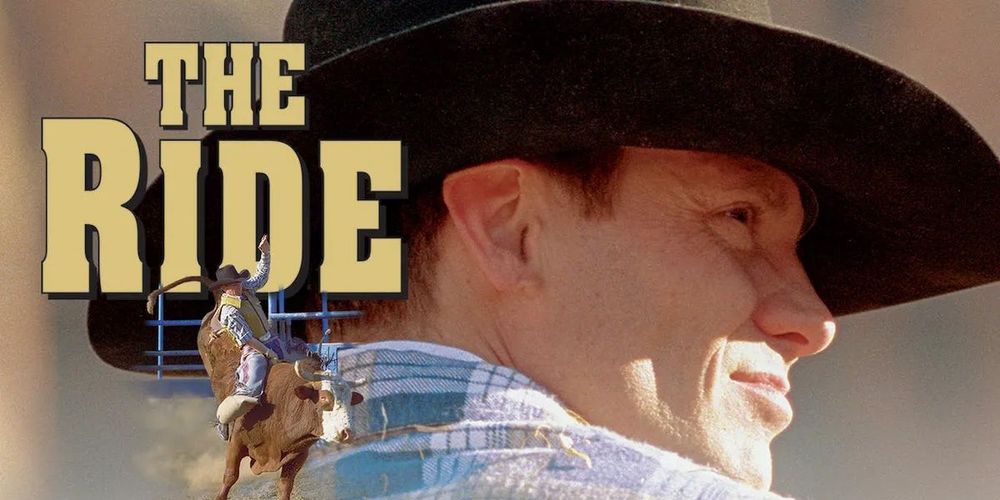



 MOVIE · 1997
The Ride (1997)
Rodeo star Smokey Banks (Michael Biehn), a former world champion bull rider, has spent the past few years messing up his life. Now he's been assigned community service at the Saguaro Boys Ranch. Smokey reluctantly agrees to the terms: stay out of trouble and teach Danny O'Neil (Brock Pierce) to ride a bull. He has no idea how things will change thru an unlikely friendship with an orphaned teen.
Oops! Is this show WOKE?
Only an account holder or member can file. Cite a scene, a line, or a pattern. Other account holders +1 or −1 that argument, once each. The show is not WOKE until enough of them have given a +1. Enough −1s remove the write-up, and it is no longer shown.
Sign in to file a woke label. One of each criterion per member.
Comments and reviews
Report a mistake
Same rule as woke labels: one report, a written reason, and the community +1 or −1 it — once per member. A net +5 applies the change. Editors can hold it for review, or apply it immediately.
No mistake reports yet.
Sign in to report a mistake. One report per field, per member.
Member review
Wes Calder Member
Oct 16, 2026
★★★★★★★★★★I put on The Ride from 1997 the other night because Michael Biehn’s name was on it and I hadn’t seen him in anything like this for a while. Smokey Banks is a former world champion bull rider who’s burned most of his bridges and ends up doing community service at the Saguaro Boys Ranch. The deal is simple enough: stay out of trouble and try to teach an orphaned kid named Danny how to stay on a bull. That’s the whole setup, and the movie doesn’t pretend it’s more complicated than that.
What works is the plain way the friendship forms. Smokey doesn’t arrive as a savior or a broken genius waiting for redemption monologues. He’s just a guy who’s been drinking too much and making the same mistakes, and the ranch forces him to show up every day. Danny isn’t written as some wise child who lectures the adult. He’s a kid who’s lost people and wants something solid to hang onto, and bull riding is the only thing that feels like it might answer. Their scenes together stay quiet. A practice run, a short conversation after a fall, the kind of small corrections that actually teach someone how to keep their seat. You can feel the time passing without the score telling you how to feel about it.
Biehn plays Smokey with the right amount of wear. He doesn’t oversell the toughness or the regret. There’s a stretch early on where you see him half-hearted about the whole assignment, and then the half-heartedness starts to drop away because the kid keeps showing up. That’s enough. Brock Pierce does the orphan role without the usual movie orphan tricks—no big speeches about loneliness, just the look of someone who’s used to packing light. The supporting faces around the ranch feel like they belong there rather than like they were hired to fill a frame. Nobody is trying to turn the place into a metaphor for society. It’s a ranch with dusty fences and a few stubborn animals, and the story stays inside those fences most of the time.
I keep thinking about how little the film reaches for big statements. In a lot of later pictures this same outline would get loaded with lectures about what men are supposed to fix in themselves or how the past is always some kind of original sin. Here the past is just the past. Smokey messed up, the kid needs a teacher, and they work at it. The bulls are bulls, not symbols. When someone gets thrown the camera doesn’t linger like it’s delivering a sermon. It just shows the dirt and the scramble to get clear. That restraint is what kept me watching past the halfway mark. You start to care whether Danny will stay on for the eight seconds because the movie has earned the small stakes instead of inventing larger ones.
There are soft spots. A couple of the side characters feel sketched in rather than lived in, and the third act settles a few things a little too neatly for my taste. You can see the shape of the ending coming, and once you see it the surprise is gone. Still, the core relationship doesn’t collapse under that predictability. The final stretches of riding practice and the quiet talk afterward hold more weight than the louder beats around them. I didn’t walk away thinking I’d found a hidden classic. I walked away thinking I’d spent a decent evening with two people who improved each other without making a production of it.
Sometimes you put a movie on and the site itself seems more interested in templates than in the thing you’re trying to watch. I had a moment early where the page looked like it wanted me to log in just to confirm the title existed. That little glitch fit the whole experience in a sideways way—this is the kind of picture that sits a little off to the side, easy to overlook if you’re only scanning for the new releases. Once it actually started, though, the movie did its own work. No need for the machinery around it.
I rated it 3.5 because it earns that middle ground. It’s better than the forgettable filler that usually fills the same slot on a Saturday night, and it’s honest about its limits. Biehn gives you a man who still knows how to ride even when the rest of his life is a mess, and the kid gives you a reason to care whether that skill gets passed on. The friendship feels earned rather than scheduled. If you’ve got an hour and a half and you want something that doesn’t shout at you, this one will sit with you without demanding applause. That’s rarer than it should be. I’ll probably think about the quiet practice pens again next time someone starts talking about redemption arcs that need three acts of speeches. This one just put two people in the same dirt and let them figure it out. That was enough for me.