
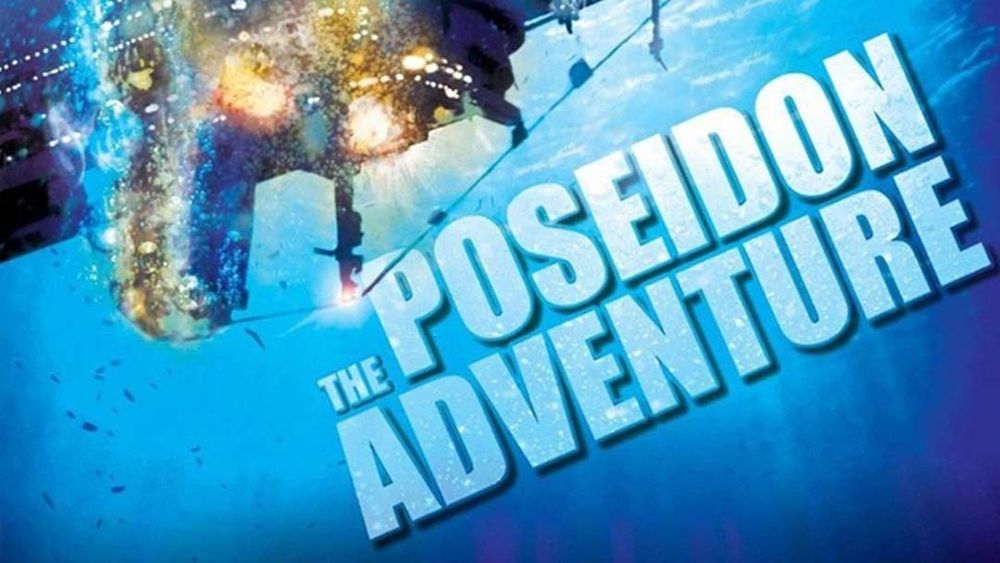



 MOVIE · 1972
The Poseidon Adventure (1972)
A luxury liner capsizes under a rogue wave on New Year's Eve, forcing a small group of passengers to climb through the inverted ship in a desperate bid to reach the hull and safety.
The Poseidon Adventure follows Reverend Frank Scott, a plainspoken minister who refuses to wait below after the SS Poseidon is rolled over by a towering wave. Scott rallies a handful of survivors—including police detective Mike Rogo and his wife Linda, older couple Manny and Belle Rosen, shy singer Nonnie, bachelor James Martin, and the Shelby siblings Susan and Robin—and insists they climb upward through the wreck rather than stay in the flooded ballroom. The group battles rising water, broken steel, and failing lights while Scott pushes them past the captain's orders to remain put. Early losses and the ship's unnatural angle turn every corridor into a vertical shaft. Belle's swimming skill and Scott's stubborn faith become immediate tools for getting past the first flooded barriers.
As the survivors press higher, Rogo clashes with Scott over leadership while Linda's fear and Nonnie's shock slow the climb. Belle makes a critical underwater swim to open a path, exhausting herself in the process, and the group crawls through the engine spaces and shaft tunnels toward the propeller housing. Explosions and collapsing decks thin their numbers further; Scott continues to drive them forward even as hope narrows. They finally reach the outer hull, where rescuers can cut them free only if someone signals from inside. The remaining passengers hold together long enough for the last desperate breach, ending the ordeal with the few who made it out alive.
Creator: Ronald Neame · IMDb
Oops! Is this show WOKE?
Only an account holder or member can file. Cite a scene, a line, or a pattern. Other account holders +1 or −1 that argument, once each. The show is not WOKE until enough of them have given a +1. Enough −1s remove the write-up, and it is no longer shown.
Sign in to file a woke label. One of each criterion per member.
Comments and reviews
Report a mistake
Same rule as woke labels: one report, a written reason, and the community +1 or −1 it — once per member. A net +5 applies the change. Editors can hold it for review, or apply it immediately.
No mistake reports yet.
Sign in to report a mistake. One report per field, per member.
Member review
Toni Briggs Member
Oct 16, 2026
★★★★★★★★★★The Poseidon Adventure still sits in that strange spot where the idea is better than half the execution, yet the idea is strong enough that you stick with it anyway. A giant ocean liner, New Year’s Eve, one massive wave, and the whole thing rolls over like a toy in a bathtub. Most of the people on board are gone in minutes. The ones left have to climb through the upside-down guts of the ship toward what used to be the bottom, which is now the only way out before the water finishes the job. That basic setup is why this movie became the template for every disaster picture that followed. It does not waste time pretending the odds are fair.
I gave it 3.5 because the first stretch after the wave hits is genuinely gripping. The ballroom sequence, the sudden tilt, the way ordinary celebration turns into pure survival math—those scenes still land. You feel the weight of the ship around them. The corridors are wrong, the stairs go the wrong direction, and every door might lead to a flooded compartment. That physical disorientation is the film’s best trick. It does not need fancy talk to sell danger. Gravity itself has become the enemy.
Gene Hackman’s preacher is the one holding the group together, and he plays it with a kind of stubborn force that fits the material. He is not gentle about it. He argues, he pushes, he refuses to sit still and wait for rescue that is never coming. The rest of the survivors are a mixed bag of types you recognize immediately: the older couple, the cop, the kid, the singer, the injured. Some of them get real moments. Others exist mainly to give the group something to argue about or something to lose. That is the trade-off with these ensemble disaster movies. You care about the situation more than any single person, and when a character drops away it stings less than it should because you never knew them past the surface.
The middle section drags in places. Once the climb starts, the film repeats the same pattern—move forward, hit an obstacle, debate, lose someone, keep going. The debates get repetitive. Faith versus practicality gets a lot of airtime, and while Hackman sells his side, the back-and-forth starts to feel like the script is marking time between set pieces. I do not mind a movie that believes in grit and leadership. I mind when it keeps stopping to explain itself. The best parts are the ones where they just keep moving through the wreckage and the water keeps rising behind them.
What holds up best is the production design and the commitment to the inverted world. Tables bolted to ceilings, furniture hanging the wrong way, the constant sense that one wrong step ends the whole party. You can see why later films copied the formula. This one showed that you could take a contained location, flip it, and generate two hours of tension without needing an alien or a monster. The ship itself is the monster. That is cleaner storytelling than a lot of what came after.
At the same time, the movie is a product of its moment in ways that show. The dialogue can be stiff. Some of the performances lean hard into melodrama. The score swells on cue. None of that ruins it, but it keeps the film from feeling as sharp as its premise. You are watching people make hard choices under pressure, and every so often the movie underlines those choices with a speech when a look or a silence would have done more work. I still root for them to make it. I just wish the film trusted the audience a little more to feel the stakes without the extra nudges.
I keep coming back to this one every few years because it is straightforward. No side plots about secret cargo or international intrigue. No modern habit of turning every character into a walking lecture. Just a ship that should not have rolled, a handful of people who refuse to quit, and a race against water and time. The ending does not cheat. Losses matter. Survival feels earned rather than guaranteed. That alone puts it ahead of a lot of louder disaster pictures that came later and mistook noise for intensity.
Is it perfect? No. The character work is thin in spots, the pacing sags when the talking starts, and a couple of the set pieces feel staged rather than lived-in. But the core experience—being trapped inside a world that has turned itself inside out—still works. You feel the cold, the dark, the shrinking options. You understand why someone would keep climbing even when the next step looks impossible. That stubborn push is what the movie is really about, and on that level it earns its reputation as the one that started the whole cycle.
I land at 3.5 because I respect what it builds and I get impatient with what it pads. It is the kind of film you put on when you want clear stakes and a group forced to act instead of posture. It delivers those things more often than not. When it stays focused on the climb and the rising water, it is still effective. When it pauses for another round of arguing about who should lead, it reminds you that even the mother of the genre had some growing to do. Worth watching, worth keeping, just not quite the seamless machine some people remember it as. The wave still hits hard. The rest is a little more uneven than the legend suggests.