
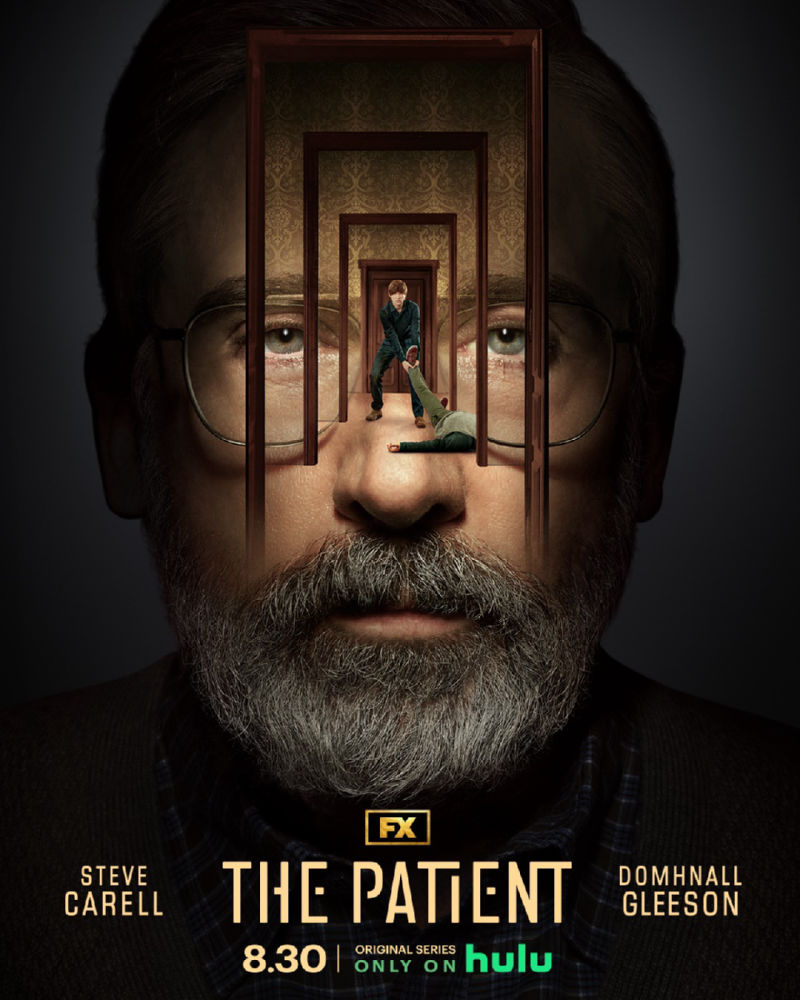



 TV · 2022
The Patient
Psychotherapist Alan Strauss is chained in a basement by serial killer Sam Fortner, who demands therapy to curb his urge to murder. Their forced sessions become a tense fight for control and survival.
The Patient follows psychotherapist Alan Strauss after he is kidnapped by Sam Fortner, a former patient who chains him inside a basement room. Sam admits he is a serial killer and insists that only ongoing therapy from Alan can stop him from killing again. Alan must read Sam’s moods, probe his history, and keep him talking while looking for any chance to escape or signal for help. Cut off from the outside world, Alan also confronts fresh grief over his wife’s death and the strained ties with his adult children. Every session risks triggering Sam’s violence, turning standard clinical techniques into a life-or-death gamble.
As days pass, Sam discloses earlier murders and the role his mother has played in enabling him, forcing Alan to decide how far he can push without becoming the next victim. Alan’s thoughts keep returning to his daughter Shoshana and son Ezra, replaying old arguments and regrets that now feel unfinished. The two men develop a brittle dependence: Sam needs Alan’s insight, while Alan needs Sam’s restraint long enough to survive. Outside the basement, limited contacts and Sam’s home life raise the stakes further. The ordeal strips both men down to raw need, testing whether understanding a killer can change him or only prolong the danger.
Oops! Is this show WOKE?
Only an account holder or member can file. Cite a scene, a line, or a pattern. Other account holders +1 or −1 that argument, once each. The show is not WOKE until enough of them have given a +1. Enough −1s remove the write-up, and it is no longer shown.
Sign in to file a woke label. One of each criterion per member.
Comments and reviews
Report a mistake
Same rule as woke labels: one report, a written reason, and the community +1 or −1 it — once per member. A net +5 applies the change. Editors can hold it for review, or apply it immediately.
No mistake reports yet.
Sign in to report a mistake. One report per field, per member.
Member review
Becky Soto Member
Oct 19, 2026
★★★★★★★★★★I settled in for The Patient on a quiet weeknight and found myself more invested than I expected, even if the whole thing never quite climbed all the way up for me. Steve Carell plays Alan Strauss, this psychotherapist who wakes up chained in a basement belonging to Sam Fortner, a former patient turned serial killer. Sam wants ongoing therapy so he can stop killing people. That setup alone is enough to keep you watching, and the two of them circling each other in that small room carries a lot of the weight.
What stuck with me most was one of the quieter sessions late in the run, when Alan is trying to dig into Sam’s relationship with his mother without setting him off. Carell’s face does this little shift where you can see him calculating every word, half therapist and half terrified hostage. It felt real in a way that bigger thriller moments sometimes don’t. Domhnall Gleeson makes Sam both pitiful and genuinely scary; you never fully relax around him, which is exactly right. Their back-and-forth has this push-pull rhythm that made me lean forward more than once. I kept thinking about how ordinary clinical techniques become life-or-death tools here, and that tension held for most of the episodes.
Alan’s grief over his wife and the mess with his kids seeps in around the edges. Those pieces gave him a life outside the basement without turning the story into pure soap. I liked that the show trusted us to sit with his exhaustion and the small calculations he makes every day just to stay alive long enough to maybe get a message out. There are moments where he almost reaches someone, and the letdown hits hard because you’ve started rooting for even the tiniest crack in Sam’s control. The limited run helps; it doesn’t overstay or pad things out with extra twists that would have felt cheap.
At the same time, I walked away feeling like it could have dug a little deeper or risked a sharper turn. Some of the later conversations start to loop in ways that feel more repetitive than revealing, and a couple of the supporting threads outside the basement never quite land with the same force. The tone stays locked in that muted, serious register the whole time, which works for the premise but left me wishing for one or two beats that surprised me more. It’s solid craft and strong acting, yet it sits right in that middle space where I appreciated it without needing to rewatch right away or recommend it to everyone I know.
I kept coming back to how the show handles the power imbalance. Alan has nothing but his words and whatever patience he can muster, and watching him try to stay professional while calculating escape routes felt honest. There’s a scene where Sam brings in food and they end up talking about faith and guilt, and Carell lets this tired kindness show through that made me ache a little for the guy. It never turns preachy; it just lets two damaged people sit in a room and try (and mostly fail) to reach each other. That restraint is part of why I landed at 3.5. It’s better than a lot of limited thrillers that chase bigger shocks, but it also never fully transcends its own tight setup.
The basement itself becomes a character after a while—the chains, the sparse furniture, the way light from the small window shifts. I noticed myself paying attention to those details the way Alan does, looking for anything that might help. Gleeson’s physicality sells the threat without needing constant violence; a sudden shift in posture is enough. By the time the story starts tying off the threads, I felt the weight of everything Alan had carried, including the parts of his family life he couldn’t fix from down there. It left me thinking about how therapy assumes a certain safety that simply doesn’t exist in this situation, and that idea lingered longer than some of the plot points.
Overall I was glad I watched. It’s the kind of show that respects your time and your attention without demanding you treat it like a masterpiece. Carell and Gleeson elevate the material, the central idea has real bite, and a handful of scenes (that mother conversation especially) will probably stay with me. It just didn’t quite hit the higher mark where I’d call it essential. Still, for a tense two-hander about control, guilt, and the thin line between helping and surviving, it does more right than wrong, and I’m fine leaving it at a solid 3.5.