



 TV · 2019
The Mandalorian
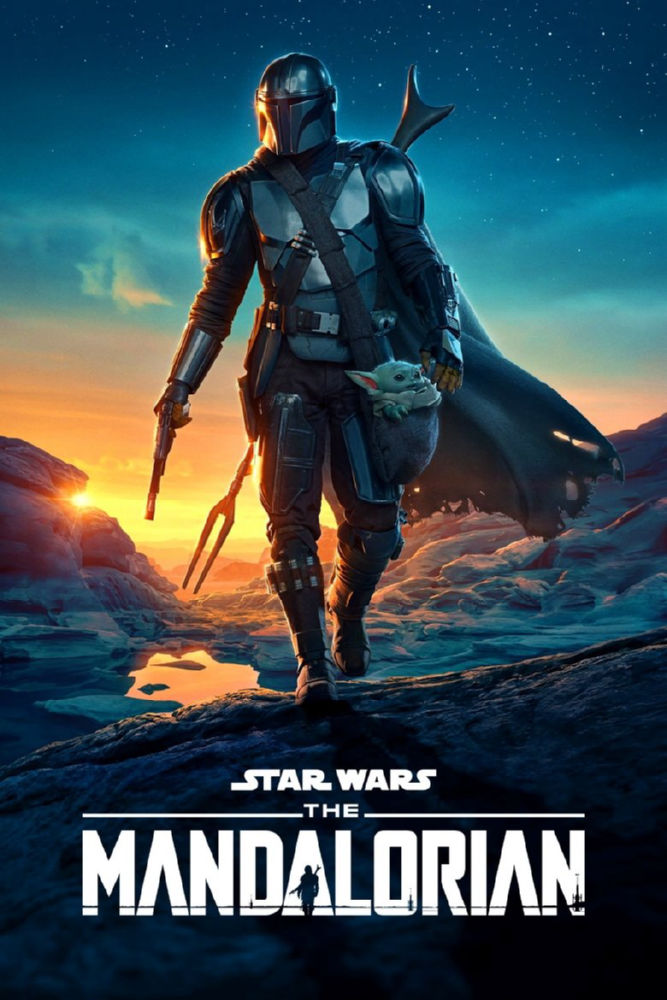
A lone Mandalorian bounty hunter works the lawless Outer Rim after the Empire's collapse and ends up protecting a mysterious Force-sensitive child. Their bond pulls him into guild politics, Imperial remnants, and the wider struggle over the child's fate.
The Mandalorian follows Din Djarin, a helmeted bounty hunter who lives by a strict warrior creed while taking contracts across a fractured galaxy. After the Empire falls, he operates on the fringes, collecting bounties for the Guild and answering to operators such as Greef Karga. A high-paying job leads him to a remote laboratory and a small green child later known as Grogu. Rather than deliver the foundling to Imperial clients, Din breaks with the assignment and flees with the child. Early allies and enemies—including the Ugnaught Kuiil, the droid IG-11, and former rebel Cara Dune—force him into firefights, uneasy partnerships, and choices that put his code against simple profit. The pair move from dusty outposts to dangerous handoffs while Imperial holdouts keep hunting them.
Din continues to shield Grogu while seeking a safe path for the child, including contact with Jedi and other Force users who might understand the boy's power. He returns to Mandalorian coverts, confronts questions of identity and leadership among his people, and crosses paths with figures such as Bo-Katan Kryze and Moff Gideon, whose remnant forces want Grogu for their own ends. Later arcs send him through sieges, rescue attempts, and uneasy alliances as he balances bounty work, creed, and father-like duty. Grogu's training and safety remain the emotional center even as larger galactic threats reappear. The story stays rooted in chases, standoffs, and the hunter's evolving loyalty to the child he refused to sell.
Oops! Is this show WOKE?
Only an account holder or member can file. Cite a scene, a line, or a pattern. Other account holders +1 or −1 that argument, once each. The show is not WOKE until enough of them have given a +1. Enough −1s remove the write-up, and it is no longer shown.
Sign in to file a woke label. One of each criterion per member.
Comments and reviews
Report a mistake
Same rule as woke labels: one report, a written reason, and the community +1 or −1 it — once per member. A net +5 applies the change. Editors can hold it for review, or apply it immediately.
No mistake reports yet.
Sign in to report a mistake. One report per field, per member.
Member review
Dan Reilly Member
Oct 19, 2026
★★★★★★★★★★The Mandalorian starts strong and then spends a lot of later runtime testing whether it still wants to be about the guy in the helmet. That is the part that sticks with me first. Din Djarin is built as a quiet professional with a creed, a trade, and a problem he cannot walk away from. Early on the show trusts that. The jobs are dirty, the Outer Rim feels sparsely populated in a useful way, and the armor actually means something instead of sitting there as costume. Then, further in, the pattern starts to show. He gets cornered, outmaneuvered, or sidelined at moments that feel engineered so someone else can step into the frame and look decisive. I am not talking about one rescue in a crisis. I mean the slow habit of making the title character the one who has to be pulled out so a “capable” woman can demonstrate competence. That is a cheap trick when you have already sold the audience on a lone hunter who survives by skill and caution. It is also a familiar Disney move at this point: introduce the beloved figure, then treat him as scaffolding for a replacement arc. Bait and switch is the polite phrase for it. The show does not always go full replacement, but it keeps flirting with the idea hard enough that you notice every time he is made to look slower or less informed than the people around him.
None of that means the whole series collapses. It does not. For a Disney Star Wars production, not being bad is already a kind of win, and this one clears that bar more often than it should. The western bones are real. Lonely towns, bad contracts, short trust, longer guns. The bounty guild stuff in the beginning has a workman’s rhythm to it that later empire-politics chapters sometimes lose. Pedro Pascal plays the role under a helmet and still sells economy of movement and voice. You believe he would take the job, finish it, and leave without a speech. The child is an obvious audience magnet, and yes, the green kid steals scenes, but the better stretches are the ones where the bond is treated as obligation rather than as a toy commercial. Kuiil’s patience, the uncomfortable droid problem, Cara Dune’s early presence as a former rebel who still knows how to fight—those pieces work because they feel like people who have already lived hard lives, not like messaging props.
Where it frays is when the writing decides manhood in this story is mostly a set of mistakes waiting for correction. Ordinary competence gets undercut so another character can look elevated by comparison. That is not strength; that is subtraction. A strong character does not need the lead to fail on schedule. When season threads start rotating around who gets to command the legacy of Mandalore, or who lectures whom about the creed, the air goes out of the simple premise that made the pilot land. I do not need the show to worship the helmet. I need it to stop treating the man wearing it like a problem to be managed. You can feel the pull toward guild politics and remnant Imperial schemes, and some of those set pieces are still sharp—tight corridors, practical violence, a sense that ammunition and fuel matter. Then a stretch arrives that seems more interested in rearranging who stands at the center of the poster.
I do not want to claim this had a clear path to greatness that someone sabotaged in a single meeting. It was always a streaming adventure with a soft spot for cute and a hard spot for lore. What it mostly avoided was the open contempt some other entries aimed at the audience. That alone puts it ahead of the pack. It still has filler episodes, convenient escapes, and a few guest turns that feel like they wandered in from a different tone meeting. The creed is invoked heavily and then bent when the plot needs bending. Imperial remnant threats sometimes land as genuine menace and sometimes as week-to-week obstacles. Even so, the craft level on the practical side—ships, dusty streets, the weight of the armor—keeps a baseline of seriousness the dialogue does not always match.
I rated it 4.5 because the best of it is still the clean idea: a man with a code, a dangerous job, and a foundling he will not surrender. When the series stays near that, it is confident and oddly calm for Star Wars. When it drifts into making Din the guy who messes up so a preferred heroine can straighten the frame, it becomes smaller and more predictable. That flaw is real and it colors the later seasons more than I wanted. Credit where it is due, though. The show found a pocket of the galaxy that felt lived-in, gave us a lead who did not need to monologue his virtue, and mostly refused to sneer at people who showed up for space westerns and quiet loyalty. It is uneven. It is sometimes compromised by the urge to re-center the story away from the man it named itself after. It is also, on balance, the rare recent entry that understands atmosphere, restraint, and the value of a closed helmet. I can live with the irritation because the core still holds more often than it breaks. That is not a blank check for whatever they do next with the character. It is an honest score for what actually made it to screen: flawed, occasionally wrongheaded about whose story this is, and still better than it had any institutional right to be.