
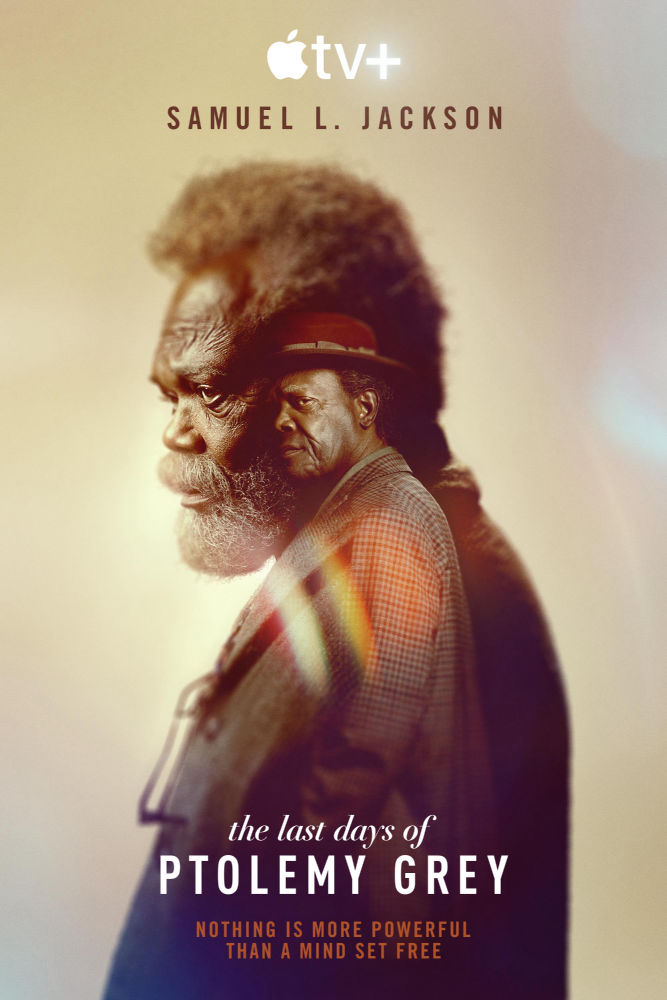



 TV · 2022
The Last Days of Ptolemy Grey
An elderly man sinking into dementia bonds with a teenage caretaker and risks an experimental treatment that briefly restores his past—and exposes deadly family secrets.
The Last Days of Ptolemy Grey follows Ptolemy Grey, a ninety-one-year-old man living alone in a rundown Los Angeles apartment while dementia steals his grip on the present. After the sudden, violent loss of the relative who had been looking after him, orphaned teenager Robyn is brought in to care for him and moves into his chaotic world. Together they learn of an experimental treatment that can temporarily clear the fog of his memories, and Ptolemy insists on trying it despite the danger. Each lucid stretch pulls him back into decades of love, betrayal, street wisdom, and a hidden fortune others still want. Robyn becomes his steady link to the present while helping him sort what is real from what the illness has scrambled. Their partnership turns a medical gamble into a race to understand the people and crimes that shaped his life.
As the treatment’s effects rise and fade, Ptolemy pushes to settle old debts, protect Robyn, and uncover who murdered his previous caretaker before the clarity disappears for good. He revisits the influence of Coydog and other figures from his youth whose choices still shadow the family’s money and safety. Relatives and hangers-on circle with competing claims on whatever fortune he once controlled, forcing hard choices about trust. Robyn, carrying her own grief and limited options, finds purpose in the work even as the neighborhood’s violence closes in. The two of them chase the truth behind the killing and the missing wealth, knowing every clear day may be among his last. What remains is
Oops! Is this show WOKE?
Only an account holder or member can file. Cite a scene, a line, or a pattern. Other account holders +1 or −1 that argument, once each. The show is not WOKE until enough of them have given a +1. Enough −1s remove the write-up, and it is no longer shown.
Sign in to file a woke label. One of each criterion per member.
Comments and reviews
Report a mistake
Same rule as woke labels: one report, a written reason, and the community +1 or −1 it — once per member. A net +5 applies the change. Editors can hold it for review, or apply it immediately.
No mistake reports yet.
Sign in to report a mistake. One report per field, per member.
Member review
June Pell Member
Oct 19, 2026
★★★★★★★★★★I came to The Last Days of Ptolemy Grey mostly because the premise snagged me—an old man losing his grip, a kid who ends up in his orbit, and this risky shot at clearing the fog for a little while. I didn’t expect it to sit with me the way it did. It’s a quiet show in a lot of stretches, and that works in its favor. You feel the weight of the apartment, the clutter, the way time slips for Ptolemy without big speeches about it. Samuel L. Jackson plays him with this careful mix of confusion and leftover steel; you catch flashes of the man who used to know exactly how the world worked, then watch that knowledge slide away again. It never feels like a stunt.
Robyn, the teenager who steps in after the relative who had been looking after him is gone, is the piece that keeps the whole thing from tipping into pure melancholy. She doesn’t arrive as some polished caretaker with a clipboard. She’s figuring it out as she goes, and the bond they build feels earned rather than scheduled. I liked how the show lets them just exist in the same space for stretches—sorting through papers, arguing gently about whether something happened yesterday or twenty years ago, deciding the treatment is worth the risk even when the smart money says leave it alone. That experimental clarity doesn’t turn him into a different person so much as it hands him back the map for a limited time. What he does with those lucid stretches is where the family secrets start leaking out, and the money other people still smell, and the old street-level sense of who can be trusted.
I took a short side path while watching and thought about how rare it is to see dementia treated without either pure horror or pure sentiment. A lot of stories either make the illness the entire point or use it as a cute device for one last adventure. Here it stays ugly and practical. He forgets names. He forgets why the door is locked a certain way. He remembers, suddenly and sharply, things that put him and Robyn in real danger. The show doesn’t rush the recovery or pretend the side effects are a minor inconvenience. You feel the cost every time the fog lifts and then drops again. That rhythm—clarity, then loss—gives the later episodes their tension without needing constant chase scenes.
What stuck with me most was the way the past and present keep trading places inside the same rooms. One minute you’re in the apartment with the radio on and the dust, the next you’re in a memory that still has heat in it—love that went wrong, betrayals that never got sorted, the kind of street wisdom that doesn’t lecture but just names how people move when money is involved. I didn’t need every secret spelled out in a neat monologue. Some of the best moments are the ones where Ptolemy is trying to explain something important and the words won’t stay in order, and Robyn has to piece it together from the scraps he can hold onto. It makes you lean in instead of waiting for the next plot beat to announce itself.
There are places where the pacing slows more than it needs to. A couple of episodes lean a little hard on atmosphere and let a scene run longer than it earns, and I caught myself checking the remaining time once or twice. The supporting family members can feel sketched in rather than fully lived-in; a few of them exist mainly to want the fortune or to complicate the caretaker arrangement. That didn’t sink the show for me, but it kept it from feeling airtight. Still, the central pairing carries so much of the load that the thinner edges don’t collapse the whole thing. Jackson and Dominique Fishback make the relationship feel specific—awkward at first, then protective, then something closer to chosen family without ever turning sappy about it.
I rated it a 4 because it respects the intelligence of the viewer and the dignity of its main character without sanding down the hard parts. It doesn’t pretend the treatment is a miracle cure or that memory alone can fix a life. It just gives Ptolemy enough time to try to set a few things right, and it lets Robyn decide what kind of person she wants to be while standing next to him. The Los Angeles setting stays lived-in rather than touristic; you get the sense of a neighborhood that has its own codes and its own long memories. By the end I wasn’t thinking about whether every plot thread had been tied with a bow. I was thinking about how much of a person remains when the calendar stops making sense, and how rare it is for someone young to stay when staying is hard.
If you’re looking for something loud and twisty every ten minutes, this won’t scratch that itch. If you can sit with a story that moves at the speed of an old man trying to hold onto a thought, and a kid who’s learning the weight of other people’s histories, it’s worth the hours. I finished it and found myself still turning over small moments—the way a name almost comes back, the way a locked drawer suddenly matters again, the quiet decision to risk the treatment because a little clarity is better than none. That’s the kind of show that stays in the room after you turn it off. Not perfect, not trying to be everything, but solid and human in a way that feels scarce.