



 TV · 2020
The Last Dance
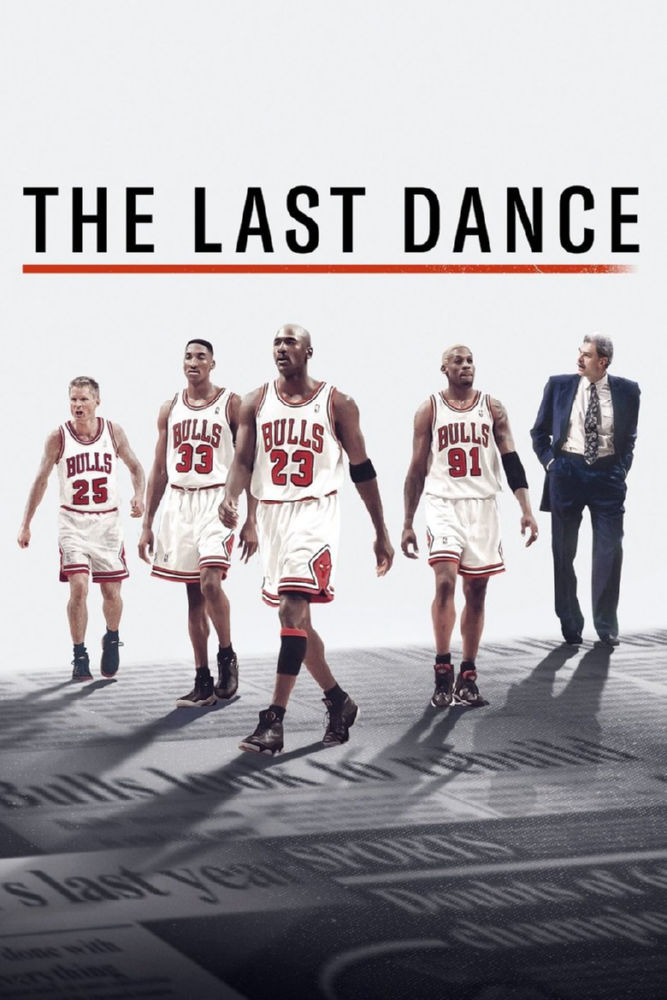
A 10-part documentary chronicling the untold story of Michael Jordan and the Chicago Bulls dynasty with rare, never-before-seen footage and sound from the 1997-98 championship season – plus over 100 interviews with famous figures and basketball’s biggest names.
Creator: Writer
Oops! Is this show WOKE?
Only an account holder or member can file. Cite a scene, a line, or a pattern. Other account holders +1 or −1 that argument, once each. The show is not WOKE until enough of them have given a +1. Enough −1s remove the write-up, and it is no longer shown.
Sign in to file a woke label. One of each criterion per member.
Comments and reviews
Report a mistake
Same rule as woke labels: one report, a written reason, and the community +1 or −1 it — once per member. A net +5 applies the change. Editors can hold it for review, or apply it immediately.
No mistake reports yet.
Sign in to report a mistake. One report per field, per member.
Member review
June Pell Member
Oct 20, 2026
★★★★★★★★★★I went into The Last Dance already knowing the outline of that last Bulls run, the way most people my age do if they ever cared about basketball at all. What I did not expect was how much raw tape still existed and how cleanly they put it together. The cameras were everywhere that season—locker rooms, buses, late-night hotel halls—and the fact that so much of it survived in usable form still surprises me. You get Jordan in real time, not just the highlight-reel version, and that alone is worth the hours.
The series stays locked on the basketball. Contract friction, the physical grind of another deep playoff push, Pippen’s place beside him, Phil Jackson managing egos with the triangle. No invented sermon on top of it. That choice feels honest. You watch decisions get made under pressure and you see how thin the line was between another title and the whole thing coming apart. The interviews with teammates, opponents, and front-office people fill in the gaps without turning anyone into a cartoon. Jordan comes across as both the engine and the source of constant tension, which matches everything I remember reading about him. He demanded the same fire from everyone else and did not always make it easy to give.
I do have one real gripe, and it kept tugging at me while I watched. The time jumps. They yank you out of 1997–98 into earlier seasons or side stories and then drop you back again, and the rhythm never quite settles. A straight chronological path would have been cleaner. The Bulls already gave them eight years of material; there was no need to shuffle the deck so hard. Once or twice I actually lost the thread of where we were in the calendar, which is the last thing a documentary should do. That is the main reason this sits at 4.5 for me instead of something higher. The footage and the talk are strong enough that the editing choice does not sink the thing, but it does leave a small mark.
What stayed with me after the last episode was how much the series made me want to pick up a ball again. I had barely touched one in years—life gets busy, the league changes, the old habits fade. Watching those games and the work that went into them brought the feel of it back. The footwork, the spacing, the way a single defensive possession could tilt a series. It is easy to forget how much craft lived underneath the celebrity. The documentary does not lecture you about greatness; it just shows the hours and the stubbornness required to keep winning when everyone is gunning for you. That landed harder than any highlight package ever did.
Pippen’s sections are especially good at showing the cost of being the second star. You see the loyalty and the resentment sitting next to each other, and neither one is sanded down for comfort. Same with the supporting cast—Rodman, Kerr, the role players who had to find their spots inside a system built around one relentless personality. Phil Jackson’s calm in the middle of it all still looks like a kind of magic, even when you know the triangle was the structure holding everything together. The series trusts you to notice those details without underlining them in neon.
I also appreciated how little it tried to turn the story into a larger cultural statement. Rivalries stay rivalries. Pressure stays pressure. The on-court dominance is allowed to be the point. In a moment when a lot of sports documentaries feel obligated to attach a thesis about society, this one mostly refuses. It follows the season, the people who lived it, and the choices that decided whether a sixth ring happened. That restraint is part of why it works.
There are stretches where the talking heads pile up and the energy dips a little, and a couple of commercial-break-style fades that feel like television rather than pure film. Those are minor. The core is the access and the refusal to polish Jordan into pure myth. You leave with a clearer sense of how exhausting and precise that final year really was. For anyone who ever loved the game and drifted away from it, the series has a way of pulling you back toward the simple pleasure of watching skilled people compete at the highest level. I finished it and found myself checking old box scores again, something I had not done in a long while.
The Last Dance is not perfect—those timeline leaps still bother me—but it is the rare long-form sports documentary that trusts the sport itself to carry the weight. The cameras caught something real, the interviews add texture without drowning the footage, and the whole thing stays pointed at basketball rather than at a lecture. That is enough to make it stick. I rated it 4.5 because the material is that good and the structural hiccups are that noticeable. If you care about that era at all, it is time well spent. Just be ready to pause once or twice when the chronology suddenly jumps and you have to reorient. The rest of it rewards the patience.