



 TV · 2018
The Kids Are Alright
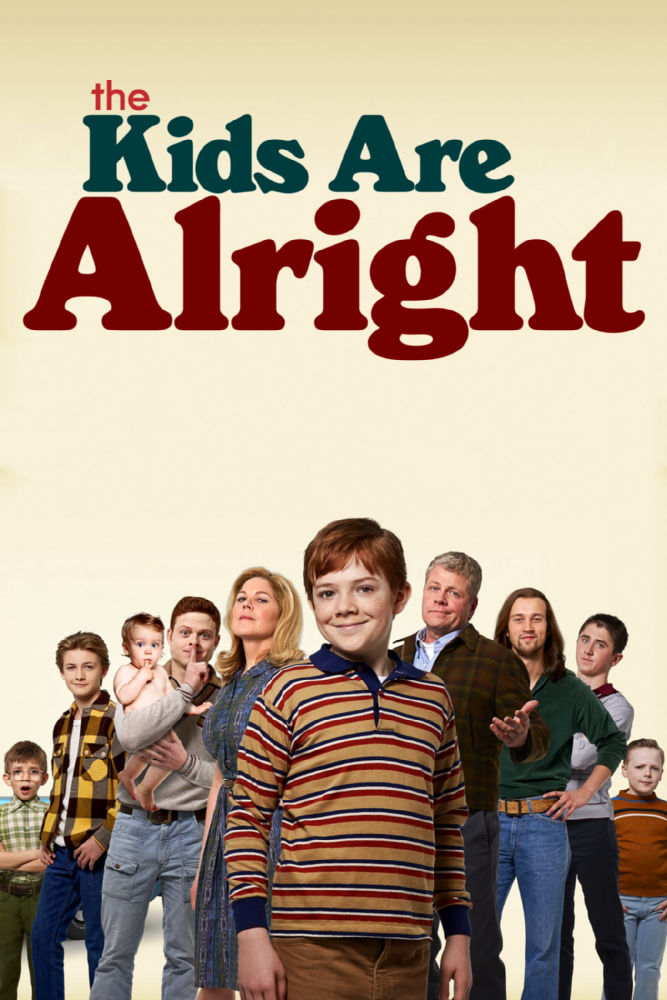
The series is a single-camera comedy about an Irish Catholic family raising eight sons in suburban Los Angeles circa 1972, navigating the trials and tribulations of the era.
Set in the 1970s, this ensemble comedy follows a traditional Irish-Catholic family, the Clearys, as it navigates big and small changes during one of America's most turbulent decades.
In a working-class neighborhood outside Los Angeles, Mike and Peggy raise eight boisterous boys who live out their days with little supervision in their three bedroom, one bathroom home. The household is turned upside down when oldest son Lawrence returns home and announces he's quitting the seminary to go off and "save the world."
Oops! Is this show WOKE?
Only an account holder or member can file. Cite a scene, a line, or a pattern. Other account holders +1 or −1 that argument, once each. The show is not WOKE until enough of them have given a +1. Enough −1s remove the write-up, and it is no longer shown.
Sign in to file a woke label. One of each criterion per member.
Comments and reviews
Report a mistake
Same rule as woke labels: one report, a written reason, and the community +1 or −1 it — once per member. A net +5 applies the change. Editors can hold it for review, or apply it immediately.
No mistake reports yet.
Sign in to report a mistake. One report per field, per member.
Member review
Wes Calder Member
Oct 19, 2026
★★★★★★★★★★The Kids Are Alright sits in that narrow lane of period family sitcoms that could have collapsed under its own premise and somehow does not. Eight sons, one bathroom, a Lockheed paycheck, a three-bedroom house outside Los Angeles in the 1970s. The setup is almost a dare. You keep waiting for it to turn into pure nostalgia bait or a rotating gag reel about how small the microwaves looked and how Bob Hope used to be on television every other night. There are stretches where it leans that way, and those stretches are the weakest parts of the show. You can only point at the era so many times before the joke stops landing. I felt that fatigue early in a couple of episodes, the same thin energy that sank That '80s Show for roughly the same reasons. The difference here is that the Cleary household itself keeps pulling focus back to people instead of props.
Mike and Peggy are not written as walking punch lines for their time. Mike comes home tired, still tries to hold a line with the older boys who are testing every rule, and still has to share air with a house that never empties. Peggy runs the place with the kind of practical iron that does not need speeches. The Catholic frame and the Irish-American habits are treated as ordinary weather rather than a costume for lectures. Mass, school, neighborhood expectations, the constant competition for space and attention—these are the real engine. The fights over the bathroom, the laundry that never ends, the younger ones creating messes while the older ones push for independence, all of it feels lived-in rather than staged for a museum tour of the decade. Cars and clothes and news items show up, but they mostly stay in the background where they belong.
What surprised me is how little the show relies on big plot machinery. Most episodes turn on ordinary scrapes: a broken rule, a sibling rivalry that escalates because there is nowhere to hide, the simple arithmetic of money that never quite stretches. That could have been flat. Instead the cast sells the density of the house. You feel the lack of square footage. You feel the way eight boys turn every small decision into a negotiation. The humor that works best is the dry kind that comes from people who know each other too well and have no private rooms left. When the writing drifts into “remember this old thing” territory, it goes soft. When it stays with Mike trying to keep order after a long shift or Peggy managing the chaos without turning into a saint or a scold, it holds.
I rated it four because the family dynamics carry more weight than the period gags, and because the show mostly resists the urge to make the 1970s the main character. It does not always succeed at that. There are nights where the culture jokes outnumber the character beats, and those nights feel thinner. But the core remains solid enough that I kept watching past the points where a pure nostalgia exercise would have lost me. The boys are distinct without each one needing a branded quirk. The parents feel like people who chose this life and are still paying the daily cost of it. Space, money, and patience are always short, and the series treats that shortage as the condition of the house rather than a problem that needs a tidy moral at the end of twenty-two minutes.
There is a temptation with material like this to either romanticize the past or sneer at it. The Kids Are Alright mostly sidesteps both. It lets the squeeze of a big working-class family do the work. The Irish-Catholic texture is present without being weaponized. No one is framed as a bigot for going to Mass or expecting the kids to sit through dinner. Ordinary manhood is not treated as the root of every household problem; Mike is flawed and tired and still trying, which is more interesting than a cartoon. The show is not deep, and it is not trying to be. It is a sitcom about a crowded house and the people who have to share it. When it remembers that, it works. When it forgets and starts pointing at rotary phones for cheap laughs, it reminds you how quickly that approach goes stale.
I am not going to pretend every episode is even. Some lean too hard on the era as comedy and leave the characters standing around waiting for the punch line to finish. Others land the quieter stuff—the look between parents after another crisis in the hallway, the way an older brother claims space the younger ones still need, the small victories that do not change the paycheck. Those are the ones that stuck. The series never convinced me it was reinventing anything. It did convince me that a tiny house full of noisy sons in 1970s Los Angeles could still feel specific rather than generic. That is enough for four stars from me. It is not perfect, it is not profound, and it is better than the premise had any right to be once the initial wave of “look how old this is” jokes wears off. I kept coming back for the Clearys more than for the decade, and that is the part worth keeping.