



 TV · 2022
The Hyperions
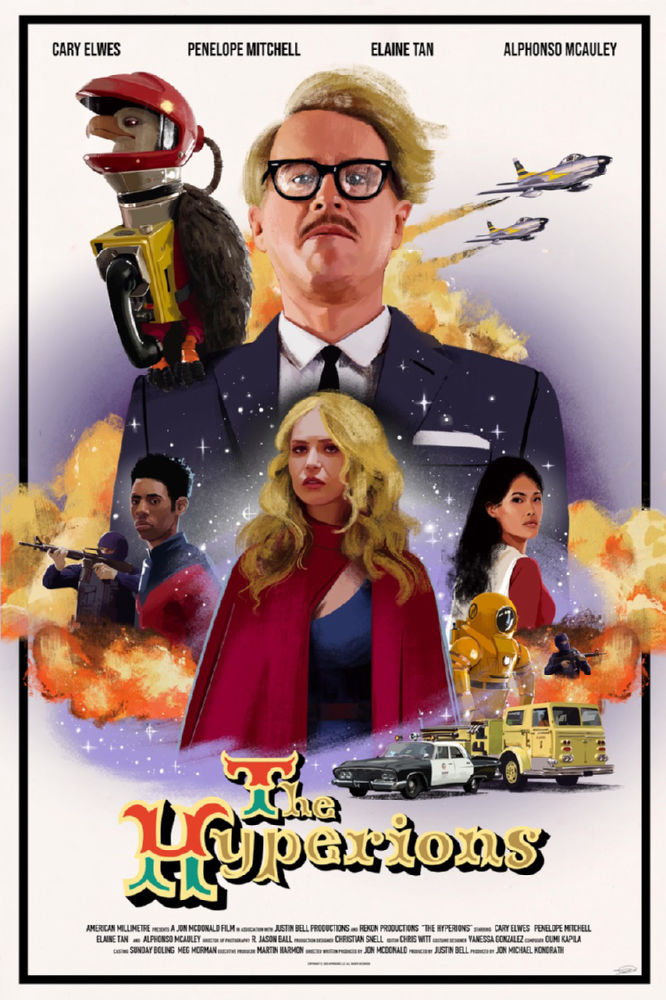
Professor Ruckus invents Titan badges that turn ordinary people into superheroes, and years later the grown original heroes fight to get those badges back amid family chaos.
The Hyperions follows Professor Ruckus, the scientist who in 1960 creates the Titan badge, a device that unlocks a specific superpower in whoever wears it. His work launches a celebrated family team that operates in public as costumed protectors. By 1979 two of those original heroes are adults again and decide they want their badges restored after the powers and the spotlight have faded. The story tracks their push to reclaim the technology while old alliances and rivalries inside the family resurface. Action set pieces and broad comedy beat against the practical mess of adult siblings who once saved the day together. Concrete stakes stay tied to who holds the badges and what each Hyperion will do to keep or seize them.
As the adults press their claim, other members of the Hyperion circle are pulled back into the fight, forcing confrontations over loyalty, leftover grudges, and who still deserves the power. Cary Elwes’s Professor Ruckus remains the inventor whose creation still drives every decision, while younger leads such as Sparks and the rest of the returning roster trade quips and punches over control of the remaining badges. Relationships inside the team shift under pressure as heists, chases, and public scrapes test whether the old unit can function again. The plot keeps returning to the simple goal of recovering the Titan devices and the personal cost of putting them back on. Later turns tighten the family conflict without abandoning the comic tone of misfit heroes who never quite left the costume behind.
Click any of the following icons below to rent or stream it!
Oops! Is this show WOKE?
Only an account holder or member can file. Cite a scene, a line, or a pattern. Other account holders +1 or −1 that argument, once each. The show is not IS WOKE until enough of them have given a +1. Enough −1s remove the write-up, and it is no longer shown.
Sign in to file a woke label. One of each criterion per member.
Comments and reviews
Report a mistake
Same rule as woke labels: one report, a written reason, and the community +1 or −1 it — once per member. A net +5 applies the change. Editors can hold it for review, or apply it immediately.
No mistake reports yet.
Sign in to report a mistake. One report per field, per member.
Member review
Wes Calder Member
Oct 19, 2026
★★★★★★★★★★The Hyperions sits in that odd corner of superhero television where the costumes matter less than the arguments over who gets to wear them. Professor Ruckus builds the Titan badges in 1960, ordinary people suddenly capable of the spectacular, a public family team that does the protecting and takes the applause. Jump ahead to 1979 and two of the originals are adults again, powers gone, spotlight cooled, and they want the badges restored. The rest of the story is them chasing that technology while the old family alliances and rivalries wake up and start throwing elbows. Concrete stakes stay locked to who holds the devices and what each person will do to keep or reclaim them. Action set pieces arrive on schedule and the comedy stays broad, but the real texture is the practical mess of grown siblings who once saved the day together and now can barely share a room without reopening every old slight.
I watched it over a stretch of quiet evenings and never felt rushed or particularly delayed. The central idea holds: faded glory is more interesting than the glory itself, especially when the technology that made you special is still out there in someone else’s hands. The badges function as both prize and reminder. Whoever wears one becomes the version of themselves the public once cheered, which creates a clean pressure on the characters who remember what that felt like and the ones who never got a full turn. Family chaos is the constant undercurrent. Meals turn into strategy sessions, old nicknames get weaponized, and the practical question of who actually deserves the power now sits next to the sentimental one of who earned it first. None of that is revolutionary, but it is handled with a steady enough hand that the show rarely collapses into pure nostalgia or pure soap.
The tone balances the spectacular and the domestic without too much strain. When the powers activate the sequences are competent, sometimes inventive in small ways, never trying to outdo the big theatrical features. Between those moments the writing leans on the friction of adult siblings who know exactly which buttons still work. One character wants the badge because the ordinary life feels like a demotion. Another treats the whole enterprise as unfinished business that has to be settled before anyone can move on. A third seems mostly interested in controlling the supply so no one else can rewrite the family history. Those motives stay legible. The show does not pretend the moral high ground is obvious. People who once fought side by side now calculate advantage the way any other family might calculate who gets the house or the car after a divorce. The superhero layer just raises the temperature.
Comedy arrives in the mismatch between epic self-image and current reality. Costumes that once fit perfectly now hang wrong. Public memory has shortened. The press that once adored them has moved on to newer novelties. The wry observation the series keeps returning to is that power was never the hard part; the hard part was deciding what to do when the power left and the bills stayed. That lands more often than it misses. A few scenes overplay the broad physical gags, but most of the humor stays dry enough to fit the overall register. I never laughed out loud, yet I kept noticing the small accurate details of people who used to matter and now have to negotiate ordinary life with the knowledge that a single piece of hardware could change everything again.
Pacing is the usual television compromise. Early episodes spend time establishing the 1979 present and the lingering weight of the 1960 origin without drowning in flashback. Later ones tighten around the chase for the remaining badges and the shifting loyalties inside the family. Not every subplot earns its minutes. A couple of side characters exist mainly to deliver exposition or to be available for a last-minute alliance. Still, the core group remains distinct enough that their arguments feel personal rather than schematic. You can tell who is operating from genuine belief and who is simply tired of being ordinary. The series trusts the audience to track those distinctions without constant underlining.
What keeps it from rising higher is a certain safety in the execution. The show knows the beats of reconciling (or failing to reconcile) a fractured team and it hits them cleanly, but it rarely surprises. Once the badges become the clear MacGuffin, the path forward is visible. Emotional payoffs arrive on time and at the expected volume. That reliability is comforting on a weeknight; it is also the reason the series never quite lodges under the skin. I finished the run neither disappointed nor eager to rewatch immediately. It did the job it set for itself. The family chaos felt lived-in, the action serviceable, the comedy serviceable, and the central question of who gets to be extraordinary again remained interesting enough to carry the hours.
In the end The Hyperions is a solid piece of genre television that understands its own limits. It does not reinvent the superhero family story. It simply lets a group of people who once wore the badges fight over them again while life has moved on around them. That is enough for three stars and a quiet recommendation if the premise already appeals. The wry pleasure is watching competent adults discover that reclaiming yesterday’s power does not automatically restore yesterday’s ease with one another. The badges can turn you into a hero. They cannot make the rest of the family stop remembering every slight that happened while the cameras were off.