
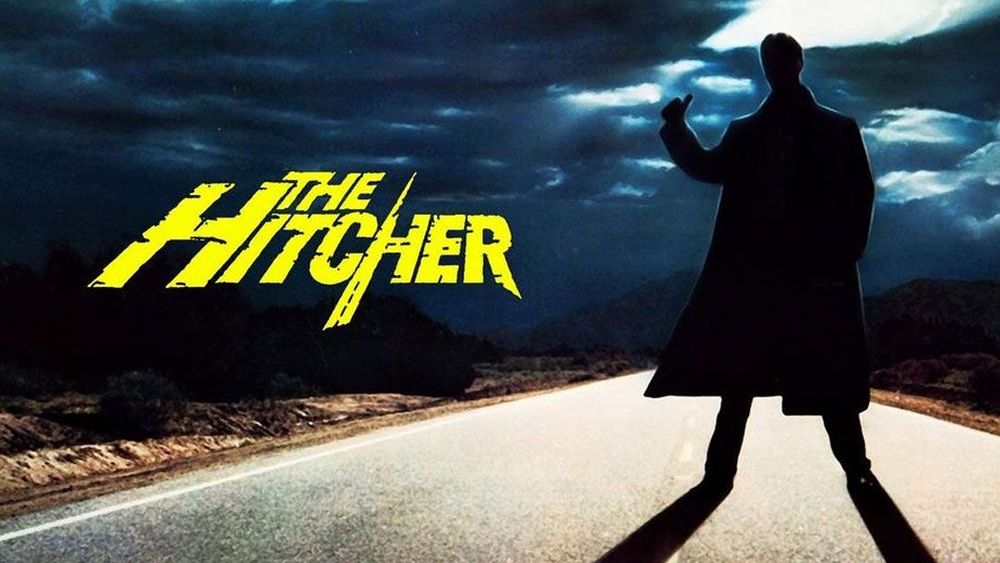



 MOVIE · 1986
The Hitcher (1986)
A young man who escapes the clutches of a murderous hitchhiker is subsequently stalked by the hitcher and framed for his crimes.
Oops! Is this show WOKE?
Only an account holder or member can file. Cite a scene, a line, or a pattern. Other account holders +1 or −1 that argument, once each. The show is not WOKE until enough of them have given a +1. Enough −1s remove the write-up, and it is no longer shown.
Sign in to file a woke label. One of each criterion per member.
Comments and reviews
Report a mistake
Same rule as woke labels: one report, a written reason, and the community +1 or −1 it — once per member. A net +5 applies the change. Editors can hold it for review, or apply it immediately.
No mistake reports yet.
Sign in to report a mistake. One report per field, per member.
Member review
Wes Calder Member
Oct 16, 2026
★★★★★★★★★★The Hitcher sits in that stretch of 1980s road pictures that treat the open Southwest like a trap rather than scenery. A young driver picks up the wrong man, gets free of him once, and then spends the rest of the film discovering that freedom was temporary. The hitcher keeps finding him, keeps framing him, and keeps turning every stretch of empty highway into the same closed circuit. The premise needs almost no setup, which is one of the better choices the movie makes. It does not pause to explain itself. It just puts you on those roads with the silences and the sense that the next pair of headlights might belong to the same problem.
Rutger Hauer plays John Ryder without raising his voice much. The calm is the point. He is charming in a flat, deliberate way that never quite becomes a performance of evil, and that restraint is what makes the character land. You keep expecting him to overplay it and he mostly does not. C. Thomas Howell has the harder job of looking permanently outmatched, and he carries that without turning the role into pure panic. The pressure between them holds for long stretches. You get the cat-and-mouse rhythm, the way each new town or diner only resets the same problem rather than solving it.
There is a version of this story that stays clean and mean. This one comes close and then occasionally steps on its own feet. The way Jennifer Jason Leigh’s character gets folded into the mess feels convenient rather than inevitable. A couple of the framing beats require Ryder to know things and be places that strain ordinary logic. I have seen the defense that he is meant to function as a mythical figure, some walking allegory about the kid’s journey and the way violence gets passed along. Maybe that was the intention. On screen it still plays more like a thriller that sometimes forgets how far a single man can reasonably stretch. A desert road flick can lose altitude when the villain becomes too free of ordinary limits. That is the soft spot here.
Even so, the lean quality does most of the work. Empty highways, long takes of nothing much happening, the awareness that help is a long drive away and the police are as likely to believe the wrong story as the right one. Those pieces hold up. The action, when it arrives, is blunt rather than showy. There is a psychological edge and a thin slasher flavor without the movie committing fully to either. It sits somewhere near older chase pictures that used remoteness as a character, the kind that mix the open country with something meaner underneath. You feel the distance more than you feel any big speeches about it.
I do not need every motivation spelled out, and the film is smarter when it trusts that. The stretches that work best are the ones that let dread accumulate from the setting and from Hauer’s quiet presence rather than from plot gymnastics. When it starts justifying the killer’s reach or forcing the supporting pieces into place, the air goes out a little. That is why it lands at 3.5 for me rather than higher. It is solid, often tense, and Hauer’s performance is the part that stays with you after the credits. It is also uneven in the connective tissue, and the mythical-character explanation feels like something added after the fact to cover a few convenient leaps.
Watching it again, I kept noticing how little fat there is in the early going and how that economy is the real engine. Later the story has to work harder to keep the frame-up and the chase in the same lane, and you can feel the effort. Still, the core nightmare of being hunted across all that open space while looking guilty of everything that happens holds together better than it has any right to. Howell never quite gets to be a classic hero, which is fine; the movie is not interested in turning him into one. Leigh’s arrival is the clunkiest gear change, and I will not pretend otherwise, but once she is in the picture the film finds a second wind for a while.
It is the kind of picture that rewards a late-night viewing more than a careful thematic reading. The allegory talk can wait. What works is the dread of the road itself, the sense that the next truck stop or motel is not safety, and Hauer standing there looking almost reasonable while everything around him goes wrong. That is enough to carry it. A few implausible turns and one awkward character entry keep it from feeling airtight, but the overall run is still entertaining in a dry, relentless way. I would watch it again for the silences and for Hauer more than for the plot mechanics. That is where my 3.5 sits: worth the time, not perfect, and honest about how little it needs to explain once the hitcher is in the car.