
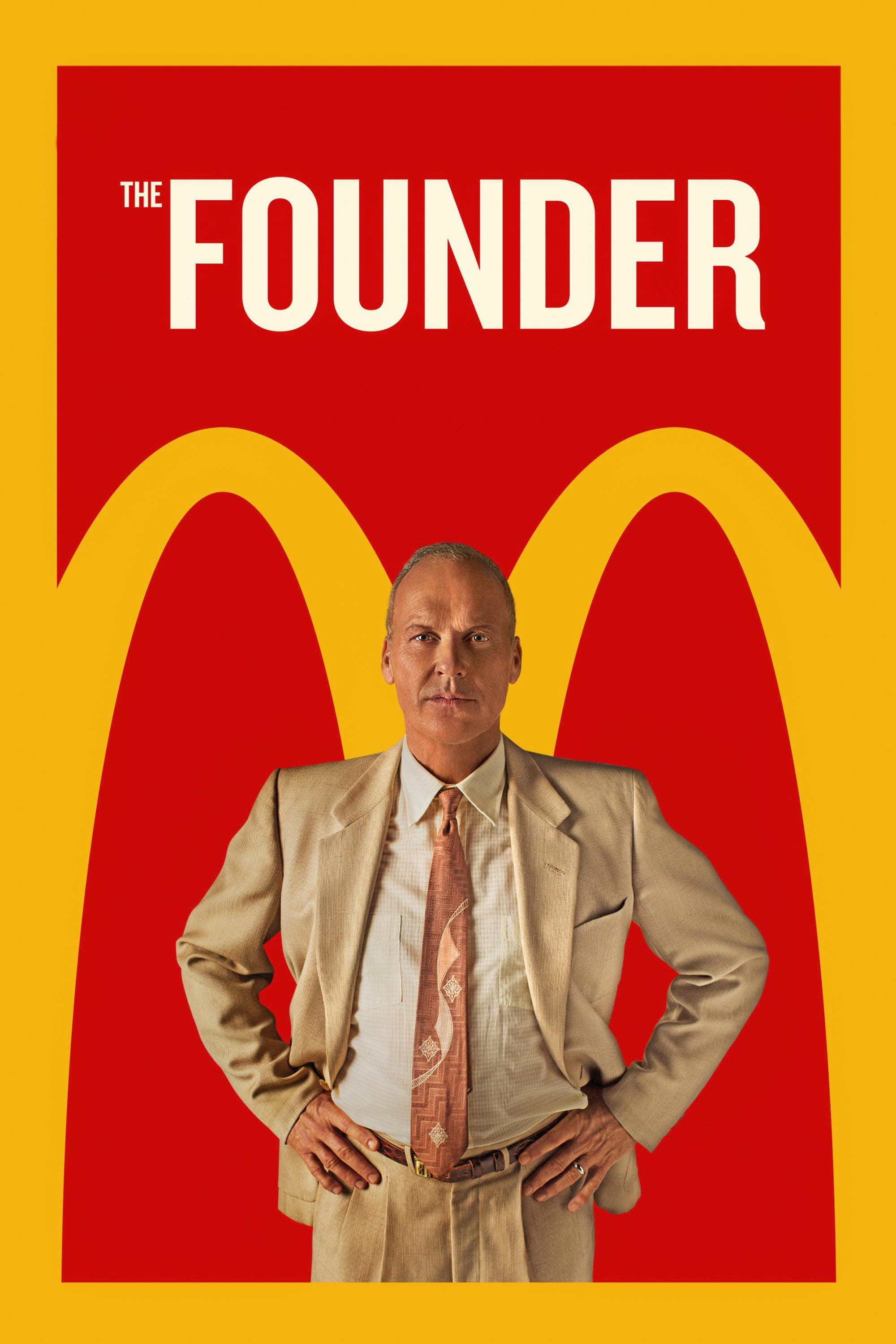



 MOVIE · 2017
The Founder
The story of Ray Kroc, a salesman who turned two brothers' innovative fast food eatery, McDonald's, into the biggest restaurant business in the world, with a combination of ambition, persistence, and ruthlessness.
The Founder is a drama that tells the true story of how Ray Kroc, a salesman from Illinois, met Mac and Dick McDonald, who were running a burger operation in 1950s Southern California.
Impressed by the brothers, speedy system of making the food at their San Bernardino hamburger stand and the crowds of patrons it attracted, Kroc immediately saw franchise potential and maneuvered himself into a position to be able to pull the company from the brothers and create a billion-dollar empire. And thus McDonald's was born.
Creator: John Lee Hancock
Click any of the following icons below to rent or stream it!
Oops! Is this show WOKE?
Only an account holder or member can file. Cite a scene, a line, or a pattern. Other account holders +1 or −1 that argument, once each. The show is not WOKE until enough of them have given a +1. Enough −1s remove the write-up, and it is no longer shown.
Sign in to file a woke label. One of each criterion per member.
Comments and reviews
Report a mistake
Same rule as woke labels: one report, a written reason, and the community +1 or −1 it — once per member. A net +5 applies the change. Editors can hold it for review, or apply it immediately.
No mistake reports yet.
Sign in to report a mistake. One report per field, per member.
Member review
Stu Kline Member
Oct 17, 2026
★★★★★★★★★★The Founder is a solid watch that leaves a sour taste, and I mean that as a compliment to how cleanly it does its job. It is not the uplifting franchise-origin story the golden arches plaque in every dining room wants you to believe. It is the story of a middle-aged milkshake-machine salesman who saw a better system, wanted it, and took it. Ambition, persistence, and a cold streak did the rest.
Michael Keaton plays Ray Kroc like a man who never quite stops selling, even when he is alone in a motel room. He is relentless without turning into a cartoon villain. That is the problem and the point. You catch yourself rooting for the hustle, then you catch yourself recoiling from the moves that actually close the deal. I have liked Keaton for years. After this I spent a day wondering if I still did. That is how thoroughly he disappears into the opportunist. The performance is the best thing in the movie and also the thing that makes the whole experience feel slightly grim.
The McDonald brothers come off as the innovators who actually built something clean and fast and smart in San Bernardino. Kroc sees the lines out the door and immediately starts talking franchise. From there the film tracks how control slides. Contracts, pressure, the slow rewrite of whose name and whose rules matter. You do not need a blow-by-blow. The shape is familiar if you have ever watched someone with more appetite and fewer scruples walk into a good idea and leave with the title. Business is not for boy scouts. The film knows it and does not pretend otherwise. Great operators often look like people worth your side-eye once the polish comes off: cold calculation sold as vision, other people treated as numbers or levers.
I grew up seeing the founder plaque and the smiling version of the story. This movie swaps that out for something bleaker and more plausible. It does not make me swear off fries forever, but it does make the brand feel less like a cheerful American success and more like a case study in who ends up holding the paper. That shift is effective. It is also why the film sits at a 3.5 for me instead of higher. It is well made and watchable, yet it never quite decides whether it wants to admire the empire-building or simply document the extraction. The lean is toward Kroc’s version of events because he is the engine, and that tilts the whole thing.
There are stretches where the drama feels tightened past what the real timeline probably needed. Deals get sharper, confrontations get louder, the moral temperature gets turned up so the audience does not miss the point. It works as entertainment. It also makes the story feel a little more stilted than a straight recounting might have been. You can sense the movie shaping tension that was already present in the history and then adding a coat of varnish so nobody can claim they were confused about who got screwed. I did not mind it most of the time. Once or twice I wished it trusted the facts more and the score less.
What sticks is the feeling after the credits. Not inspiration. Not pure contempt either. Something in between: respect for the system the brothers built, and a clear-eyed look at the salesman who scaled it by being willing to do what they would not. McDonald’s became huge for reasons that include speed, consistency, real estate, and a man who treated hesitation as a personal insult. The film stays mostly neutral on the surface and still leaves you with the sense that the “right kind of wrong” is what got the arches across the country. That is an honest enough take on how a lot of big things get built.
Keaton carries scenes that would sag with a softer actor. The supporting work around the brothers and the early franchisees is grounded enough that you believe the kitchen and the parking lot and the handshake that later gets rewritten. Production design does its quiet job: 1950s California, roadside America, the slow creep of uniforms and procedures. Nothing flashy. The movie does not need flash. It needs you to sit with the bargain.
I am not going to pretend this reinvented the business biopic. It is another entry in the “how the sausage got made” lane, executed with craft and a lead performance that refuses to wink. If you want pure celebration, look elsewhere. If you want a clean account of how control changes hands when one side wants it more, this does the work. It left a disappointing flavor in the soul and still earned the time. That is rare enough. Three and a half stars feels right: strong craft, a bleak core, and just enough distance from hero worship to keep it honest without turning into a lecture. I will think twice next time I see the plaque. That is more than most of these movies manage.