
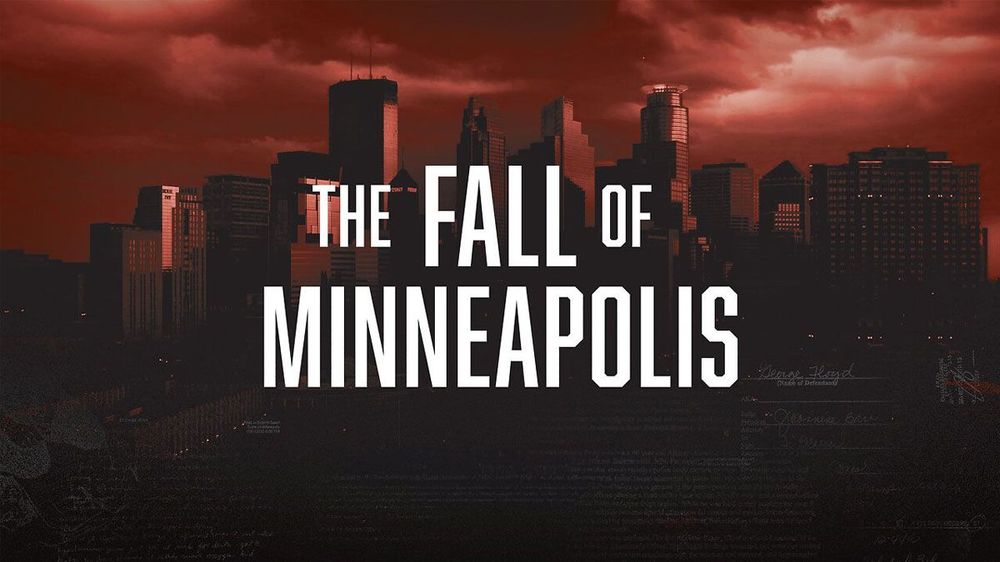



 MOVIE · 2023
The Fall of Minneapolis
The Fall of Minneapolis revisits George Floyd’s death in custody, the 2020 riots that gutted parts of the city, and the political choices that left Minneapolis reeling. It uses officer interviews, body-camera material, and trial context to contest the dominant public narrative.
The Fall of Minneapolis examines the night George Floyd died after a Minneapolis police arrest and the cascade of unrest that followed. The film draws on interviews with officers who worked the city during the crisis, including personnel connected to the Third Precinct, and revisits body-camera and scene evidence from May 25, 2020. It tracks how protests escalated into arson, looting, and the abandonment and burning of the precinct as crowds overwhelmed local control. City leadership figures such as Mayor Jacob Frey and department command appear in the account of stand-down decisions, public messaging, and the collapse of order across neighborhoods. Medical and use-of-force disputes raised around Floyd’s condition and the restraint are presented alongside the pressure that shaped charging and public framing of officer Derek Chauvin and his colleagues.
The documentary continues through the weeks of curfews, National Guard deployment, and the political drive to restructure or defund policing while businesses and blocks remained damaged. Officers describe operational chaos, fear of prosecution, and the personal cost of working under intense media and activist scrutiny as the Chauvin trial approached. Archival news clips and local testimony are set against claims about crowd size, outside agitators, and how quickly elected leaders conceded narrative ground. The film follows the institutional fallout inside the department and city hall as morale, recruitment, and street presence eroded. It closes on the longer civic bill—boarded corridors, resident displacement, and a police force operating under rules rewritten in the heat of the crisis—without resolving every contested forensic point into a single courtroom verdict.
Creator: 1 hr, 42 min
Oops! Is this show WOKE?
Only an account holder or member can file. Cite a scene, a line, or a pattern. Other account holders +1 or −1 that argument, once each. The show is not WOKE until enough of them have given a +1. Enough −1s remove the write-up, and it is no longer shown.
Sign in to file a woke label. One of each criterion per member.
Comments and reviews
Report a mistake
Same rule as woke labels: one report, a written reason, and the community +1 or −1 it — once per member. A net +5 applies the change. Editors can hold it for review, or apply it immediately.
No mistake reports yet.
Sign in to report a mistake. One report per field, per member.
Member review
June Pell Member
Oct 7, 2026
★★★★★★★★★★I sat down with The Fall of Minneapolis on a quiet evening when I finally had the bandwidth for something heavier than the usual streaming fluff. What pulled me in wasn’t the promise of fireworks or a neat partisan score-settling exercise. It was the simple fact that so much of what we were told in 2020 arrived already packaged, already decided, and this film tries to open the package again with primary material. Liz Collin’s approach, building from her own reporting and the book They’re Lying, stays close to body-worn camera video, autopsy details, trial exhibits, and the voices of officers who were actually on the ground when the city came apart. That grounding matters. It keeps the piece from floating off into pure theory.
The body-cam stretches are the part that stayed with me longest. You watch the arrest unfold without the filtered stills or the selected seconds that dominated the first news cycle. The camera doesn’t flinch, and neither does the editing. You see the struggle, the restraint, the medical response that followed, and you hear the officers’ radio traffic in real time. I found myself pausing more than once, not because the film told me to feel a certain way, but because the raw footage forces a slower look. People forget how much of the early public reaction rested on incomplete clips and secondhand summaries. Sitting with the longer record is uncomfortable in a useful way. It doesn’t erase the tragedy of a man dying in custody. It does, however, make clear that the simplified version many of us absorbed left out context that the courts later had to wrestle with.
What the film does especially well is braid that footage with the aftermath. Minneapolis didn’t just experience a few nights of protest. Neighborhoods burned, businesses closed for good, and the police department itself was hollowed out by resignations, demoralization, and political pressure that treated every officer as a villain by default. Interviews with people who worked those shifts give the sense of a city that lost its bearings. Some of them still sound shell-shocked years later. Others are just tired. I appreciated that the film lets them talk without turning each conversation into a monologue about ideology. You get the practical wreckage: response times that ballooned, residents who stopped calling for help, the quiet exodus of people who could afford to leave. That material feels under-covered even now, and it lands harder because it follows directly from the initial event rather than floating free of it.
There is a short stretch where the film steps back to examine how quickly institutions—media, city leadership, national figures—locked into one narrative and treated any deviation as moral failure. I went down a brief mental side path here thinking about how often we demand certainty in the first forty-eight hours of a crisis, then punish anyone who later brings receipts that complicate the story. The film doesn’t dwell on that point for long; it returns to the evidence. Autopsy findings, toxicology, the specific charges and the trial record are laid out without theatrics. You can disagree with how some of it is framed, but you can’t claim the documents aren’t there. That restraint is what earned my respect. A lesser version of this project would have spent half its runtime sneering at opponents. This one mostly stays with the record and lets the gap between the record and the prevailing story do the work.
I’m not someone who needs every documentary to confirm what I already believe. I watched this because I wanted a clearer picture of what actually happened on the street that day and what the city paid afterward. The film delivers that clarity more often than not. It has rough edges—occasional pacing dips when it circles back to the same piece of footage, a couple of interviews that feel slightly overlong—but those are minor against the value of seeing the material assembled in one place. The civil unrest sequences are particularly hard to shake. You watch a functioning downtown slide into something unrecognizable, and you realize how fragile ordinary order really is once the permission structure for chaos takes hold. That lesson feels larger than Minneapolis.
Four stars feels right. The film is serious, evidence-forward, and willing to sit with complexity instead of offering easy catharsis. It doesn’t pretend George Floyd’s death was nothing. It does insist that the story surrounding it was incomplete, and that the consequences for a city and for policing nationwide were real and lasting. I came away less interested in scoring points and more interested in the simple question of what we choose to see and what we choose to look away from when the cameras are rolling. That question still matters. The footage is still there. The damage to Minneapolis is still visible if you go looking. This documentary makes looking harder to avoid.