
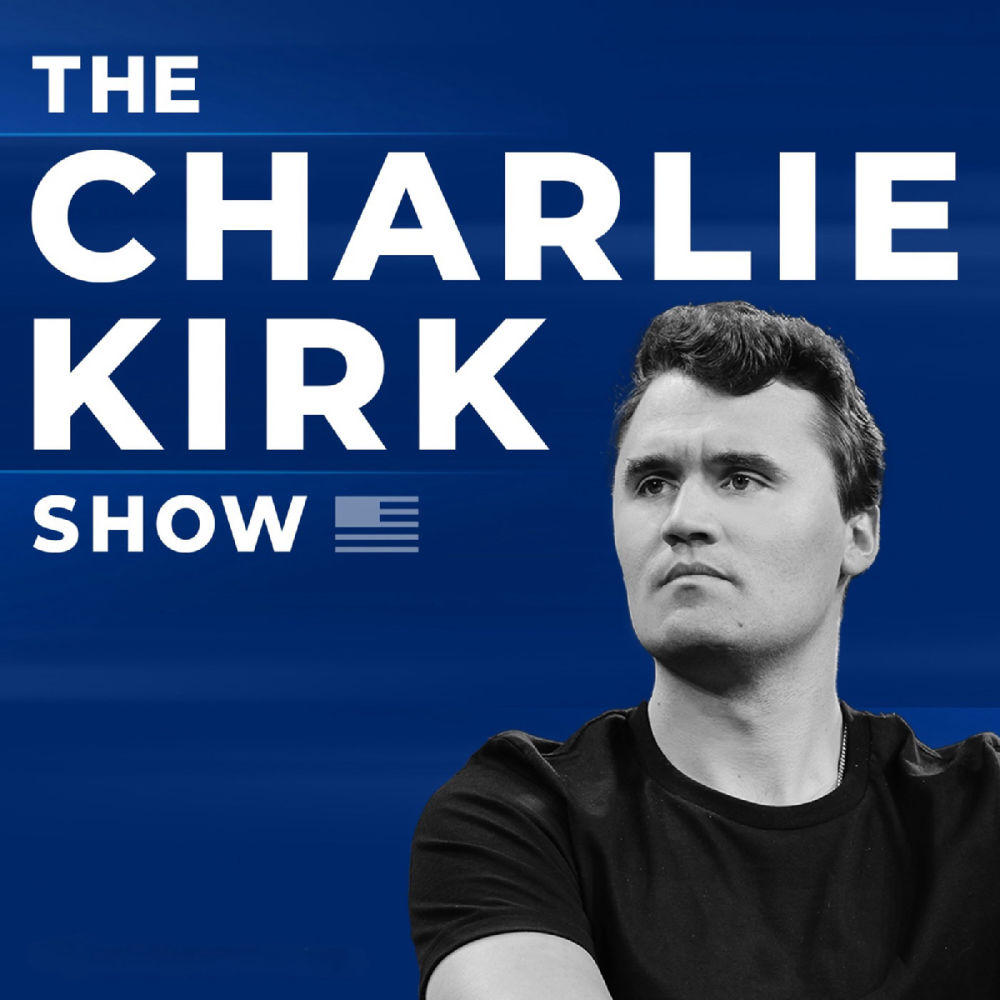



 PODCAST · 2019
The Charlie Kirk Show
The Charlie Kirk Show is a daily conservative talk podcast that breaks down politics, culture, and headlines from a right-wing grassroots perspective. It continues as a platform for populist commentary even after the loss of its founder.
The Charlie Kirk Show follows Charlie Kirk, the right-wing activist and Turning Point USA co-founder who anchors fast-paced episodes on American politics, media, and cultural flashpoints. Each installment gives listeners an inside read on major news and what Kirk argues is really happening behind the headlines. Guests and monologues reinforce traditional values, limited-government themes, and critiques of progressive institutions. The program airs on Salem Media Group’s network and built a large audience through consistent alignment with the populist wing of the Republican Party. Download and streaming numbers placed it among the most-heard political podcasts, with heavy presence on platforms such as Rumble. Kirk’s on-air style mixes rapid news roundups with calls to grassroots organizing.
Kirk remained the central voice until his assassination in September 2025, after which the show’s trajectory changed while its mission was publicly reaffirmed. High-profile conservatives, including Vice President JD Vance, stepped in for episodes and pledged to keep the platform active for its audience. Production later settled under Andrew Kolvet and Blake Neff, who continue daily coverage of events, politics, and culture from the same right-wing vantage. The program still functions as a hub for commentary linked to Turning Point USA and Salem’s “The Answer” channel. Listeners receive ongoing analysis rather than a scripted narrative arc, yet the through-line remains defense of the founder’s populist priorities. The broadcast endures as a staple of conservative talk radio and podcasting.
Oops! Is this show WOKE?
Only an account holder or member can file. Cite a scene, a line, or a pattern. Other account holders +1 or −1 that argument, once each. The show is not WOKE until enough of them have given a +1. Enough −1s remove the write-up, and it is no longer shown.
Sign in to file a woke label. One of each criterion per member.
Comments and reviews
Report a mistake
Same rule as woke labels: one report, a written reason, and the community +1 or −1 it — once per member. A net +5 applies the change. Editors can hold it for review, or apply it immediately.
No mistake reports yet.
Sign in to report a mistake. One report per field, per member.
Member review
Toni Briggs Member
Oct 16, 2026
★★★★★★★★★★I set the headphones down after another Charlie Kirk Show episode and the tempo was still in my head. That clip-along pace never really lets you half-listen. He talked like someone who had already done the reading and decided the polite version of the story was a waste of time. Politics, culture, the daily headlines—he treated them as things that actually matter to people trying to raise kids and keep a paycheck, not as content for a seminar.
The monologues are the spine. Charlie would open a topic, strip the press language off it, and tell you what he thought was actually moving underneath. Limited government was not a slogan with him; it was the recurring answer to agencies that keep expanding their reach while the results stay mediocre. Traditional values showed up the same way—not as nostalgia, but as the practical frame that used to keep communities from coming apart. Guests usually reinforced that rather than soft-pedaling it. You got the sense of a room full of people who had already agreed the other side was not arguing in good faith.
One stretch on the Supreme Court lighting a constitutional fight stayed with me. Seventeen minutes, no throat-clearing. He walked through the stakes without the usual both-sides cushion. Another piece on stories that do not click felt even sharper. Those are the items that disappear from the feed because they refuse to flatter the preferred narrative. He had a habit of dragging them back into the light and asking why they vanished in the first place. It is a simple habit and it still works.
Homelessness came up in the way it rarely does on other shows. He offered an actual set of steps instead of the endless cycle of more funding and softer language. You could disagree with the details, but at least there were details. The same directness showed up when he talked about Gavin Newsom’s recent podcast move. Charlie’s read was that the California governor had just torched whatever primary path he thought he still had. No long wind-up, just the judgment and the reasons. That kind of clarity is why the downloads stayed high.
The sound of the show itself is clean and urgent. Salem’s production keeps the levels steady so the energy comes from the talking, not from fake crowd noise or stingers. You can hear him lean into a point, then cut to a guest who has the same temperature. It never drifts into the soft middle where every sentence needs three disclaimers. When South Park took a shot at him he treated the parody like material instead of a personal injury. That willingness to stay in the fight without thin skin is part of what made the hours feel useful rather than exhausting.
Even after the loss of its founder the platform keeps the same populist edge. Listening now you catch the weight in the older cuts and in the way people around the show still speak. The head of security’s real account of that day is hard to shake once you have heard it. So are the last interviews and the raw reactions from people who worked beside him. None of that turns the podcast into a memorial reel. The work continues as commentary on the same flashpoints—media double standards, campus capture, the slow bleed of institutions that used to know their lane. Faith is still treated as a live force instead of a costume for the villain. Ordinary manhood is not framed as the original problem that needs fixing. Those choices keep the show from sliding into the scolding tone that dominates so much of the rest of the dial.
I do not come to this for comfort. I come because the takes land clean and the pace refuses to waste the hour. Charlie had a gift for making the large fights feel local again. You finish an episode sharper than you started, not because every claim is airtight, but because someone finally said the quiet part at full volume and expected you to keep up. The continuing show still carries that charge. It is not subtle and it is not trying to be. For a daily conservative talk podcast that actually wants to win arguments instead of just surviving them, that is enough. The headphones go back on the next day without much internal debate.