
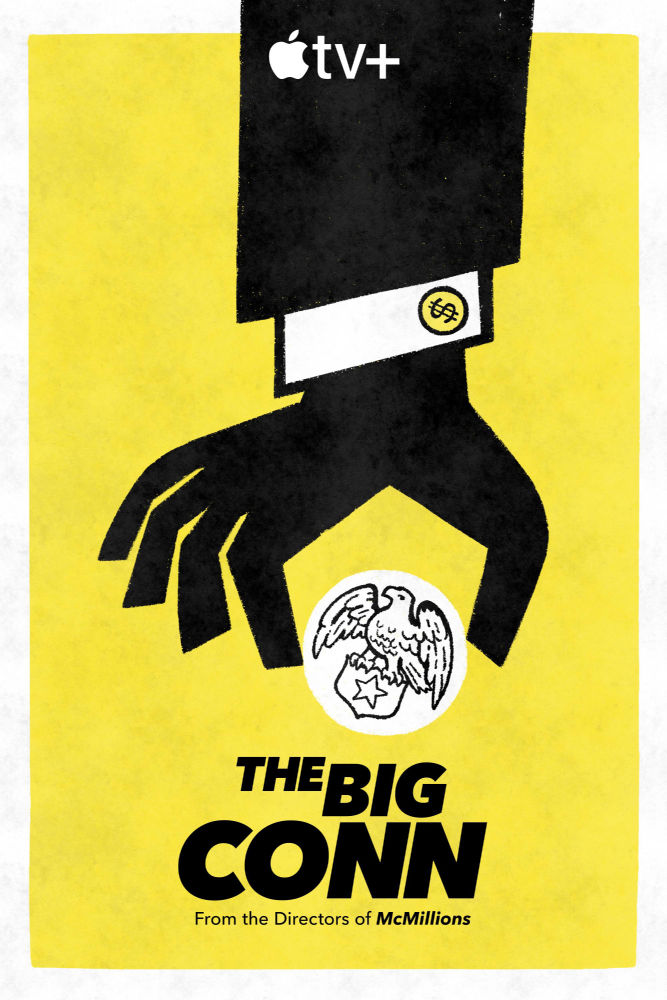



 TV · 2022
The Big Conn
Eastern Kentucky lawyer Eric C. Conn runs a disability-claims empire that drains more than half a billion dollars from Social Security until whistleblowers and federal agents tear the scheme apart.
The Big Conn follows Eric C. Conn, a flamboyant attorney in rural eastern Kentucky who turns Social Security disability filings into a high-volume business. Conn advertises aggressively, lives large with planes and entourages, and steers thousands of clients onto the federal rolls while a cooperative judge helps rubber-stamp claims. Inside the system, employees Sarah Carver and Jennifer Griffith notice the volume, the shortcuts, and the money flowing through Conn’s firm. Their tips draw investigators into what becomes one of the largest government fraud cases in U.S. history. The series reconstructs how the operation thrived in a hard-hit coal region and how paperwork, wiretaps, and insider courage finally cracked it open.
As the net tightens, Conn’s flashy public image collides with mounting evidence of kickbacks, fake medicals, and a pipeline of approved claims worth hundreds of millions. Federal agents move in; Conn bolts, sparking a manhunt that ends with his capture and a cascade of guilty pleas and sentences for the lawyer, the judge, and others in the circle. Whistleblowers face retaliation and career fallout even as the case validates their warnings. The series stays with the money trail, the courtroom reckoning, and the human cost to taxpayers and the disability system Conn exploited, closing on the scale of the theft rather than a moral lecture.
Oops! Is this show WOKE?
Only an account holder or member can file. Cite a scene, a line, or a pattern. Other account holders +1 or −1 that argument, once each. The show is not WOKE until enough of them have given a +1. Enough −1s remove the write-up, and it is no longer shown.
Sign in to file a woke label. One of each criterion per member.
Comments and reviews
Report a mistake
Same rule as woke labels: one report, a written reason, and the community +1 or −1 it — once per member. A net +5 applies the change. Editors can hold it for review, or apply it immediately.
No mistake reports yet.
Sign in to report a mistake. One report per field, per member.
Member review
Stu Kline Member
Oct 19, 2026
★★★★★★★★★★The Big Conn sits in that middle zone where the story is strong enough to hold you but the telling never quite locks in. Eric Conn built a disability claims machine in eastern Kentucky that pulled more than half a billion out of Social Security. He flew planes, kept an entourage, plastered his face everywhere, and fed thousands of people onto the federal rolls with a cooperative judge greasing the path. Two women inside the system, Sarah Carver and Jennifer Griffith, saw the volume and the shortcuts and started talking. That tip line turned into one of the bigger government fraud cases on record. The series lays out the paperwork, the wiretaps, and the collapse without dressing it up as pure thriller. I gave it 3.5 because it works when it stays with the mechanics and the people who noticed, and it drags when it leans too hard on the flash.
Conn himself is the obvious magnet. Flamboyant lawyer in a hard-hit coal region, selling hope and cash advances to folks who needed both. The show does not pretend the area was thriving. Mines closing, jobs gone, disability claims becoming a parallel economy. That backdrop matters. You see why the scheme could scale so fast. Clients lined up, forms got rubber-stamped, money moved. The cooperative judge piece is almost too clean: one man approving stacks while the firm pumped volume. I kept waiting for more on how the internal incentives lined up that way for so long. The series shows the money flow and the lifestyle, but it never quite digs into the quiet institutional blindness that let it run for years. That gap keeps it from feeling complete.
The whistleblowers carry a lot of the weight, and that is where it gets personal for me. Carver and Griffith are not presented as saints or crusaders. They are people who noticed the pattern, the shortcuts, the sheer number of claims moving through one firm, and decided the risk was worth it. Their side of the story is the strongest stretch. You watch the tips turn into investigations, the slow grind of federal agents piecing together bank records and recordings. No Hollywood montage of genius detectives. Just persistence against a guy who knew how to play the system and the local culture. I liked that the show did not turn them into symbols. They stayed specific. That restraint is rare enough that I noticed it.
Where it loses steam is in the reconstruction of Conn’s empire. The planes, the ads, the parties, the big talk. It is entertaining in short bursts, but the series circles back to the same images of excess more than it needs to. You get the point early: this was a high-volume operation dressed up as local hero work. Repeating the flash starts to feel like padding. I wanted tighter cuts between the client intake scenes and the back-office fraud. The paperwork and the wiretaps are more interesting than another shot of Conn living large. When the show trusts the dry details, it lands. When it chases the character, it thins out.
The region itself comes through clearly without lectures. Eastern Kentucky is not a backdrop for pity or a stage for moralizing. It is a place where disability money became one of the few steady streams left. Conn understood that and built a business on it. The series shows how the claims process could be gamed when volume met a willing judge and a firm that treated filings like product. No grand speeches about systems. Just the cumulative effect of thousands of cases moving too fast with too little scrutiny. That feels honest. I did not need anyone explaining what poverty does to a community. The numbers and the interviews did the work.
Pacing is uneven across the episodes. Some stretch the investigative timeline in ways that feel longer than the material supports. Others snap into focus when the agents close in or when the internal documents start contradicting the public story. I never checked out completely, but I did check the clock a few times. A tighter edit would have pushed this closer to something I would rewatch. As it stands, it is solid once and then done. The fraud itself is so large and so brazen that the bare facts carry most of the interest. The production does not need to invent drama. It just needs to stay out of the way more consistently.
I kept thinking about how ordinary the machinery looked once you saw it. Forms, signatures, medical opinions that lined up a little too neatly, payments routed through the firm. No mastermind in a vault. Just a lawyer who figured out the weak points and scaled them. The show captures that better than most true-crime treatments. It also shows the cost on the other side without turning every client into a villain or a victim. Some needed the money. Some got pulled into a pipeline that did not care about the difference. That gray area is handled cleanly.
By the end you understand why the case mattered and how long it took to unwind. The series does not overclaim. It does not pretend one bust fixed the disability system. It just follows this particular empire until the walls came in. That limited scope is a strength. I walked away knowing more about how these schemes hide in plain sight and less interested in Conn’s personal mythology. For a show built around a flamboyant central figure, that is a decent outcome. It earns the 3.5 by sticking close to the fraud and the people who refused to look past it, even when the flashier material tempts it to wander. Worth the time if the subject already pulls you in. Not essential if it does not.