



 TV · 2022
That Dirty Black Bag
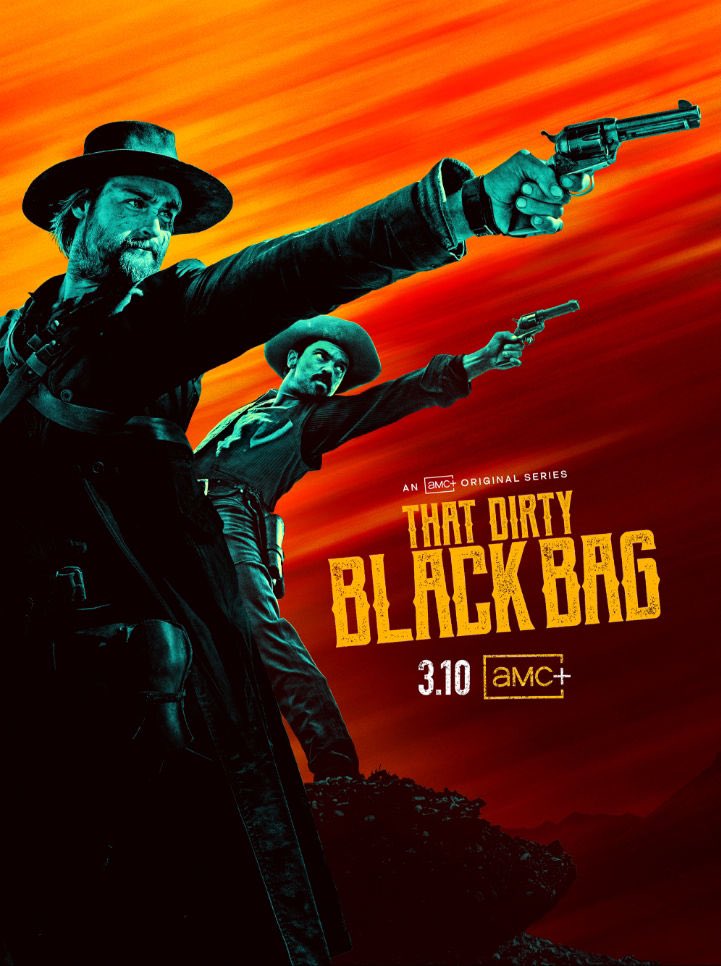
An incorruptible sheriff with a haunted past collides over eight days with Red Bill, a solitary bounty hunter who beheads his targets and carries the heads in a filthy black bag. The series tracks their bloody reckoning across a drought-struck gold town ruled by hangings and hard bargains.
That Dirty Black Bag follows Arthur McCoy, an incorruptible sheriff whose troubled past collides with the arrival of Red Bill, an infamous bounty hunter who decapitates victims and stuffs their heads into a dirty black bag. McCoy tries to keep order in a gold-mining settlement already strained by water shortage, public executions, and the constant threat of the noose. Red Bill rides in as a solitary horseman whose reputation for ax work and cold efficiency unsettles deputies and townsfolk alike. Over a compressed stretch of days the two men circle each other through gallows yards, farming outskirts, and the town’s rough edges, each move raising the body count. Alliances form and break around the sheriff’s office and the local whorehouse as gold, fear, and old debts pull every side deeper into violence.
As the clash tightens, McCoy’s sense of law is tested by the bounty hunter’s methodical cruelty and by the town’s own hunger for swift hanging justice. Red Bill continues his grim harvest while McCoy and his deputies scramble to stop the next execution or ambush before the bag fills again. Secondary figures—farmers, hangmen, and those who profit from the chaos—force both leads into choices that strip away any remaining illusions about clean justice on the frontier. The eight-day span compresses chases, standoffs, and personal reckonings until the sheriff and the hunter can no longer avoid a final accounting. What remains is a raw portrait of men who kill easily and discover that dying may be easier still.
Click any of the following icons below to rent or stream it!
Oops! Is this show WOKE?
Only an account holder or member can file. Cite a scene, a line, or a pattern. Other account holders +1 or −1 that argument, once each. The show is not WOKE until enough of them have given a +1. Enough −1s remove the write-up, and it is no longer shown.
Sign in to file a woke label. One of each criterion per member.
Comments and reviews
Report a mistake
Same rule as woke labels: one report, a written reason, and the community +1 or −1 it — once per member. A net +5 applies the change. Editors can hold it for review, or apply it immediately.
No mistake reports yet.
Sign in to report a mistake. One report per field, per member.
Member review
June Pell Member
Oct 19, 2026
★★★★★★★★★★That Dirty Black Bag sat with me longer than I expected for a show that leans so hard into dust, rope, and the kind of violence that leaves a stain you can almost smell. I rated it 3.5 because it does enough right to keep you watching while still leaving you aware of the seams. It is not a grand statement western and it does not pretend to be. It is eight days of two stubborn men grinding against each other in a place already half dead from thirst and greed.
Arthur McCoy arrives as the sheriff who will not bend, and that alone sets a certain tone. The haunted past is there, but the show mostly lets it sit under the surface instead of spelling it out in long speeches. Red Bill is the cleaner disruption. A man who takes heads, bags them, and rides on. The filthy bag itself becomes the image that sticks. It is not subtle, and it does not need to be. You understand the threat the moment he shows up. The town around them is a gold settlement running dry, where hangings are public business and bargains get struck in the shade of the gallows. Water is short. Patience is shorter. That pressure does more work than any monologue.
What I liked was the compressed timeline. Eight days forces the story to stay tight. You feel the heat and the waiting. McCoy trying to hold a line that keeps shifting under him, Bill moving through like a force that does not care about the line. Their circling feels personal even when they are not in the same frame. Gallows yards, outskirts, the kind of rooms where men decide who dies next. The show trusts the space between them. It does not rush every confrontation into a shootout. Sometimes the quiet is worse.
I kept thinking about the bag itself while I watched. Not as a gimmick, but as a practical object that carries weight. Heads as proof, as currency, as warning. In a town already ruled by the noose, it fits. Bill’s reputation does half the work before he even speaks. Deputies get nervous. Townsfolk step aside. McCoy has to decide whether this kind of efficiency is a tool he can use or a disease he has to cut out. That tension is the real engine. The drought and the gold just tighten the screws.
There are stretches where the show settles into a familiar rhythm of western grit. Hard men, harder bargains, dust that never quite leaves the clothes. I did not mind most of it. The performances hold. Nobody feels like they wandered in from a different production. McCoy’s refusal to corrupt himself lands because you see the cost on him. Bill’s solitude feels earned rather than posed. When they finally collide in full, it carries the days that came before it.
Still, 3.5 is honest. Some of the supporting pieces blur together. A few side characters exist mainly to fill the frame or die on schedule. The town’s desperation is clear, yet certain beats repeat the same idea of scarcity without adding new pressure. I wanted one or two sharper turns in the middle stretch, something that would have made the reckoning feel less inevitable and more chosen. The violence is frequent and bloody, which fits the premise, but it sometimes arrives on cue rather than out of genuine surprise. You start to know when the ax is coming.
I also noticed how little room the story gives for ordinary life outside the conflict. That may be the point. A place this dry and this ready to hang people does not leave much room for softness. Even so, a little more texture in the quieter hours would have helped the bloody stretches hit harder by contrast. The show knows what it is selling and mostly sticks to it. That is both a strength and a limit.
What stays with me is the simple collision. An incorruptible man who has already paid for his principles meeting a professional who treats death as inventory. The bag is dirty because the work is dirty. No one pretends otherwise. In a gold town running out of water, that honesty feels almost refreshing. You are not asked to root for purity or for efficiency. You are asked to watch two methods of order grind against each other until something breaks.
I would watch it again on a slow week, not because it reinvents anything, but because the mood holds. The eight days feel like eight days. The heat feels present. The bag feels heavier each time it appears. That is enough for me to land where I did. Not a revelation, not a waste. A solid, grim piece of work that knows its territory and walks it without apology. Some nights that is exactly what you want from a western that refuses to clean itself up.