
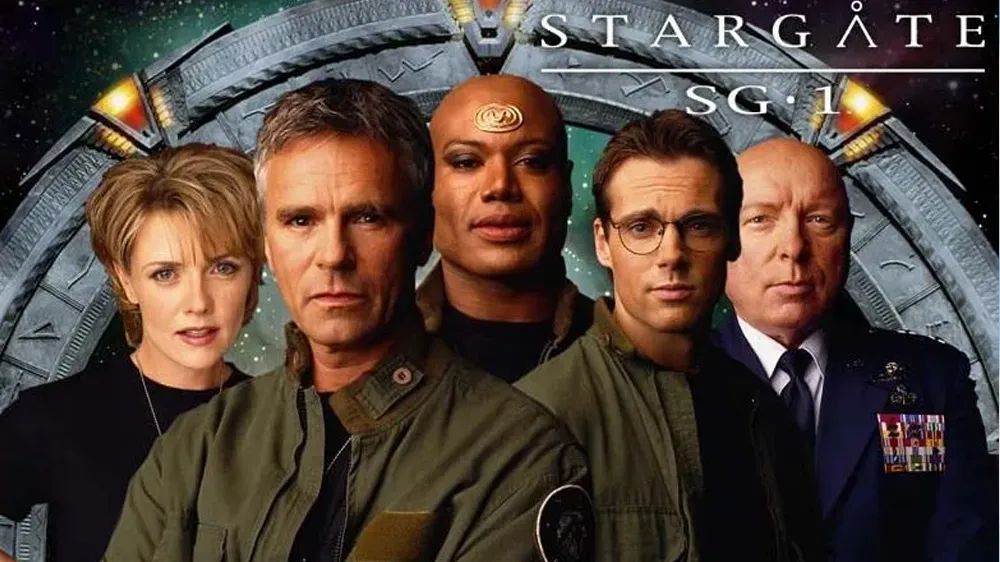



 MOVIE · 1997
Stargate: SG1
The basic premise of Stargate Sg-1 is that a secret military team has discovered a network of portals that can instantly transport people all over the galaxy -- so, with typically earnest human curiosity, they set off to discover the mysteries of the cosmos. The show has a very complex mythology: The Stargates were created by the Ancients, an ultra-advanced race that disappeared eons ago, and humans and several other races are slowly figuring out how to use them. One of these is the Goa'uld, a snake-like species of parasites bent on taking over the galaxy; until the Stargate team arrived on the scene to oppose them, they were close to attaining their goal.
Oops! Is this show WOKE?
Only an account holder or member can file. Cite a scene, a line, or a pattern. Other account holders +1 or −1 that argument, once each. The show is not WOKE until enough of them have given a +1. Enough −1s remove the write-up, and it is no longer shown.
Sign in to file a woke label. One of each criterion per member.
Comments and reviews
Report a mistake
Same rule as woke labels: one report, a written reason, and the community +1 or −1 it — once per member. A net +5 applies the change. Editors can hold it for review, or apply it immediately.
No mistake reports yet.
Sign in to report a mistake. One report per field, per member.
Member review
Dan Reilly Member
Oct 17, 2026
★★★★★★★★★★Stargate SG-1 starts with a premise that should have collapsed under its own weight. A secret Air Force team finds a ring that dumps them anywhere in the galaxy, and instead of treating it like a one-and-done adventure they turn it into a decade-long commute. The early mythology is thick. Ancients built the gates, then vanished. Goa’uld parasites hijack hosts and play gods. Entire seasons get spent explaining who left what device where and why the next planet’s rules contradict the last one. That density is the first thing that didn’t work for me. You can feel the writers stacking lore because the weekly formula needed fresh obstacles, and sometimes the stack wobbles. A couple of arcs drag because the show refuses to leave a thread alone; it has to circle back and add another layer until the original idea is buried. The humor can land flat when the same characters keep undercutting tension with the same dry quips. And once the universe expands past a certain point, some of the later threats feel like they exist mostly to keep the gate spinning rather than because anyone had a sharp new idea.
Still, I kept watching, and the reason is simple. Richard Dean Anderson walks into the lead role carrying everything that made the original MacGyver work. I love that MacGyver the same way most people do, and I have no patience for the later remake that decided the character needed a political upgrade. Here he just shows up as Jack O’Neill and the fit is natural. He never has to defuse a bomb with hockey tickets, but the same practical, slightly weary problem-solver energy is right there. The rest of the team locks in around him without needing speeches about why they belong. Carter is sharp without turning every scene into a lecture. Teal’c is stoic in a way that actually reads as character instead of costume. Daniel brings the curiosity that justifies the whole exploration premise. They argue, they screw up, they get each other out of messes. That chemistry carries more weight than any of the bigger mythology dumps.
What the show does well is use the other planets as a thin veil for current issues without turning into a sermon. You get political power plays, religious control, scientific overreach, the cost of isolation versus the risk of contact. It looks at those questions, offers a few angles, and then usually lets the story move on without demanding you pick the approved side. That restraint is rarer than it should be. Plenty of science fiction pretends to examine something and then just hands you the moral at the end. SG-1 mostly stays curious. The military framing helps; these are people with orders and consequences, not free-floating idealists who get to rewrite the rules whenever the plot needs a win. When they break protocol it costs them. When they succeed it usually comes with a bill.
The production values of the late nineties and early two-thousands hold up better than expected in the practical sets and creature work. Some CGI has aged into that plastic look everyone remembers, but the gate itself and the basic alien environments still sell the idea that these people are somewhere else. The procedural rhythm—arrive, assess, survive, return—becomes comforting once you accept it. Episodes that lean too hard on the mythos can feel like homework, yet the ones that stay smaller and character-driven still feel alive. I never needed the show to reinvent the weekly format; I needed it to keep the team interesting while they walked through that format, and most of the time it managed that.
There are stretches where the formula repeats itself a little too cleanly. Another false god, another betrayed ally, another ancient device that must not fall into the wrong hands. You start to spot the shape of the hour before the teaser ends. That predictability is the price of longevity, and SG-1 ran long enough to pay it several times over. Yet even in those middling stretches the core group stays watchable. Anderson’s timing never really deserts him. The supporting cast gets room to breathe instead of being reduced to functions. And the show rarely pretends the galaxy is a simple place where the right people always win cleanly.
I rated it four stars because the parts that work outweigh the clutter. The mythology eventually becomes its own obstacle, the later seasons chase bigger threats that don’t always feel earned, and a few characters get sidelined or flattened when the writers need a new status quo. But the basic engine—curious people stepping through a door into trouble they only half understand—holds up. It treats its audience like adults who can sit with a complicated problem without being told how to feel about it. It also gives you a lead who still feels like the MacGyver people actually liked, dropped into a setting that lets him stay competent without becoming a cartoon. That combination is rarer than the gate network itself. I can live with the uneven mythology when the hours spent with that team still feel like time well spent.