



 MOVIE · 1999
Star Wars: The Phantom Menace
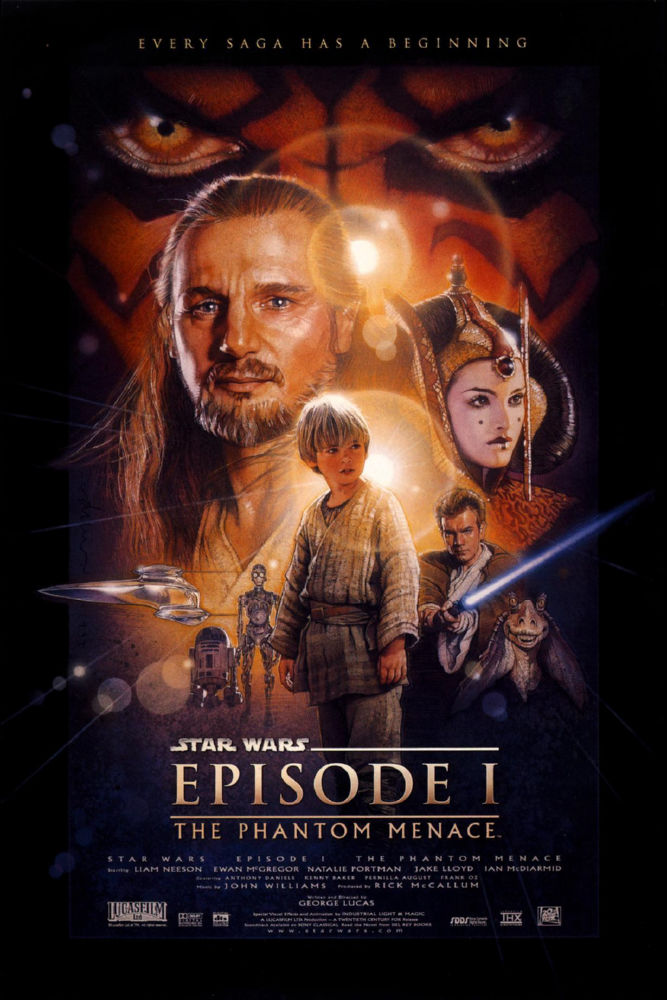
Jedi Master Qui-Gon Jinn and his apprentice shield Naboo from a Trade Federation invasion while uncovering Sith involvement and meeting a gifted slave boy named Anakin.
Star Wars: The Phantom Menace follows Qui-Gon Jinn, a Jedi Master sent with apprentice Obi-Wan Kenobi to end the Trade Federation blockade of Naboo. After the negotiators try to kill them, the Jedi flee with Gungan exile Jar Jar Binks and reach Queen Amidala as her capital falls. Needing parts, they land on Tatooine and meet young slave Anakin Skywalker, whose podracing skill and high midi-chlorian count convince Qui-Gon he is the prophesied Chosen One. Amidala travels to Coruscant seeking Republic aid while the Jedi sense a darker hand behind the invasion. Political delays force the queen to return home and fight for her people herself.
On Naboo the queen forges an alliance with the Gungans so their army can draw the droid forces into the open. Obi-Wan and Qui-Gon confront the Sith apprentice Darth Maul in the generator complex while Anakin accidentally joins the space battle above the planet. The boy destroys the droid control ship, shutting down the invasion army at the critical moment. Qui-Gon falls to Maul’s blade before Obi-Wan defeats the Zabrak warrior. In the aftermath the Jedi Council agrees to train Anakin, Amidala’s people celebrate liberation, and the surviving Sith lord continues his hidden plans for the Republic.
Oops! Is this show WOKE?
Only an account holder or member can file. Cite a scene, a line, or a pattern. Other account holders +1 or −1 that argument, once each. The show is not WOKE until enough of them have given a +1. Enough −1s remove the write-up, and it is no longer shown.
Sign in to file a woke label. One of each criterion per member.
Comments and reviews
Report a mistake
Same rule as woke labels: one report, a written reason, and the community +1 or −1 it — once per member. A net +5 applies the change. Editors can hold it for review, or apply it immediately.
No mistake reports yet.
Sign in to report a mistake. One report per field, per member.
Member review
Toni Briggs Member
Oct 16, 2026
★★★★★★★★★★I have split feelings about The Phantom Menace, and I am not going to pretend otherwise. It is a huge drop off from the original trilogy, and anyone who lived through the wait knows the sting of that. I still like it, mind. Enough of it works that I keep it in the rotation when I go through the saga in order, and I rated it a solid 3.5 because the good parts are real and the bad parts never quite kill the whole thing for me.
The casting is the clearest win. Liam Neeson gives Qui-Gon a calm weight that holds the middle of the movie together when the script starts wandering. Ewan McGregor already sounds like he belongs in the robe; you can hear the older Obi-Wan forming without him forcing it. I am not as annoyed by young Anakin as a lot of people are. Jake Lloyd is a kid playing a kid who happens to be the center of a prophecy, and some of the stiffness is the writing more than the performance. Padmé works for me too. Natalie Portman plays the dual role with more poise than the dialogue earns, and I actually care what happens to her side of the story even when the Senate scenes try to smother it.
That is the core problem. Too much of the runtime is spent establishing furniture for later films instead of telling a clean story in its own right. You get long stretches of political meetings that feel like someone left the procedural draft in the final cut, and the overreliance on CGI that looked ambitious in 1999 now sits on the screen like a layer of plastic. The Trade Federation blockade, the negotiations, the endless talk about taxation and treaties—none of it has the snap of a simple rescue or a clear chase. It is setup dressed as drama. When the movie remembers it is allowed to move, it suddenly feels alive again. The podrace is still a blast: loud, dangerous, and staged so you feel the speed instead of just being told about it. The final lightsaber work with Darth Maul is the reason a lot of us forgive the rest. Ray Park’s physicality and the dual blade give the duel a shape the dialogue never manages. Maul does not need monologues. He needs space to fight, and when he gets it the movie briefly becomes the thing people showed up for.
Jar Jar is the open wound everyone already knows about. I will not spend a thousand words on him, but the comic relief lands with a thud that pulls focus every time the story needs gravity. The midi-chlorians are worse in a quieter way. They take something mystical and turn it into a blood test. I understand the impulse to explain the Force for a new generation, but explanation is not the same as wonder, and that choice still bothers me on rewatches. The same goes for the tone whiplash—grand space opera one minute, broad pantomime the next—until you can feel the buzz of the opening drain away. I still remember the blast of John Williams’s horns and the crawl and the droidekas rolling in. That first stretch has real charge. Then the script starts talking like it was written to check boxes for the films that follow, and the charge leaks out.
I do not hate the movie for being a prequel. I mind that it often behaves like a corporate handoff memo with lightsabers attached. The virtuous Jedi leaning on a child to race so they can wager their way out of a jam sits wrong if you think about it for more than a second. The age gap awkwardness in the early Anakin–Padmé scenes does not help. None of that rises to the level of some modern checklist filmmaking; it is just clumsy. This is still Lucas chasing a kids-and-mythology tone and missing the mark more than he hits it. Yet the production design, the score, and those two set pieces keep me from writing it off. Neeson and McGregor sell the Jedi code better than the plot sells the stakes. Samuel L. Jackson, Terence Stamp, and the rest of the bench give the frame some texture even in small doses.
When I watch it now, I treat it as an uneven opening chapter rather than a sacred text. It introduces ideas it does not fully earn, undercuts its own mysticism, and wastes time in rooms full of bureaucrats. It also gives you Maul, a great podrace, and a pair of leads who make the Jedi feel like people instead of statues. That is enough for 3.5 from me. I would rather rewatch it than pretend the original trilogy never raised the bar. I would also rather keep the parts that still hum than join the pile-on that acts like nothing here works. It is flawed, often dull in the middle, and occasionally thrilling. Split feelings are the honest ones.