
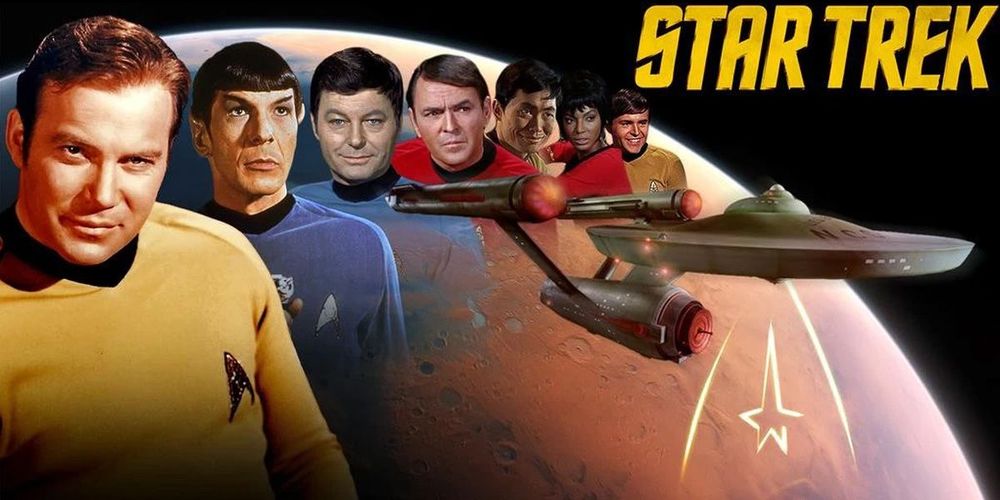



 TV · 1969
Star Trek (1966)
The 23rd century adventures of Captain James T. Kirk and the U.S.S. Enterprise (NCC-1701), a powerful interstellar spacecraft dispatched by Earth-based Starfleet Command to explore the galaxy. Kirk commands a crew of 430 men and women aboard his starship, which can travel at speeds surpassing the speed of light. Kirk’s five-year mission—and his mandate from Starfleet—is to seek out new life and new civilizations, and to boldly go where no man has gone before.
Oops! Is this show WOKE?
Only an account holder or member can file. Cite a scene, a line, or a pattern. Other account holders +1 or −1 that argument, once each. The show is not WOKE until enough of them have given a +1. Enough −1s remove the write-up, and it is no longer shown.
Sign in to file a woke label. One of each criterion per member.
Comments and reviews
Report a mistake
Same rule as woke labels: one report, a written reason, and the community +1 or −1 it — once per member. A net +5 applies the change. Editors can hold it for review, or apply it immediately.
No mistake reports yet.
Sign in to report a mistake. One report per field, per member.
Member review
June Pell Member
Oct 17, 2026
★★★★★★★★★★Star Trek from the late sixties still feels like a show that trusts its audience to keep up. I came to it in pieces over the years, not in some big rewatch binge, and what sticks with me is how cleanly it sets its own terms. You get a starship, a captain who actually leads, and a five-year stretch of going out there to look around. The premise is straightforward: explore, make contact, try not to wreck everything you find. That mandate has weight because the people carrying it out are allowed to be competent without needing a speech every week about why competence matters.
Kirk is the center in a way that still works. He is decisive, sometimes impulsive, often smarter than the situation first appears. He does not apologize for command. Spock and McCoy give him the friction he needs—logic pulling one way, gut and conscience the other—and the three of them form a working unit instead of a therapy circle. The rest of the crew fills in with real jobs. Scotty keeps the ship alive. Uhura runs communications like it is serious work. Sulu and Chekov are there because the bridge requires people who know what they are doing. Nobody is filling a slot for the sake of a photo. That quiet professionalism is part of why the show still lands for me.
I will admit I sometimes drift when an episode leans too hard on the monster-of-the-week or the planet that looks exactly like a backlot. The production limitations are obvious now. The colors are bright in a way that can tip into artificial, and some of the alien cultures feel sketched rather than lived-in. Yet the best hours push past that. They ask what happens when you meet something that does not share your rules, or when your own rules start to look thin under pressure. The show is willing to let Kirk argue a point and win or lose on the merits instead of on identity checkboxes. It treats curiosity as a virtue and restraint as a hard-earned skill. That combination feels rarer the longer you look at later television.
There is an optimism running underneath that never turns soft. The Federation is not perfect, and Starfleet officers make messes. They also clean them up when they can. The five-year mission is not a vacation or a guilt tour. It is work. I like that the series never seems embarrassed by the idea that human beings—and the other beings they meet—might improve by contact rather than by constant self-flagellation. You can watch an episode and feel the pull of the unknown without being told the unknown is mainly a mirror for your worst traits. When the stories do turn inward, they usually do it through character choices, not through a lecture inserted sideways.
I catch myself thinking about the ship itself more than I expect to. The Enterprise is a place with routines and a clear hierarchy. People know their stations. When something goes wrong, the response is technical and tactical first, emotional second. That order of operations still feels adult to me. Modern shows often reverse it and then wonder why the stakes go mushy. Here the danger is external more often than not—space is large and unfriendly—and the crew’s job is to meet it with skill. The moral questions arrive after the immediate problem is contained, which is how real pressure tends to work.
A short side path: I once spent an afternoon reading about actual deep-space probes and the quiet absurdity of sending metal boxes out past the planets with almost no chance of ever hearing back. The scale is humbling in a clean way. Star Trek takes that scale and gives it faces and arguments and the occasional fistfight, which is a cheat, of course, but a useful one. It lets you feel the distance without drowning in it. Then you come back to Kirk on the bridge deciding whether to risk the ship for one life or for a principle, and the distance shrinks into something human-sized again.
Not every episode earns its keep. Some lean on formula until the formula creaks. A few of the social-issue hours are heavy-handed even by the standards of their time. I do not need the show to be flawless to keep returning to it. What I need is the sense that the people making it believed exploration was worth the trouble and that character could carry the weight of big ideas without collapsing into slogans. On that score it holds up better than a lot of shinier later efforts. The performances are committed. The central trio still crackles. The ship still feels like a place you could almost work.
I rated it four stars because the highs are genuinely high and the baseline is sturdy enough that the weaker entries do not erase the whole. It is not sacred text. It is a television series that set out to go somewhere and, more often than not, arrived with something worth saying. Watching it now, I still get the same small lift from the idea that a crew could be sent out with orders to look, listen, and try to understand before they start rewriting everything they find. That remains a solid way to spend an hour.