
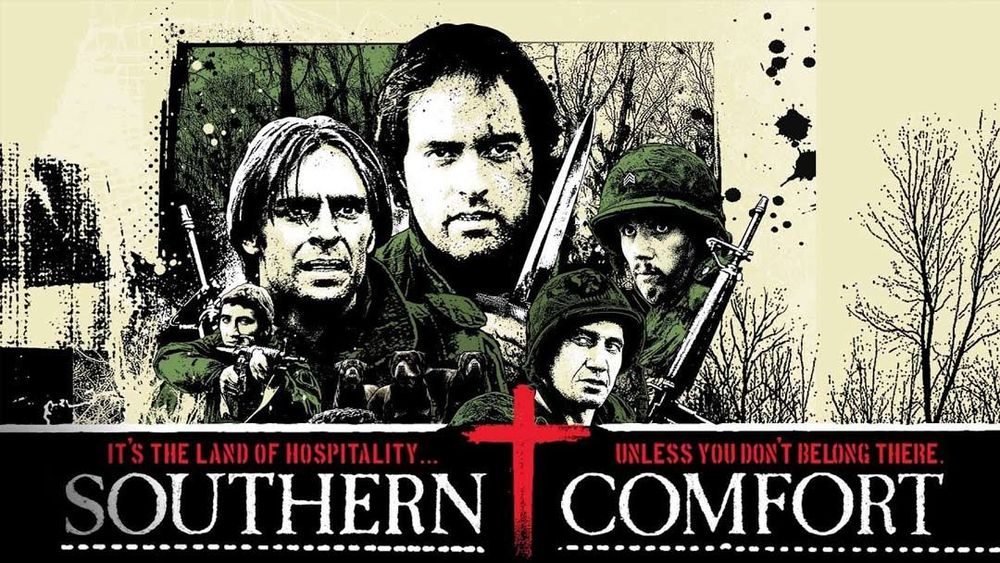



 MOVIE · 1981
Southern Comfort (1981)
A Louisiana National Guard squad on a weekend bayou exercise steals canoes, sparks a deadly feud with local Cajuns, and must fight to survive the swamp.
Southern Comfort follows Guardsman Spencer, a level-headed soldier stuck with a mismatched squad on what should be a routine training weekend in the Louisiana wetlands. Lieutenant Casper leads the men, including hard-edged Hardin, volatile Reece, and the rest of the unit, as they move through the bayou with blank ammunition and little real preparation. When the group “borrows” Cajun canoes without permission and one soldier shoots a local’s dog, the isolated community turns hostile. The Guardsmen quickly lose their bearings, their map, and any sense of control. What begins as an exercise becomes a running fight against an enemy who knows every channel and thicket. Spencer and Hardin emerge as the pair most able to keep thinking while the others panic or lash out.
As the Cajuns close in, the squad fractures under fear, bad decisions, and the swamp itself. Men are picked off one by one; trust erodes and leadership collapses. Spencer tries to hold a line of reason while Hardin pushes for ruthless survival tactics. The remaining soldiers push toward any sign of civilization, haunted by the knowledge that their own arrogance started the bloodshed. Alliances shift, ammunition runs short, and the bayou offers no clean escape. By the time Spencer and Hardin reach the edge of the conflict, the exercise has become a raw test of who can endure the consequences of the unit’s first mistakes.
Creator: Walter Hill · IMDb
Oops! Is this show WOKE?
Only an account holder or member can file. Cite a scene, a line, or a pattern. Other account holders +1 or −1 that argument, once each. The show is not WOKE until enough of them have given a +1. Enough −1s remove the write-up, and it is no longer shown.
Sign in to file a woke label. One of each criterion per member.
Comments and reviews
Report a mistake
Same rule as woke labels: one report, a written reason, and the community +1 or −1 it — once per member. A net +5 applies the change. Editors can hold it for review, or apply it immediately.
No mistake reports yet.
Sign in to report a mistake. One report per field, per member.
Member review
June Pell Member
Oct 16, 2026
★★★★★★★★★★Southern Comfort sits with me in a way that a lot of weekend-warrior stories never quite manage. I put it at 3.5 because the parts that work stay with you, while the stretch in the middle lets some air out of the tension. Keith Carradine and Powers Boothe carry a quiet competence that feels earned rather than announced. You watch these Guardsmen start out loose and a little cocky on what should have been a simple exercise, and then the swamp closes in. The choice to leave them without live rounds is the smartest thing the movie does. It forces every decision into a narrower space. They are armed for show and suddenly the show is over.
What I keep coming back to is how the film treats the Louisiana bayou as its own character. It is not scenery. The water, the cypress knees, the way sound travels differently out there—it all works on the men the same way the heat and the unknown worked on soldiers a decade earlier. The parallel to Vietnam is plain without being hammered. No one stands up and makes a speech about it. You just feel the same isolation, the same sense that the map no longer matches the ground. I grew up around enough back-country types to recognize when a story respects the people who live in hard places. The Cajuns here are not cartoon villains. They are angry for a reason that makes sense once you see how the Guardsmen treated their canoes and their territory. That does not excuse what follows, but it keeps the conflict from turning into simple good-guys-versus-bad-guys.
There is a stretch after the first real clash where the movie seems to circle. You get the sense the writers knew they had a strong setup and were filling time before the next escalation. A couple of the supporting Guardsmen blur together; I had to remind myself who was who once the group started thinning out. Still, Boothe’s character stays sharp. He has that practical edge, the man who understands the situation has already gone past the point of talking it out. Carradine plays the other side of the coin—more reflective, still trying to find a line that will not get everyone killed. Their scenes together give the film its center.
I caught myself thinking about how rare it is now to see a story that lets ordinary men be both capable and badly out of their depth without turning them into symbols. Nobody is here to lecture about manhood or the military. The Guardsmen make dumb choices and then have to live with the results. Some of them freeze. Some of them adapt. The movie does not punish them for being men; it just drops them into a place that does not care what they are. That feels cleaner than a lot of more recent films that feel obligated to explain the moral of every action.
The violence, when it comes, is sudden and ugly in the right way. It is not stylized. You feel the weight of the environment more than any particular weapon. The locals know the ground; the Guardsmen do not. That imbalance drives everything after the canoes are taken. I liked that the film never softens the cost. People get hurt in ways that stick. At the same time, it never tips into pure exploitation. There is a grim logic to the pursuit that keeps it from feeling random.
One small side path: I watched this on a rainy afternoon when the windows were fogged and the house was quiet, and the sound design did half the work. The insects, the water, the occasional distant shot—those details matter more than any big set piece. When a film trusts atmosphere that much, I tend to forgive the softer middle. It reminded me of other older outdoor thrillers that understood place first and plot second. Not everything needs to race.
By the end I felt the movie had earned its bleakness without wallowing. It leaves you with the sense that some lines, once crossed, cannot be uncrossed, and that an exercise can stop being practice the moment real stakes appear. I would not call it perfect. A tighter second act and a clearer sense of a couple of the secondary characters would have pushed it higher. But the core holds. Carradine and Boothe make the fear and the stubbornness feel human. The swamp does the rest. For a film that came out more than forty years ago, it still knows how to put you in a place you would rather not stay. That is worth the time, even if I am not rushing to revisit it every year. It sits at that honest 3.5 for me—solid, pointed, and just flawed enough to feel like it was made by people who were figuring it out as they went, much like the men on screen.