



 TV · 2022
Son of a Critch
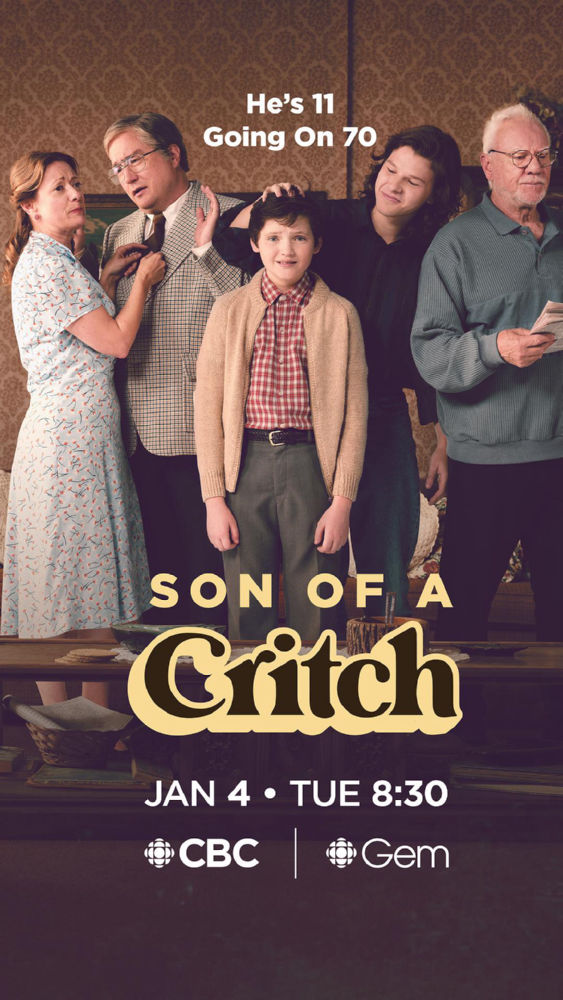
It's a heartfelt window into the life of a child - much older inside than his 11 years - using comedy and self-deprecation to win friends and connect with the small collection of people in his limited world.
Set in 1980s Newfoundland, young Mark Critch navigates the challenges of adolescence against the backdrop of his quirky family and colorful community. Mark's misadventures range from navigating his parents' eccentricities to dodging school bullies. His coming-of-age journey intertwines with the broader societal changes of the era, offering humor and heart in equal measure.
As Mark grapples with family dynamics and the complexities of growing up, viewers are treated to a nostalgic yet fresh perspective on the universal trials of youth. Through laughter and poignant moments, "Son of a Critch" captures the essence of an unforgettable upbringing.
Oops! Is this show WOKE?
Only an account holder or member can file. Cite a scene, a line, or a pattern. Other account holders +1 or −1 that argument, once each. The show is not WOKE until enough of them have given a +1. Enough −1s remove the write-up, and it is no longer shown.
Sign in to file a woke label. One of each criterion per member.
Comments and reviews
Report a mistake
Same rule as woke labels: one report, a written reason, and the community +1 or −1 it — once per member. A net +5 applies the change. Editors can hold it for review, or apply it immediately.
No mistake reports yet.
Sign in to report a mistake. One report per field, per member.
Member review
June Pell Member
Oct 19, 2026
★★★★★★★★★★Son of a Critch settled into my week in a quiet way that surprised me. I put it on expecting a light Canadian comedy about a kid growing up in the 1980s, and it turned out to be something more specific and more honest than that. The central figure is young Mark, eleven on the outside but carrying himself like someone who has already done a fair bit of observing. He uses jokes and a certain self-deprecating slant to make space for himself among a small circle of people—family, classmates, the odd neighbor—and that approach feels true rather than performed. You watch him figure out how to belong without losing the private version of himself, and the show never rushes the process.
What works best is the texture of the place and the time. Newfoundland in that decade comes across as a real limited world, not a postcard. The family quirks land because they are allowed to be ordinary irritations and comforts at the same time. Parents who are eccentric without becoming cartoons, a community that is colorful but not endlessly quirky for effect. Mark’s misadventures with school bullies and the slow navigation of his parents’ habits feel like the kinds of things that actually stick with a person later. There is comedy, yes, but it sits next to quieter moments where you see him measuring the distance between who he is inside and what the room expects. That balance kept me watching even on nights when I only meant to do one episode.
I kept thinking about how rare it is to see a child character treated this way—much older inside than the calendar says, yet still recognizably eleven. The writing trusts the audience to notice the gap without underlining it. Self-deprecation becomes his tool for connection, and it never tips into the kind of forced charm that makes you roll your eyes. Instead it feels like a practical strategy for a kid whose world is small and whose observations are already sharp. The broader backdrop of the era—social shifts, local habits, the slow way news and fads reached places like that—gives the personal story room to breathe without turning into a history lesson. You get the sense of an upbringing that was unforgettable for him precisely because it was so particular.
One short side path I went down while watching: I remembered being around that age and realizing that some of the adults in my own orbit were still figuring things out themselves. The show captures that recognition without making it heavy. Mark sees the adults clearly, sometimes more clearly than they see themselves, and the humor softens the edges so it never becomes cruel. That felt right to me. Coming-of-age stories often either over-sentimentalize the past or sneer at it; this one mostly just sits with it. There are nostalgic touches, sure—the clothes, the references, the rhythm of school and home—but they serve the character rather than the other way around. You leave an episode thinking about how he will carry those years forward, not about how cleverly the production designer recreated a kitchen.
It is not perfect. A few supporting characters stay a little thin, and occasionally an episode leans harder on the fish-out-of-water gag than it needs to. The pacing sometimes settles into a comfortable groove that risks becoming predictable if you binge too many in a row. Still, those are small complaints against the larger effect. The heart is genuine. The comedy grows out of character instead of being pasted on top. And the portrait of a limited world that still feels full—because it is full to the kid living inside it—stays with you. I rated it a four because it earns the affection it asks for without demanding more. It is a solid, warm series that knows what it is doing and mostly does it well. If you have any soft spot for stories about growing up in a place that feels both protective and confining, this one will sit comfortably on that shelf. I finished the available episodes glad I had spent the time, and that is the simplest measure I trust.