



 MOVIE · 1996
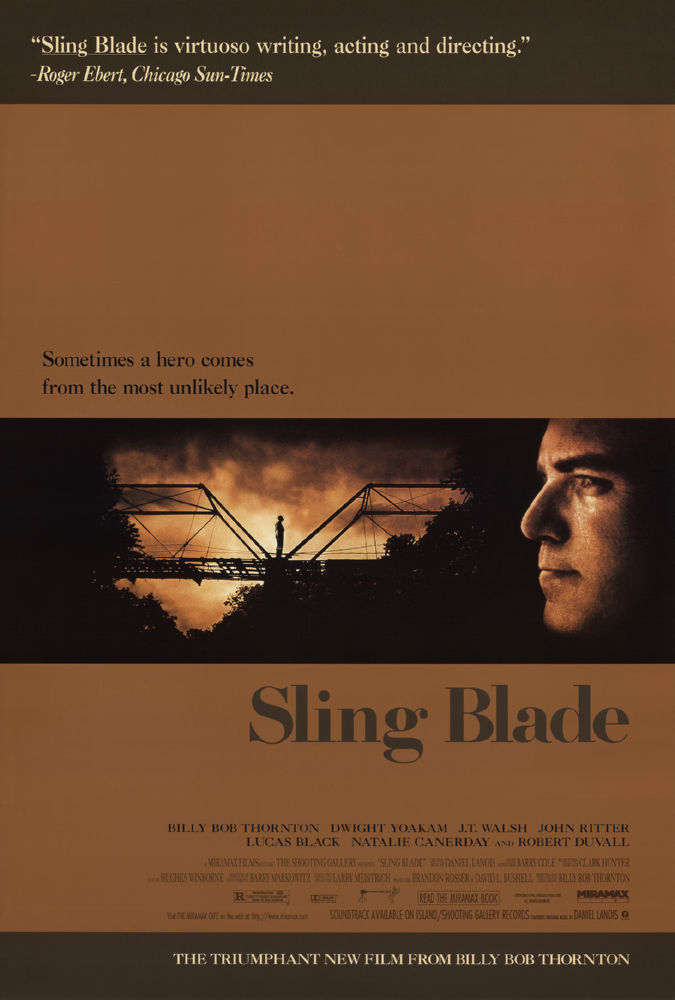
Sling Blade
25 Years after committing an unthinkable crime, a quiet man named Karl(Thornton) finally returns home. Once there, he's befriended by a fatherless boy and his mother. But when his newfound peace is shattered by the mother's abusive boyfriend, Karl is suddenly placed on a collision course with his past!
Oops! Is this show WOKE?
Only an account holder or member can file. Cite a scene, a line, or a pattern. Other account holders +1 or −1 that argument, once each. The show is not WOKE until enough of them have given a +1. Enough −1s remove the write-up, and it is no longer shown.
Sign in to file a woke label. One of each criterion per member.
Comments and reviews
Report a mistake
Same rule as woke labels: one report, a written reason, and the community +1 or −1 it — once per member. A net +5 applies the change. Editors can hold it for review, or apply it immediately.
No mistake reports yet.
Sign in to report a mistake. One report per field, per member.
Member review
June Pell Member
Oct 6, 2026
★★★★★★★★★★Sling Blade sat with me longer than I expected it to. I put it on one evening mostly because the title had floated around in the back of my mind for years, and I finally had the quiet stretch of time it seemed to ask for. Billy Bob Thornton’s Karl is the kind of performance that doesn’t grab you by the collar. He just arrives, speaks in that careful, measured way, and the whole room adjusts around him. You feel the weight of what he’s done before the movie ever spells it out, and somehow that weight never turns into cheap dread. It just stays present, like weather.
What got me was how little the film rushes. Karl comes back to the place that made him and doesn’t try to reinvent himself or apologize his way into acceptance. He works. He listens. He ends up near a boy who needs someone steady and a mother who’s trying to keep a household from collapsing under ordinary pressure. The friendship that forms there isn’t staged as some big redemption arc with swelling music. It’s smaller and stranger than that. Two people who don’t quite fit the usual shapes of talk find a rhythm with each other, and you start to care about the quiet evenings and the simple meals more than you care about any big confrontation waiting down the road.
I kept thinking about the way the movie handles damage. Karl’s past is monstrous by any normal measure, yet the film never asks you to pretend it didn’t happen or to treat it as a quirky backstory. At the same time it refuses to make him a walking warning sign. He has a code. It isn’t pretty or fully explained, but it’s consistent, and that consistency becomes its own kind of gravity. When the mother’s boyfriend starts taking up more space—loud, entitled, the kind of man who confuses volume with authority—you feel the old collision course starting to form without anyone having to underline it. The danger doesn’t come from stylized villainy. It comes from someone who thinks the house and the people in it belong to him by default.
There’s a side path I went down while watching that I still can’t quite shake. I used to know a man who fixed small engines for a living and barely spoke more than a dozen words a day. People called him simple and left it at that. After he died I learned he’d once done something that cut him off from his own family for decades. Nobody in town ever put the two pieces together in public. Sling Blade doesn’t moralize about that kind of silence, but it understands the cost of it. Karl’s limited speech isn’t a gimmick for the camera. It forces everyone else—and the audience—to slow down and meet him where he is. You start hearing the pauses as part of the conversation.
The boy’s presence keeps the whole thing from tipping into pure gloom. He isn’t written as a wise little prophet or a project for Karl to complete. He’s just a kid who likes having someone around who doesn’t yell or vanish. Their scenes together have a plainness that feels rare now. No montages of bonding, no speeches about found family. Just sitting, fixing things, walking. I found myself protective of those stretches, the way you get protective of a calm afternoon you know can’t last.
Dwight Yoakam’s character works because he never quite becomes a cartoon. He’s mean in the ordinary, exhausting way some people are mean—the kind that wears everyone down until resistance starts to look like the only option left. The movie doesn’t lecture about manhood or violence; it just lets the pressure build until Karl’s particular way of seeing the world collides with it. I won’t pretend the ending left me comfortable. It didn’t. But comfort isn’t what this story is selling. It leaves you with the sense that some acts close a circle that was never going to close any other way, and that the people left behind have to live with the shape of that circle.
Technically the film stays out of its own way. The photography is straightforward, the score never elbows in, and the editing gives faces room to just exist. Thornton wrote it as well as starred, and you can feel a single stubborn vision holding the tone steady. Nobody is trying to make Karl lovable in a conventional sense. They’re trying to make him legible, which is harder and more interesting. I rated it four stars because the patience pays off and the central relationship feels earned, not manufactured. A few supporting beats land a little square, and once or twice the dialogue tips toward explaining what the silence already showed, but those are small complaints against something that mostly trusts its audience to sit still and pay attention.
I keep returning to the idea of home in this movie—not as a warm place you recover, but as a set of rooms and streets that remember what you did and still have to decide whether you get to walk them again. Karl doesn’t demand forgiveness. He just tries to be useful. That choice, more than any speech, is what stays with me. In a time when a lot of stories hurry to declare their morals out loud, Sling Blade stays quiet long enough for the moral weight to arrive on its own. I finished it later than I meant to, sat in the dark for a bit, and felt like I’d spent the evening with someone real rather than with a collection of points someone wanted to score. That’s rare enough that I’m glad I finally made the time.