
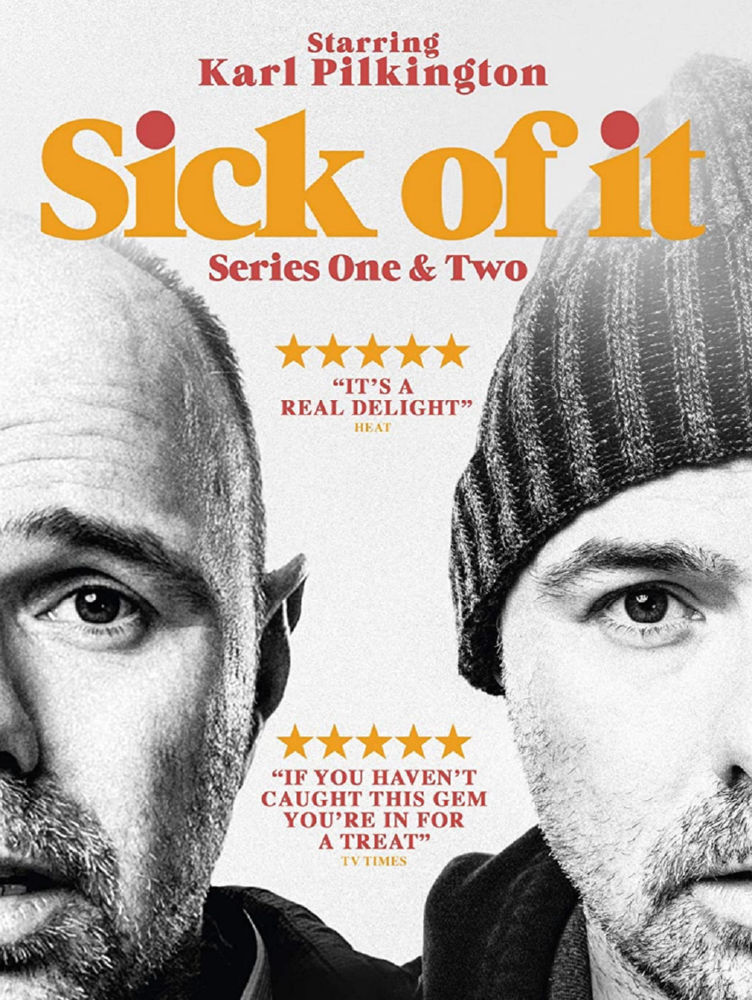



 TV · 2018
Sick of It
After his girlfriend leaves him, middle-aged Karl moves in with his elderly aunt and spends most of his time bickering with a blunt doppelgänger version of himself. The series follows his awkward attempts to fix his life while that inner critic refuses to shut up.
Sick of It follows Karl, a middle-aged man freshly dumped by his long-term girlfriend and stuck living with his elderly Auntie. His closest companion is not a friend or neighbor but a doppelgänger alter ego who looks exactly like him and never stops pointing out how pathetic his choices are. Karl drifts through ordinary days—odd jobs, half-hearted social plans, and domestic routines—while the other Karl needles him about laziness, loneliness, and missed chances. Auntie provides a steady, no-nonsense household backdrop as Karl tries, and often fails, to pull himself together. The show stays close to his small world of frustrations, habits, and self-sabotage rather than sprawling plot machinery.
As the series continues, Karl keeps testing small changes—new routines, tentative connections, and attempts to prove the alter ego wrong—only to slide back into familiar patterns. The doppelgänger remains a constant presence, turning everyday errands and conversations into arguments about what Karl should want and who he has become. Relationships around him, including his bond with Auntie and brief brushes with other people, highlight how stuck he feels after the breakup. Later turns push him into slightly bigger decisions about independence and self-respect, still filtered through the same dry, self-critical humor. The story stays grounded in Karl’s limited circle and the running duel with himself rather than outside crusades or lecture beats.
Click any of the following icons below to rent or stream it!
Oops! Is this show WOKE?
Only an account holder or member can file. Cite a scene, a line, or a pattern. Other account holders +1 or −1 that argument, once each. The show is not WOKE until enough of them have given a +1. Enough −1s remove the write-up, and it is no longer shown.
Sign in to file a woke label. One of each criterion per member.
Comments and reviews
Report a mistake
Same rule as woke labels: one report, a written reason, and the community +1 or −1 it — once per member. A net +5 applies the change. Editors can hold it for review, or apply it immediately.
No mistake reports yet.
Sign in to report a mistake. One report per field, per member.
Member review
June Pell Member
Oct 19, 2026
★★★★★★★★★★I put on Sick of It mostly because the premise sounded like something I would actually sit through on a weeknight: a middle-aged bloke gets dumped, ends up at his aunt’s, and has to share the house with a version of himself who will not stop talking. That setup is simple enough that it could have gone soft or turned into pure sketch-show padding. It does neither, at least not all the time, and that is why I landed at 3.5 instead of something lower.
Karl is ordinary in the way a lot of people really are after a long relationship ends. He is not broken in a dramatic sense; he is just stuck, a bit lazy, and suddenly living under someone else’s roof again. The aunt is the steady part of the frame. She has her routines and her blunt practicality, and the show lets her sit there without turning her into a joke generator or a fountain of wisdom. That choice keeps the domestic scenes from floating off into sitcom air. Most of the time Karl is just moving through the day—odd jobs, half-plans with people he half-knows, small decisions that never quite become momentum. The other Karl is always there for those moments. He looks exactly like him and sounds like the voice you hear when you have already disappointed yourself twice before lunch. The bickering is the engine. It is not clever wordplay; it is closer to the way a person talks himself out of trying anything new because the safer option is to stay put and complain about it.
What works is how little the series reaches for bigger stakes. There is no grand redemption arc waiting in the wings. Karl tries things, botches some of them, and the double is right there to name the failure in plain language. I found that more honest than a lot of comedy about “finding yourself.” The show stays inside a small radius—house, local spots, the same handful of faces—and that limited geography makes the self-criticism feel heavier. You cannot escape the doppelgänger by changing cities or starting a new career overnight. He is already in the kitchen. There is a stretch in the middle where the jokes start to circle the same drain: Karl avoids effort, the other Karl calls him pathetic, Auntie carries on. It is funny the first few times and then it becomes the texture of the show rather than a fresh hit. That is part of why I did not go higher than 3.5. The concept is strong enough to carry whole episodes, yet the rhythm can feel locked in place once you know the pattern.
I kept thinking about how many people end up in some version of this living arrangement without the comic double. You move back in with family, or you stay longer than planned, and the silence in the house starts to feel like judgment. Sick of It just makes the judgment walk around and open the fridge. That side thought pulled me away for a minute, but it actually helps explain why the series lands for me. It is not aspirational. It does not pretend that a few good choices will reset a decade of drift. Karl’s attempts to fix things are awkward because they are half-hearted, and the show does not punish him with melodrama for that. It just lets the other version of him keep the ledger. The humor stays dry and a little mean without becoming cruel for its own sake. You can feel the writers trusting the audience to recognize the pattern from their own lives rather than spelling out the psychology.
Performance-wise, the dual role is the obvious hook, and it holds up better than it has any right to. The physical sameness is used for timing more than for spectacle. A look, a pause, a muttered correction—those land harder than big set pieces would. Supporting characters stay secondary, which is the right call. This is not an ensemble show pretending to be about one man’s head. It is about one man’s head, full stop. The aunt’s household rules and quiet presence give the whole thing a floor to stand on so it does not tip into pure internal monologue.
I would not call it essential, and I would not rewatch it every year. Some episodes thin out once the novelty of the double settles. Still, there is a steady intelligence in how little it flatters its lead. Karl is not secretly brilliant or secretly kind under a grumpy shell. He is exactly as limited as the voice in his ear says he is, and the comedy comes from watching him live with that fact instead of conquering it. That is rarer than it should be. The series never expands into something larger than its premise, and that restraint is both its strength and the reason it sits at a solid but unspectacular 3.5 for me. It knows the size of the room it is in and mostly stays there, needling away at the same uncomfortable truths without needing a big finish. If you have ever argued with yourself in an empty kitchen, you will recognize the tone immediately. If you have not, the show will still make the argument plain enough.