



 MOVIE · 1992
Scent of a Woman
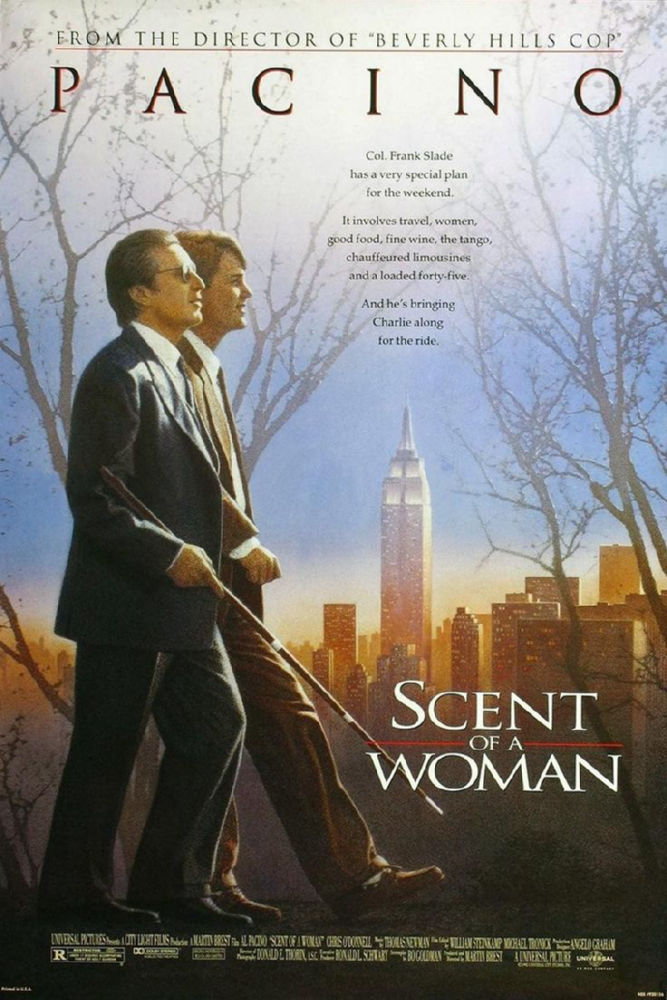
Al Pacino won his first Best Actor Oscar® for his brilliant portrayal of an overbearing, blind retired Lieutenant Colonel who hires a young guardian (Chris O'Donnell), to assist him. It's a heart-wrenching and heartwarming tale of opposites attracting when they embark on a wild weekend trip that will change the lives of both men forever.
Oops! Is this show WOKE?
Only an account holder or member can file. Cite a scene, a line, or a pattern. Other account holders +1 or −1 that argument, once each. The show is not WOKE until enough of them have given a +1. Enough −1s remove the write-up, and it is no longer shown.
Sign in to file a woke label. One of each criterion per member.
Comments and reviews
Report a mistake
Same rule as woke labels: one report, a written reason, and the community +1 or −1 it — once per member. A net +5 applies the change. Editors can hold it for review, or apply it immediately.
No mistake reports yet.
Sign in to report a mistake. One report per field, per member.
Member review
Wes Calder Member
Oct 6, 2026
★★★★★★★★★★Scent of a Woman is the kind of picture you put on because nothing else is on, and then you stay with it longer than you planned. I did that again recently. Four stars is where it lands for me, and I don’t feel the need to talk myself into a higher number.
Charlie Simms is a scholarship kid at a prep school who needs cash over Thanksgiving. He takes a short job looking after a blind retired colonel staying with relatives. The expectation is quiet duty and a paycheck. Frank Slade has other ideas. He is irritable, depressed, and not interested in being managed. He decides the weekend belongs to New York, and Charlie goes along because the alternative is worse and because the older man has a way of framing hesitation as a failure of nerve.
Pacino’s Slade is loud in the ways that matter and quiet in the ones that count. The voice work, the sudden shifts from courtly manners to pure meanness, the appetite for things he can no longer fully enjoy—it could have become a stunt. It doesn’t, quite. You get the sense of a man who has already lost the better part of his life and is testing whatever is left. Chris O’Donnell plays Charlie without pushing. The kid is trying to keep his place at school and his sense of himself intact at the same time. The performance stays out of the way of that tension, which is the right call.
The city stretch is where the movie lives. Hotel rooms, restaurants Charlie can’t afford, a car that should not be driven by a blind man, a tango that shouldn’t work and somehow does. Slade is chasing a kind of freedom that looks a lot like self-destruction. Charlie is trying to keep the colonel alive and himself out of trouble. Their codes of honor start to overlap even as their temperaments scrape against each other. I like that the film doesn’t tidy this up into a neat lesson. Slade is often impossible. Charlie is often scared. Both still have a line they won’t cross, and the story is interested in what happens when that line gets tested.
The prep-school subplot—vandalism, pressure to name names, the threat to a scholarship—sits in the background until it has to matter. It connects without feeling bolted on. Both men are being asked to trade integrity for comfort. Neither wants to, and the movie respects that stubbornness more than it explains it. I don’t need the final hearing scene to run as long as it does. Pacino can carry a speech, and he does, but the point had already been made in smaller moments. Still, the film earns most of its runtime. It doesn’t rush the relationship, and it doesn’t apologize for the roughness in it.
There is a quality here that feels slightly out of step with a lot of what came later. Nobody is fixed by a group process. Character is treated as something you either bring or you don’t. Despair is allowed to look ugly. Appetite is allowed to look reckless. The movie doesn’t pause to instruct you on how to feel about any of it. That restraint helps. When Slade is at his worst, you still understand why Charlie doesn’t walk out. When Charlie is at his most cautious, you see why Slade keeps needling him. The push and pull holds the weaker patches together.
I have watched it enough that certain beats arrive before the dialogue does. That can kill an older film. Here it mostly doesn’t. The central pairing is strong enough to carry the familiar stretches. Supporting parts are thinner than they need to be, and a couple of school scenes lean on stock types. Those are real limits. They don’t sink the thing. The relationship at the center has weight, and the film has a spine. It treats honor as costly rather than decorative, which is rarer than it should be.
I wouldn’t call it flawless, and I wouldn’t climb on a chair about it. It works. The performances stay honest more often than not. The weekend in New York still has charge. On a quiet night I will put it on again without needing a better reason than that it continues to hold. Four stars feels accurate—high enough to mark the craft and the nerve, low enough to leave room for the parts that run long or sit thin. That is where I leave it.