
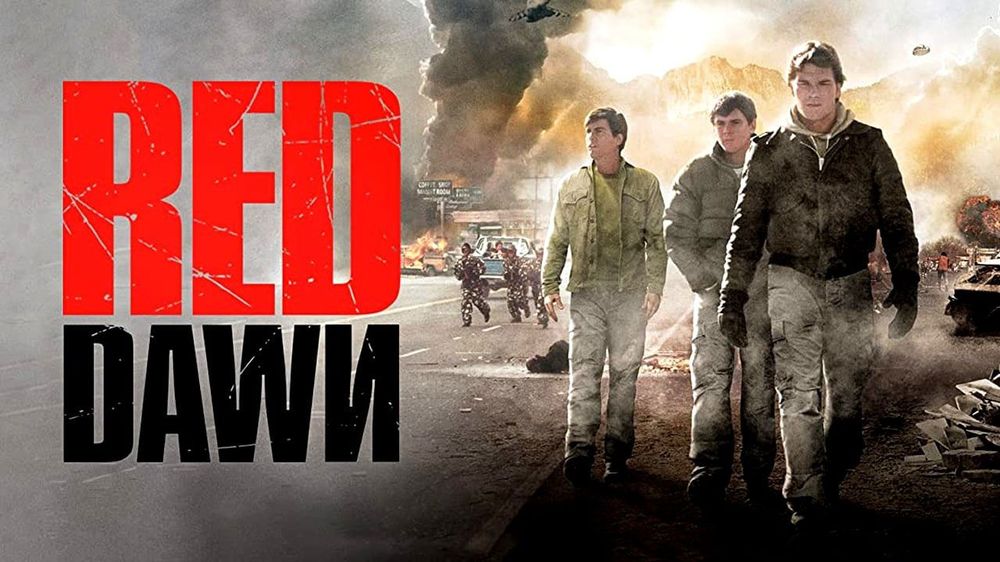



 MOVIE · 1984
Red Dawn (1984)
Red Dawn (1984) is an homage to Emile Reynaud, the first man to project animated films on a public screen.
Red Dawn (1984) follows Emile Reynaud as he pioneers the projection of animated films for public audiences. His early experiments with moving images mark a turning point in visual storytelling. The narrative traces the technical hurdles he overcomes to stage the first public screenings. Reynaud's persistence drives the central events of the story.
Later sequences show how his inventions spread and influenced emerging filmmakers. The film depicts the excitement and limitations of his era's technology through concrete demonstrations of his devices. Relationships with contemporaries highlight the collaborative aspects of early animation development.
Creator: Sándor Békési · IMDb
Oops! Is this show WOKE?
Only an account holder or member can file. Cite a scene, a line, or a pattern. Other account holders +1 or −1 that argument, once each. The show is not WOKE until enough of them have given a +1. Enough −1s remove the write-up, and it is no longer shown.
Sign in to file a woke label. One of each criterion per member.
Comments and reviews
Report a mistake
Same rule as woke labels: one report, a written reason, and the community +1 or −1 it — once per member. A net +5 applies the change. Editors can hold it for review, or apply it immediately.
No mistake reports yet.
Sign in to report a mistake. One report per field, per member.
Member review
Wes Calder Member
Oct 16, 2026
★★★★★★★★★★Red Dawn sits in that middle drawer of movies I can put on without expecting much and without feeling cheated when it ends. Three stars feels honest for it. The premise does most of the heavy lifting: Soviet, Cuban, and Nicaraguan troops drop onto a Colorado high school football field, the place comes apart in minutes, and a handful of teenagers scramble into the mountains with hunting rifles, pistols, and whatever else they can grab. They survive the winter, dodge KGB patrols, and eventually start hitting back under the Wolverines name. That is the whole engine, and it still turns over.
I first saw it young enough that the invasion felt like something that could actually happen next week. Watching it again years later, the same scenes play more like a product of their exact moment. The parachutes hitting the field still have a blunt force to them. The kids bolting for the trucks and the hills still reads as pure panic rather than movie bravado. After that opening, the film settles into a pattern of cold camps, short raids, and the slow realization that going home is not an option for a long while. Patrick Swayze and the rest of the young cast sell the hunger and the exhaustion better than they sell military genius. You believe they are scared and half-frozen. You believe less that a few high-schoolers with bows and deer rifles keep a real occupation force off balance for as long as the story wants.
The movie never pretends to be subtle about its politics. The invaders are the invaders, the kids fight because the alternative is worse, and the mountain country becomes both shield and prison. Guns here are tools, not symbols that need a sermon attached. That alone keeps the film from drifting into the kind of lecture that later versions of this material sometimes chase. When the group finally starts picking off patrols, the satisfaction is basic and a little grim. They are not trained. They make mistakes. People die in ways that feel more accidental than heroic. A few of those losses land harder than the broad strokes around them would suggest.
Pacing is where it loses me in stretches. There are long quiet passages of waiting out the weather, arguing over whether to keep fighting or try to find family, and staring at dwindling supplies. Some of that downtime gives the winter weight. Some of it just feels like the script marking time between the next ambush. The direction is workmanlike rather than sharp. You can spot the budget edges, the moments that settle for adequate rather than precise. The slogan gets repeated enough that it starts to feel like the film is trying to brand itself in real time. It worked, for better or worse. People still know the name.
What keeps the rating from dropping is the refusal to sand everything smooth. These are not super-soldiers. They are kids who hunted and played football and suddenly have to decide whether killing a patrol is survival or something darker. The film lets that question hang without resolving it into tidy speeches. The cold looks genuinely miserable. The occupied town feels small and watched. Those pieces give the fantasy a little grit. I never fully bought the strategic side of it, but I bought the fear and the stubbornness.
It is very much an artifact of 1984. Hair, clothes, the way the foreign troops are drawn, the straightforward belief that ordinary people would pick up what weapons they had and try. Later attempts at the same story updated the enemies and polished the surfaces and lost some of that bluntness. I prefer the original’s rough edges. It does not apologize for its premise and it does not dress the resistance up as something more sophisticated than it is. A group of teenagers in the high country, calling themselves after a school mascot, trying not to freeze or get caught. That is enough for the runtime.
I am not going to claim it is tightly constructed or that every performance carries equal weight. Some scenes hold. Others remind you how young the cast was and how much the script asked of them. The early scramble from the school remains the strongest stretch. Everything after that is a cycle of hide, strike, hide again, with the body count rising the way these stories require. Serviceable is the word that keeps coming back. It does the job it set out to do without a lot of extra ornament. For a Friday night when you want the plain version of an invasion story instead of the louder modern ones, it still works.
Three stars means I respect the nerve it had at the time and the basic charge of kids refusing to fold, while admitting the execution is uneven and the logistics strain belief. I would watch it again if it turned up late and nothing better was lined up. That is the right temperature for it. Not a film that demands revisits, not one that wastes the two hours either. It remains the straightforward Cold War resistance picture, winter and all, and that is about as much as it needs to be.