



 MOVIE · 1985
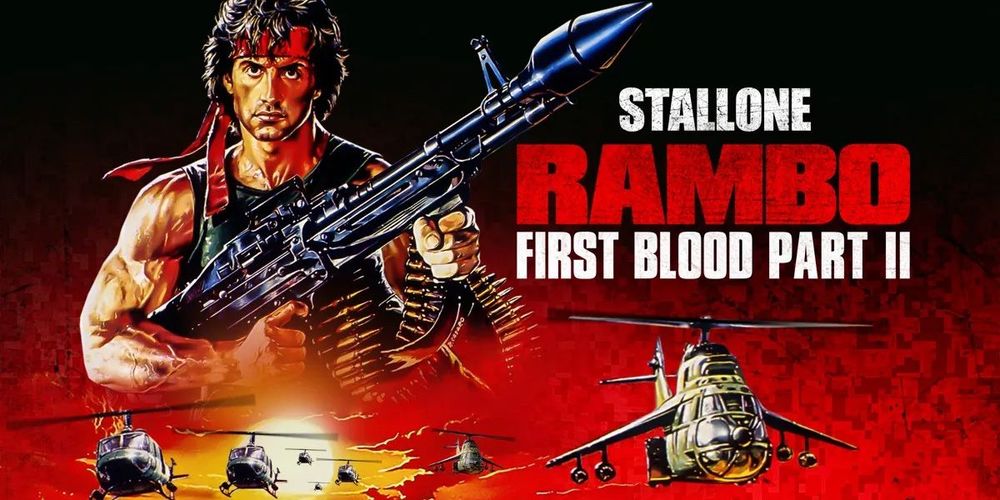
Rambo: First Blood II
John Rambo (Sylvester Stallone) is doing hard time in jail when his former boss, Col. Troutman (Richard Crenna), offers him a deal. If Rambo travels to Vietnam to try to find the American prisoners of war, his criminal record will be expunged. Rambo takes the reconnaissance assignment and agrees not to get involved in any of the action. However, when his Vietnamese lover, Co Bao (Julia Nickson), is killed by American forces, Rambo forgets his promise and takes matters into his own hands.
Oops! Is this show WOKE?
Only an account holder or member can file. Cite a scene, a line, or a pattern. Other account holders +1 or −1 that argument, once each. The show is not WOKE until enough of them have given a +1. Enough −1s remove the write-up, and it is no longer shown.
Sign in to file a woke label. One of each criterion per member.
Comments and reviews
Report a mistake
Same rule as woke labels: one report, a written reason, and the community +1 or −1 it — once per member. A net +5 applies the change. Editors can hold it for review, or apply it immediately.
No mistake reports yet.
Sign in to report a mistake. One report per field, per member.
Member review
Ray Okonkwo Member
Oct 16, 2026
★★★★★★★★★★Rambo: First Blood Part II sits in that odd middle ground where the first movie’s tight, bruised character work gets traded for something bigger, louder, and more deliberately comic-book. I don’t mean that as pure insult. The sequel knows what it is: a muscular guy with a knife and a bow, dropped back into Vietnam under thin official cover, told to take pictures and stay quiet, then refusing to stay quiet the second the mission turns rotten. That setup still works on a basic level. Stallone’s physical presence does a lot of the lifting before anyone fires a shot. You believe he can move through jungle and survive on scraps of gear because the camera treats his body like a working tool, not a statue.
The deal that gets him out of the stockade is simple enough. Trautman shows up with the usual mix of loyalty and government paperwork, and Rambo takes the assignment knowing the people running it from a distance do not want a real rescue. They want proof that can be buried. That cynicism is the one leftover piece of the first film that still has some bite. Charles Napier’s Murdock is the kind of smooth operator who smiles while he cuts the cord, and the movie is clearest when it lets that betrayal sit in the open. Rambo’s “no involvement” promise lasts about as long as you expect once Co Bao is in the picture and then gone. Julia Nickson plays her straight, without turning the role into a speech. Her death is the switch that flips the whole second half into pure one-man war, and while the logic is pure pulp, the anger lands because the film has already shown him being used.
What I keep coming back to is the texture of the action more than the body count. Jack Cardiff’s photography makes the green look wet and heavy, and Jerry Goldsmith’s score knows when to stay out of the way and when to push. The set pieces are efficient: the extraction that isn’t, the camp raid, the river and the helicopter work. Stallone and the stunt people sell the physical cost without turning every explosion into a joke. Berkoff’s Podovsky is cartoon-villain loud, which fits the tone once the gloves are off, even if he never feels like a real person so much as a pressure point the story needs. Martin Kove hovers on the edges in the way these movies often stock their military side characters—present, useful, not deep.
I am not going to pretend the jeopardy always holds. Once Rambo is fully unleashed, the enemy soldiers start behaving like they read the same script he did. They chase him through spaces that should get more people killed than the plot cares about, and the movie shrugs. That bothered me more than the body count itself. You can feel the film deciding that momentum matters more than consequence, which is fine for a Saturday night machine but undercuts the “noble cause” talk it keeps circling. The POW angle is treated as sacred and then used mostly as fuel. I wanted a little more weight on the men still in the cages and a little less on Rambo turning into weather.
There is a goofy side complaint I can’t quite shake either. In the middle of all the righteous fury and jungle warfare, the film has him grab food the hard way, and yes, that includes a chicken that did not sign up for the war. It is a tiny beat, almost throwaway, and yet it sits next to the speeches about abandoned men and it feels tonally weird. Not offensive—just the kind of detail that reminds you this is still a broad action picture first. If you came for quiet moral inquiry, you came to the wrong sequel. If you came for a guy who can turn a compound into a bad day for everyone who lied to him, you get what you paid for.
The cast around Stallone is better than the material strictly requires. Crenna still plays Trautman as the one adult who understands both the soldier and the machine that uses him. Their scenes together keep a thin line of humanity open even when the rest of the movie is busy stacking explosions. The writing, shared across a few names including Stallone and an early James Cameron pass, knows how to get from point A to the big set pieces without much fat. It does not hang about. That speed is a virtue when the alternative would be more speeches about how Washington forgot the war.
I rated it 3.5 because it delivers the checklist—muscle, cause, jungle combat, betrayal from above—without ever quite matching the leaner punch of the first film or rising into something sharper. It is highly entertaining in stretches and completely indifferent in others. The one-man-army fantasy is front and center, and the movie owns that. It does not pretend Rambo is a subtle operator after Co Bao dies; it lets him become the problem the system created and then tried to discard. That fantasy still scratches an itch for a lot of people, myself included on the right night. On other nights you notice how little real danger sticks to him once the arrows start flying and the bodies start dropping in neat patterns.
For what it is aiming at in 1985, the craft is solid. Direction by Cosmatos keeps the frames readable in the chaos. The editing does not linger for applause. You get in, you get the mission twisted, you get the revenge run, you get the confrontation that was always coming. I do not need it to be more “intelligent” than a strong pulp adventure, and the people who act like the chicken or the village flyovers are deep moral tests are mostly joking. Still, those little frictions keep me from treating the whole thing as airtight. It is a loud, confident sequel that knows its audience and feeds it exactly the shape of catharsis it wants, while quietly losing some of the first movie’s bruised soul along the way. That trade is worth making once. I just would not call it deeper than the gunfire and the green.
If you want the pure Rambo fantasy with a quality supporting cast and enough anger at the brass to give the explosions a motive, this is the one that locks the template in place. I like it more than I respect it, and that feels honest for a 3.5. It does what it came to do, then leaves the quieter questions for somebody else’s war movie.