
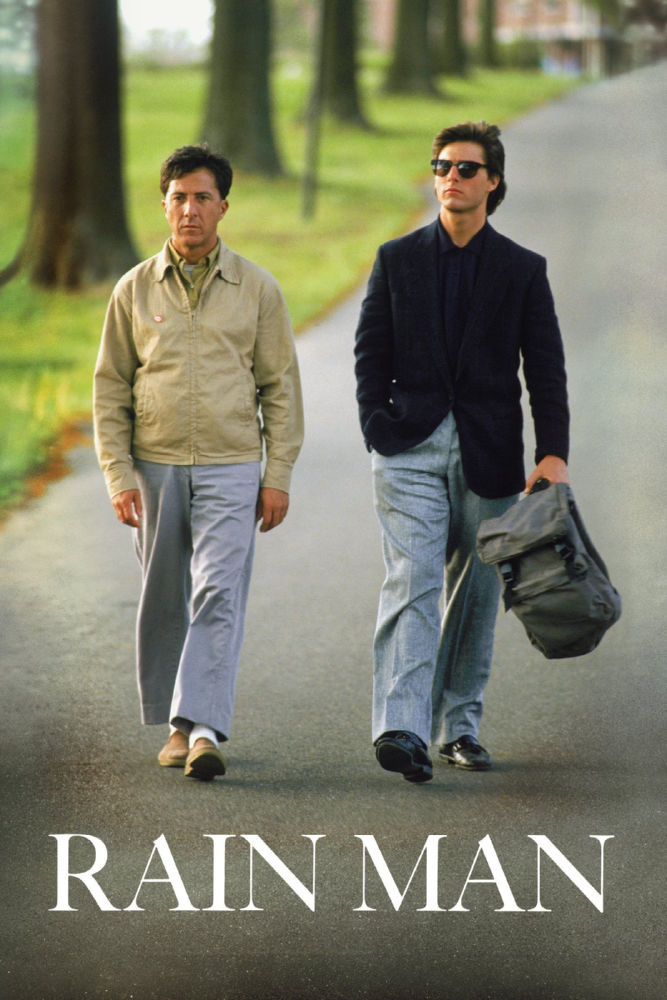



 MOVIE · 1988
Rain Man
After a selfish L.A. yuppie learns his estranged father left a fortune to an autistic-savant brother in Ohio that he didn't know existed, he absconds with his brother and sets out across the country, hoping to gain a larger inheritance.
When car dealer Charlie Babbitt learns that his estranged father has died, he returns home to Cincinnati, where he discovers that he has a savant older brother named Raymond and that his father's $3 million fortune is being left to the mental institution in which Raymond lives.
Motivated by his father's money, Charlie checks Raymond out of the facility in order to return with him to Los Angeles. The brothers' cross-country trip ends up changing both their lives.
Oops! Is this show WOKE?
Only an account holder or member can file. Cite a scene, a line, or a pattern. Other account holders +1 or −1 that argument, once each. The show is not WOKE until enough of them have given a +1. Enough −1s remove the write-up, and it is no longer shown.
Sign in to file a woke label. One of each criterion per member.
Comments and reviews
Report a mistake
Same rule as woke labels: one report, a written reason, and the community +1 or −1 it — once per member. A net +5 applies the change. Editors can hold it for review, or apply it immediately.
No mistake reports yet.
Sign in to report a mistake. One report per field, per member.
Member review
Wes Calder Member
Oct 6, 2026
★★★★★★★★★★Rain Man is the kind of movie I put on when I want something that still works without needing a lecture attached. I had not watched it straight through in a long time, and the first thing that hit me again was how little it softens Charlie Babbitt. Tom Cruise plays him as a genuine pain, the Los Angeles car importer who treats people like inventory and then acts shocked when the inventory talks back. He learns his father left the fortune to a brother he never knew existed, and his first move is pure calculation. That choice keeps the whole thing honest. Charlie is not secretly noble underneath. He is just smart enough to notice when the math stops favoring him.
Dustin Hoffman as Raymond does the quieter work. The routines, the fear of flying, the way numbers and details stick to him like static. It never feels like a party trick even when the plot uses it. The card counting stretch in Vegas is still the cleanest sequence in the film because it shows Charlie exploiting the gift and then having to sit with what that means. Hoffman stays locked in without begging for sympathy. Raymond is difficult. He is not a lesson with a pulse. That restraint is what keeps the road trip from turning into a self-help montage.
The drive itself is the real engine. Charlie wants to contest the will. Raymond wants the television at the right time and the same bed and the same food. Those collisions force the only real change that matters. Charlie starts planning around Raymond instead of through him. There is no big speech where he announces he has become a better man. He just stops treating every delay as a personal insult. The Buick, the diners, the cheap hotels, all of it becomes the space where that shift happens slowly enough to feel true. I like that the movie trusts the audience to notice it without underlining every frame.
What still lands for me is how the inheritance fades into the background. The money starts as the entire point and ends up almost irrelevant. That is rarer than it should be. Most stories would have Charlie win the cash and the brother and the moral high ground in one tidy package. Here the fortune stays where the father left it, and Charlie has to live with a different kind of outcome. The final stretch at the institution does not pretend everything is fixed. Raymond goes back. Charlie has to decide what kind of contact is possible. It is unfinished in a way that feels adult rather than unfinished in a way that feels lazy.
Cruise and Hoffman play opposite poles without turning it into a contest. Cruise has the surface heat and the short fuse. Hoffman has the absolute refusal to bend. Their scenes in the car are the ones I remember most, the small negotiations over radio stations and bathroom stops that gradually stop being pure friction. Valeria Golino as Charlie’s girlfriend stays useful without becoming the emotional translator the script could have forced her into. She sees what is happening earlier than Charlie does and does not make a production out of it. The doctors and caretakers are mostly obstacles or paperwork, which fits Charlie’s worldview at the start.
I will say the middle has some stretch marks. A couple of the motel nights and the repeated explanations of Raymond’s rules could have been trimmed without losing the rhythm. The film trusts repetition to do character work, and most of the time that is correct, but once or twice it just sits there. Still, those are pacing notes, not foundation problems. The foundation is the two men stuck together because one of them is greedy and the other one cannot fly. That is enough.
Watching it now, the thing that holds is the refusal to turn Raymond into a symbol or Charlie into a redeemed brand. Autism is shown as a specific set of limits and abilities, not a metaphor for pure innocence or hidden genius waiting to save the day. Charlie remains abrasive even after he cares. That combination is why I keep the rating at four. It earns the length by staying concrete. The cross-country structure gives them nowhere to hide from each other, and the movie never pretends the road solves more than it does. I came away remembering the small shifts more than any single set piece, which is usually the mark of something that was built right the first time.