
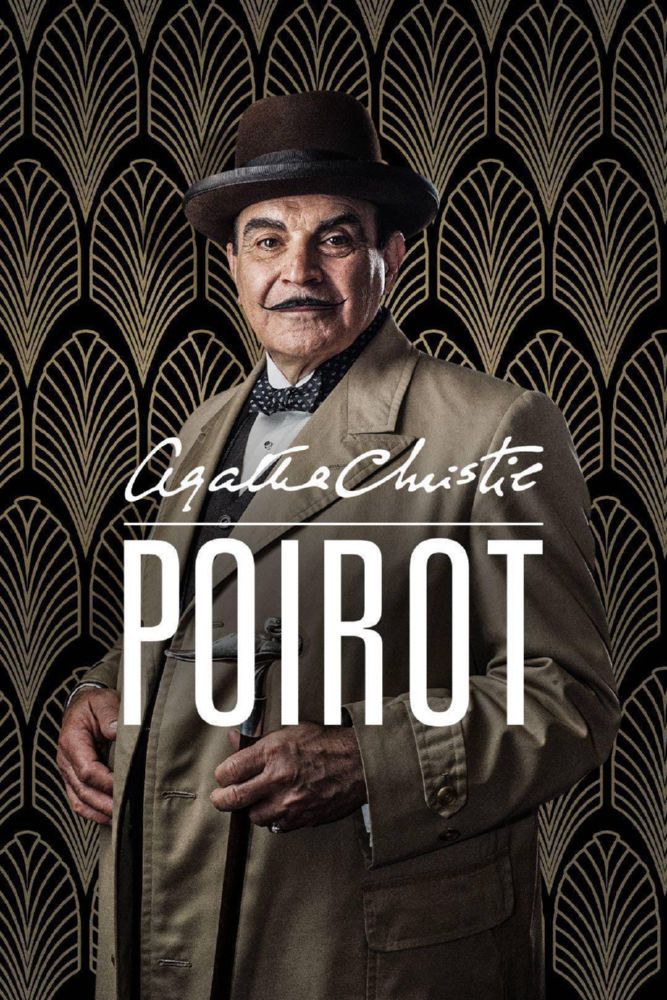




 TV · 1989
Poirot IS WOKE
Belgian detective Hercule Poirot unravels intricate crimes in 1930s England with the help of Captain Hastings and Inspector Japp.
Poirot follows Hercule Poirot, the meticulous Belgian detective whose sharp observation and insistence on order draw him into murders, thefts, and tangled family secrets across England and the Continent. Working from his London flat and often accompanied by the loyal but less brilliant Captain Arthur Hastings, he pieces together clues that Scotland Yard’s Chief Inspector James Japp has already mishandled. Episodes adapt Agatha Christie’s short stories and novels, sending Poirot to country houses, ocean liners, and quiet villages where polite society hides blackmail, jealousy, and carefully planned killings. Miss Felicity Lemon keeps his office running while he interviews suspects with elaborate courtesy and private contempt for sloppy thinking. Each case ends with Poirot gathering the principals to expose the true sequence of events and the guilty party.
As the series continues, Poirot’s reputation brings him ever more elaborate puzzles, from poisoned inheritances to disappearances that seem impossible. Hastings supplies muscle and occasional romantic distraction while Japp supplies official authority and frequent wrong theories that Poirot quietly dismantles. The detective’s vanity, egg-shaped head, and insistence on symmetry remain constant even as the crimes grow darker and the settings more exotic. Relationships among the regulars stay professional and affectionate without modern revision; the focus stays on the locked-room logic and the final drawing-room revelation. Viewers watch Poirot restore order one case at a time until the last confession is extracted and the little grey cells can rest.
WHAT CRITERIA MAKES IT WOKE?


Oops! Is this show WOKE?
Only an account holder or member can file. Cite a scene, a line, or a pattern. Other account holders +1 or −1 that argument, once each. The show is not WOKE until enough of them have given a +1. Enough −1s remove the write-up, and it is no longer shown.
Sign in to file a woke label. One of each criterion per member.
Comments and reviews
Report a mistake
Same rule as woke labels: one report, a written reason, and the community +1 or −1 it — once per member. A net +5 applies the change. Editors can hold it for review, or apply it immediately.
No mistake reports yet.
Sign in to report a mistake. One report per field, per member.
Member review
June Pell Member
Oct 21, 2026
★★★★★★★★★★I’ve been coming back to Poirot for years, usually on quiet evenings when I want something orderly and a little old-fashioned. David Suchet still feels like the definitive version to me; the way he holds himself, the fussy little adjustments to his mustache, the quiet contempt for anyone who can’t keep a thought straight. The early seasons especially settle into a rhythm that feels comfortable without ever going soft. You get the country houses, the train compartments, the polite interviews that slowly turn the knife. Hastings remains the right kind of loyal foil, and Japp’s bluster never quite ruins the cases. Miss Lemon running the office with that clipped efficiency is one of those background pleasures I notice more the second or third time through.
That said, the later series started making choices that pulled me out of the story in ways the books never did. I first caught it properly in “Five Little Pigs.” In the novel Amyas Crale and Philip Blake are simply rivals circling the same woman; the adaptation turns them into secret lovers instead. It isn’t played for openness or tenderness. It’s a hidden history that rewrites the original motive structure, and once I saw it I couldn’t unsee how neatly it swapped heterosexual jealousy for something the writers clearly found more contemporary. The same pattern shows up again in “Cards on the Table.” Three characters are rewritten as gay, and every one of them ends up villainous or compromised. A new superintendent is being blackmailed over photographs, Dr. Roberts’s affair is switched from the wife to the husband, and Rhoda is recast as a lesbian who tries to kill Anne. None of this feels organic to Christie’s plotting. It feels like the production decided certain identities needed to be inserted and then immediately tied them to weakness or crime. I don’t mind characters who happen to be gay. I mind the tally that keeps landing on the same side of the moral ledger.
There’s a similar invention that still bothers me for different reasons. In one of the later stories they create Sister Agnieszka, a nun who simply does not exist in the book. She turns out to be working with a gang of slavers trying to kidnap the youngest Boynton daughter. Using a religious figure as the surprise accomplice in that kind of trafficking plot feels like a cheap shot. The original material didn’t need an anti-clerical twist to make the family horror land; the writers added it anyway. I kept waiting for some counterweight, some decent person of faith, and it never arrived. It left a sour little aftertaste on an otherwise carefully made episode.
None of these changes sink the whole enterprise for me. The production design stays handsome, the guest casts are usually strong, and Suchet’s Poirot continues to treat every crime as a personal insult to order itself. I still rewatch the better early adaptations when I want the comfort of watching a mind work without modern noise. But the pattern in those later seasons is real, and once you notice the gay characters being stacked among the compromised and the invented nun serving the slavers, it becomes hard to pretend the show is only interested in faithful mystery. It starts editing the past to fit newer habits of suspicion. I rated it 4.5 because the core pleasures are still there and because most of the run predates the heavier rewriting. I just wish they had trusted Christie’s own geometry of desire and belief a little longer instead of sanding it down and then loading the edges with contemporary freight. The best hours of the series still feel like clear water. A few of the later ones taste of something else entirely.