



 MOVIE · 1968
Planet Of The Apes (1968)
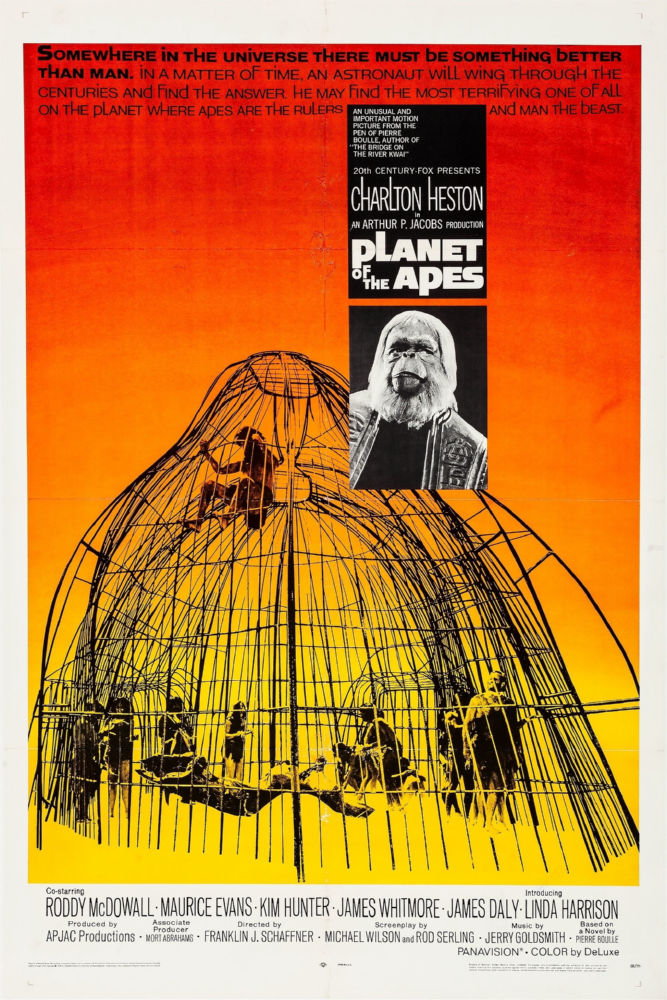
Charlton Heston and Roddy McDowall star in this legendary science fiction masterpiece. Astronaut Taylor (Heston) crash lands on a distant planet ruled by apes who use a primitive race of humans for experimentation and sport. Soon Taylor finds himself among the hunted, his life in the hands of a benevolent chimpanzee scientist (McDowall).
Oops! Is this show WOKE?
Only an account holder or member can file. Cite a scene, a line, or a pattern. Other account holders +1 or −1 that argument, once each. The show is not WOKE until enough of them have given a +1. Enough −1s remove the write-up, and it is no longer shown.
Sign in to file a woke label. One of each criterion per member.
Comments and reviews
Report a mistake
Same rule as woke labels: one report, a written reason, and the community +1 or −1 it — once per member. A net +5 applies the change. Editors can hold it for review, or apply it immediately.
No mistake reports yet.
Sign in to report a mistake. One report per field, per member.
Member review
Ray Okonkwo Member
Oct 16, 2026
★★★★★★★★★★Having seen all three films from the rebooted series, I came into watching the original expecting something relatively similar. To my pleasant surprise, it's a very different story. The 1968 version sits heavier on atmosphere and quieter dread than the modern ones, and I ended up preferring the dynamic it sets up. Those later movies are entertaining in their own right, but this one feels more like a man stranded inside an idea that keeps turning against him.
Charlton Heston is Taylor, an astronaut on a long-term mission with a small crew. His delivery can lean theatrical, almost like he is addressing a gallery instead of the person next to him, yet it fits the material. Taylor is already half-disgusted with humanity before the ship even goes down. That attitude becomes the spine of the whole thing. When he lands and starts realizing the rules of this place, his anger and arrogance do not feel like actor flourishes. They feel like a man who thought he had left the worst of his own kind behind and found a crueler mirror waiting.
I keep coming back to the early stretch after the crash. The landscape is empty in a way that is not just set design. Dust, rocks, silence, then those mute humans scavenging like animals. The first appearance of the apes on horseback still lands. It is not flashy. It is the simple wrongness of the hierarchy that hits. Humans are livestock and lab subjects. Taylor gets injured and cannot speak at first, which forces him into the exact position the apes assign to his species. That stretch, where he is caged and observed while Zira the chimpanzee zoologist starts noticing something is off, is where the movie earns most of its power for me. Roddy McDowall and Kim Hunter play the curious scientists with a kind of earnest seriousness that never tips into camp. Maurice Evans as the orangutan authority figure carries the weight of doctrine without needing to shout it.
The society the apes have built is agrarian, hierarchical, and convinced of its own rightness. Religion and science sit in the same room and argue over what a human is allowed to be. The film does not rush the argument. It lets Taylor scrape against the rules until the rules start to crack. I liked that it trusts the audience to sit with the discomfort instead of cutting to another chase every few minutes. There is adventure here, yes, escapes and hunts and a sense that the ground can open under you, but the real engine is the reversal. You watch a man who used to command a mission reduced to proving he has a mind at all.
Jerry Goldsmith’s score does a lot of quiet work. It is eerie without being constant noise, and it matches the way the camera frames the barren country and the ape village. The makeup and costumes have that late-sixties practical look. You can see the seams if you hunt for them, but I rarely wanted to. The faces hold. Once you accept the world, the world stays put.
There is a line Taylor speaks early that stuck with me longer than most of the set pieces. He talks about being a seeker, about not being able to help thinking that somewhere in the universe there has to be something better than man. Has to be. The movie spends the rest of its runtime testing that hope and then twisting the knife. I will not lay out the final beat for anyone who has somehow avoided it, but the way the story pays off the journey is still one of the cleaner gut punches in big studio science fiction. It is not subtle. It does not need to be. The point lands because everything before it has been building the same suspicion: that the worst thing about the place might not be the apes.
I am not going to pretend every scene is airtight. Some of the dialogue around the tribunal leans on speeches that could have been trimmed, and a couple of the supporting humans exist mostly to fill space or get chased. Linda Harrison’s Nova is more presence than character, which worked for the allegory in 1968 and feels thinner now if you are looking for modern depth. Still, none of that sinks the film. The central idea is strong enough to carry the weaker patches.
What I appreciated most, coming off the reboots, is how little this version cares about making the apes cool action figures first. They are people with power, customs, and blind spots. The humans are stripped of speech and status until one of them forces the issue. That setup lets the movie talk about race, religion, scientific dogma, and nuclear dread without turning into a lecture with commercial breaks. You feel the allegory because the story keeps putting Taylor in positions where pride, fear, and survival collide. It is cleaner than a lot of later attempts at the same themes.
I rated it four stars because the craft and the ending still hold, and because the central performances give the premise a human face even when that face is buried under ape makeup. It is not flawless, and it is very much of its time in places, but it remains a strange, stubborn piece of science fiction that trusts silence and implication more than spectacle. If you only know the recent trilogy, this one is worth the look. It moves at its own speed, it lets Heston be Heston, and it leaves you with that seeker’s question ringing a little louder than it did at the start.