



 MOVIE · 1992
Of Mice And Men
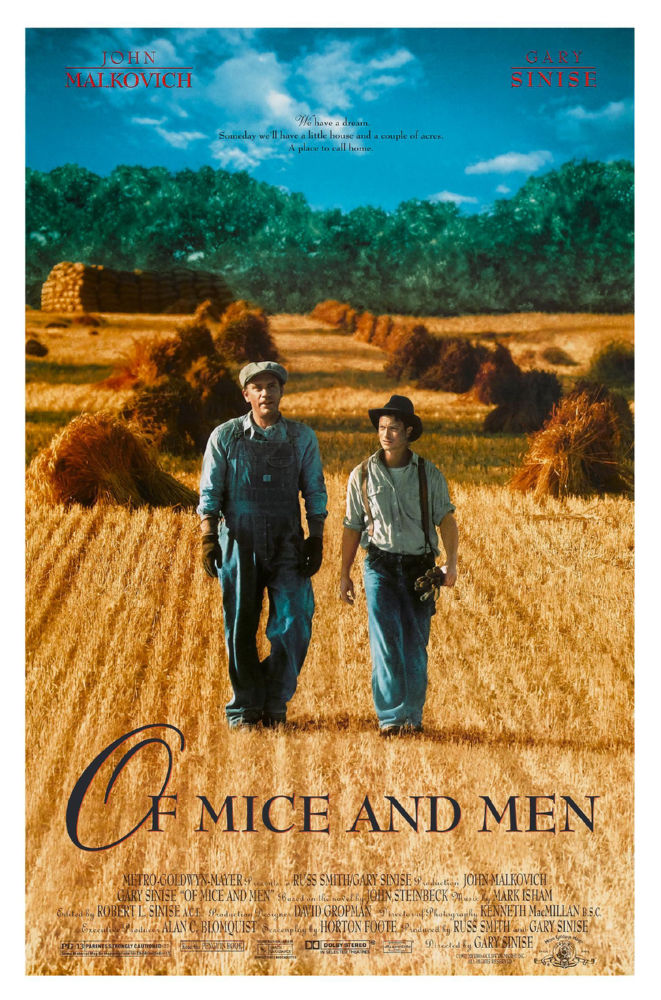
John Steinbeck's classic 1937 novel is given new life by director Gary Sinise who also plays the part of George Milton, a laborer who has thrown in his lot with a gentle but slow giant, Lennie Small (John Malkovich). George has become Lennie's protector. Although intellectually disabled, Lennie is a willing, strong worker, and between them they expect to earn enough money to buy their own small piece of land. Lennie's strength is also his curse. He has a childlike attachment to small animals, but often crushes them to death. And women, to Lennie, are like soft, small and gentle animals. The tragedy that will emerge from this fact will involve an exploited and misused woman (Sherilyn Fenn).
Oops! Is this show WOKE?
Only an account holder or member can file. Cite a scene, a line, or a pattern. Other account holders +1 or −1 that argument, once each. The show is not WOKE until enough of them have given a +1. Enough −1s remove the write-up, and it is no longer shown.
Sign in to file a woke label. One of each criterion per member.
Comments and reviews
Report a mistake
Same rule as woke labels: one report, a written reason, and the community +1 or −1 it — once per member. A net +5 applies the change. Editors can hold it for review, or apply it immediately.
No mistake reports yet.
Sign in to report a mistake. One report per field, per member.
Member review
Dan Reilly Member
Oct 6, 2026
★★★★★★★★★★The 1992 Of Mice and Men starts with a couple of choices that hold it back. John Malkovich’s Lennie is the biggest one. He commits hard to the soft voice and the big physical presence, but it often feels like a carefully built mannerism rather than a living person. You catch him working the part, and once you notice that, it’s hard to stop noticing. Lennie has to feel dangerous and innocent at the same time; when the performance tips too far into studied simplicity, the danger starts to look rehearsed. That undercuts some of the dread the story needs.
Gary Sinise directed and plays George, and the dual role shows. He clearly loves the material and knows the rhythms of the book, yet the camera stays pretty polite. A lot of bunkhouse scenes sit still and let the dialogue do the lifting. That can work on stage. On film it sometimes just sits there. The ranch itself looks right—dust, heat, the low ceilings of temporary living—but the film doesn’t always push the visual side hard enough to make the place feel like a trap closing in. You get the period and the work, but not always the slow pressure.
Curley’s wife is another soft spot. Sherilyn Fenn plays her with a kind of restless loneliness that fits, yet the character still functions mostly as the spark that lights the final fire. The movie doesn’t find much new in her. She wants company, the men treat her like trouble, and the story rolls forward. In a piece this short and this pointed, every figure needs weight. She ends up feeling lighter than the rest.
Those problems keep it from being great. What keeps it honest is the core relationship. Even when Malkovich’s choices grate, the bond between George and Lennie still lands. Sinise plays George as a man who is simply tired of being responsible and yet cannot quit. You see it in the way he explains the same rules over and over, the way he snaps and then softens. Their talk about the little place they want—a few acres, some rabbits, a life that belongs to them—still carries that mix of stubborn hope and quiet knowledge that it probably will not happen. The film doesn’t dress the dream up or undercut it with irony. It just lets two broke men believe in it for a while, and that belief is the most fragile thing on screen.
Ray Walston as Candy does quiet, excellent work. The old swamper overhearing the plan and offering his savings is one of the cleanest moments in the picture. You watch a man who has already lost almost everything decide to gamble the rest on a maybe. No big speech, just the sudden light in his face and the way George and Lennie recalculate their future around him. That scene earns its place. Crooks gets a quieter stretch of the same loneliness, and the film is smart enough not to turn it into a lecture. Isolation is isolation; the movie shows it and moves on.
The ending still hurts the way it should. Sinise keeps George’s final act small and exhausted rather than operatic. There is no speechifying about mercy or fate. Just a man who has run out of better options and knows it. That restraint is where the adaptation respects Steinbeck most. The story has always been about how little room there is for softness in a hard world, and how that softness still insists on existing until it can’t. The film gets that part right even when some of the performances and staging feel a half-step off.
I landed at 3.5 because the heart of it works and the surface doesn’t always. It is a careful, respectful version that never quite shakes free of feeling like a careful, respectful version. If you come to it fresh, the friendship and the final blow will stay with you. If you already know the book, you’ll feel the places where the page still cuts deeper. Either way it is solid work by people who took the material seriously. It just never quite becomes more than that. The dream of the farm, the rabbits, the few quiet years—those stay with you after the credits. So does the sense that the world these men move through has no real place for them. That is enough to make the movie worth sitting with, even when certain choices keep it from hitting as clean as it might have.