
Find a mistake?


 MOVIE · 2023
Napoleon (2023) IS WOKE
8
8/10Community rating
Label it
IS WOKE
No summary on file yet. Know this one? Tell us.
WHAT CRITERIA MAKES IT WOKE?


Oops! Is this show WOKE?
Only an account holder or member can file. Cite a scene, a line, or a pattern. Other account holders +1 or −1 that argument, once each. The show is not WOKE until enough of them have given a +1. Enough −1s remove the write-up, and it is no longer shown.
Sign in to file a woke label. One of each criterion per member.
Comments and reviews
Report a mistake
Same rule as woke labels: one report, a written reason, and the community +1 or −1 it — once per member. A net +5 applies the change. Editors can hold it for review, or apply it immediately.
No mistake reports yet.
Sign in to report a mistake. One report per field, per member.
Member review
Lila Marsh Member
Sep 24, 2026
★★★★★★★★★★I finally sat down with Napoleon the other night after putting it off for months. Not because I hate historical epics—I don’t—but because the trailers left me cold and I kept hearing it was a mess in that expensive Ridley Scott way. Turns out it is a mess, just not the kind I expected, and that landed me right at three stars. Worth the time if you’re in the mood, not something I’ll revisit soon.
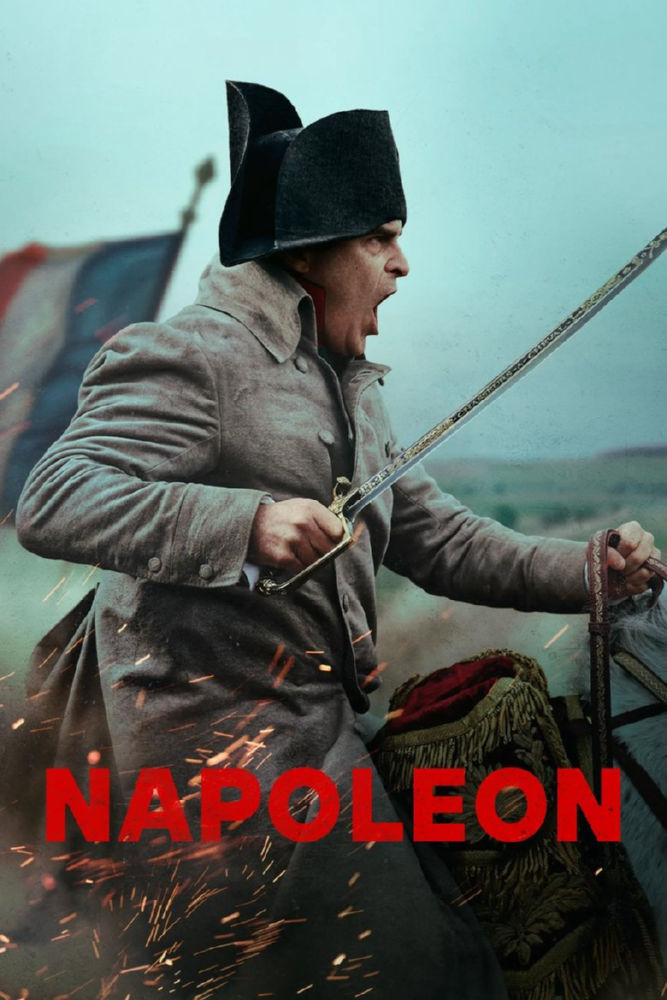
Joaquin Phoenix is the whole engine here, and he plays Bonaparte like a man who’s always half a step ahead of everyone else while also being weirdly unsure of himself. You get the battlefield genius early: the sieges, the way he reads terrain and morale faster than the older officers around him. Those sequences have real snap. Cannons, mud, the sudden shift when a line breaks—Scott still knows how to stage chaos so you feel the weight of it. I bought the climb from Corsican outsider to the guy everyone has to deal with. The problem is what happens when the movie leaves the field.
The Josephine stuff takes over more than it should. Vanessa Kirby is sharp and she makes the widow feel like an actual person with her own angles, not just a trophy. Their scenes together have heat and then this strange insecurity that keeps looping. He measures wins against her reaction. She keeps her own counsel and plays the politics just as hard. Fine. But the film leans on that bond so heavily that whole stretches of the power grab in Paris feel like they’re happening in the background of a marriage drama. I get that the private life fueled the public one; the script just doesn’t always know when to cut away. A couple of the more intimate moments veered into the ridiculous for me—tone swings that pulled me out instead of pulling me closer.
Historically it’s loose, and I knew that going in. Dates jump, battles get rearranged, some decisions are simplified into pure willpower. I’m not a stickler who needs every uniform button correct, but when the movie spends so much energy on the relationship and then skims the larger consequences, it starts to feel thin. The coup lands, the coronation happens, the empire expands, yet I rarely felt the grind of holding it together. Phoenix gives you brilliance and petulance in the same look, which is interesting for a while, then starts to flatten. By the later campaigns I was watching a brilliant, insecure man do brilliant, insecure things without much new information.
What kept me watching was the craft in the big set pieces. Snow, dust, the sound of horses and guns—those parts still work. Scott shoots scale without apology, and the editing usually lets you track who is where. When it settles into quieter rooms the energy drops and you notice how little connective tissue there is between the personal obsession and the map-changing moves. I wanted more of the cold calculation that must have gone into outmaneuvering the Directory, less of the circular need for approval. The film tells you he’s driven by both genius and that marriage; it shows the marriage more clearly than the genius once the early wars are done.
I didn’t hate it. There are stretches where the ambition on screen matches the ambition of the subject, and Kirby and Phoenix bounce off each other well enough that you understand why the story keeps circling back to them. But the whole thing never quite decides whether it wants to be a war film with a love story attached or a love story that happens to involve conquering Europe. That indecision is why it sits at three for me. Entertaining in pieces, frustrating as a complete thought. If you like watching large armies move and don’t mind some historical freestyling, you’ll get your money’s worth. If you want a tighter sense of how one man’s private hungers actually remade the continent, you’ll leave wanting a different movie. I finished it, shrugged, and moved on. That’s the three-star version of Napoleon for me—solid craft, incomplete grip, and a central performance that fascinates without fully landing.