



 TV · 2018
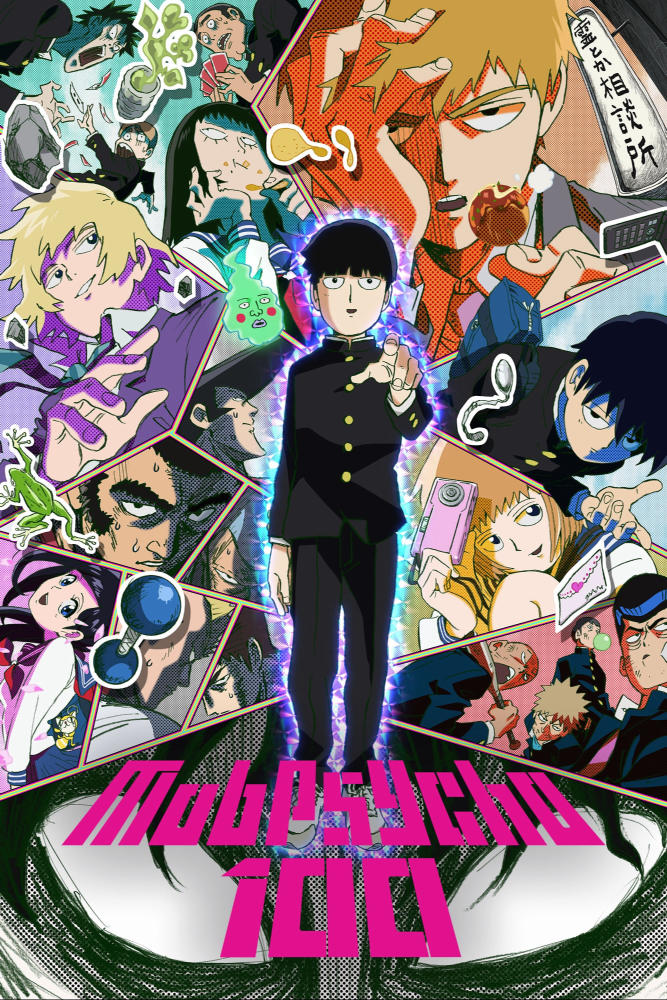
Mob Psycho 100
A quiet middle-school psychic with overwhelming power tries to stay ordinary while working for a flashy con man and stopping other espers who want to rule the world.
Mob Psycho 100 follows Shigeo Kageyama, called Mob, an unremarkable-looking middle school boy who hides enormous psychic ability and a carefully counted emotional limit. He works after school at the Spirits and Such Consultation Office run by Reigen Arataka, a smooth-talking fraud who takes credit for Mob’s real exorcisms while teaching him odd life lessons. Mob wants simple things—friends, a normal routine, and the courage to talk to the girl he likes—yet residual spirits and rival psychics keep pulling him into fights. His younger brother Ritsu notices the gap between Mob’s quiet life and the danger around him, and schoolmate Teruki Hanazawa challenges Mob’s refusal to flaunt power. When Mob’s feelings hit one hundred percent his powers erupt, forcing him and Reigen to clean up the aftermath before ordinary people notice.
As the series continues, Mob is drawn into larger conflicts with organizations that recruit or exploit other espers, including groups that dream of psychic dominance over ordinary society. He keeps returning to claw-machine games, body-improvement club practice, and awkward conversations rather than glory, while Reigen bluffs through crises and Dimple, a lingering evil spirit, attaches himself as an unwelcome advisor. Ritsu’s own latent abilities and resentment complicate the brothers’ bond, and classmates become both allies and people Mob must protect when battles spill into the city. Later arcs test whether Mob will suppress himself forever or accept the full range of his emotions without destroying the life he wants. The story stays on his growth, the mentor-student odd couple with Reigen, and the cost of power used for control versus ordinary kindness.
Click any of the following icons below to rent or stream it!
Oops! Is this show WOKE?
Only an account holder or member can file. Cite a scene, a line, or a pattern. Other account holders +1 or −1 that argument, once each. The show is not WOKE until enough of them have given a +1. Enough −1s remove the write-up, and it is no longer shown.
Sign in to file a woke label. One of each criterion per member.
Comments and reviews
Report a mistake
Same rule as woke labels: one report, a written reason, and the community +1 or −1 it — once per member. A net +5 applies the change. Editors can hold it for review, or apply it immediately.
No mistake reports yet.
Sign in to report a mistake. One report per field, per member.
Member review
Wes Calder Member
Oct 19, 2026
★★★★★★★★★★Mob Psycho 100 stayed on my list longer than it should have because the setup looked cleaner than the usual psychic-kid material. A quiet middle-schooler with more power than he wants, trying to stay ordinary while clocking hours for a flashy fraud who runs a consultation office. That part works. The rest never quite settles into something I cared about past the surface.
Mob keeps his emotions behind a running percentage that builds until it hits one hundred and everything comes loose. The first couple of times the device lands. After that it starts to feel like the show is just winding a spring and waiting for the release. The fights that follow have a loose, scribbly energy that some people treat as revolutionary. I found them stylish in short bursts and empty once the pattern set in. Another esper shows up with a plan or a chip on his shoulder, Mob’s number climbs, the screen gets busy, and the status quo returns. It is competent spectacle. It is also predictable once you have seen the mechanism twice.
Reigen is the only character who consistently earns the minutes he gets. A smooth talker who knows he is full of it and still manages to hand Mob pieces of advice that sound almost accidental. Their office scenes have a flat, everyday rhythm the rest of the series keeps abandoning. Whenever the story drifts into school rivalries or the younger brother’s sudden interest in the family secret, the air thins out. Ritsu’s stretch feels like it should carry more weight than it does. Teruki exists mostly to be shown the error of flaunting power and then folded back into the group. Neither arc surprised me.
I gave it 2.5 because the show keeps advertising a story about choosing a normal life and then spends most of its runtime on the interruptions. The quiet stretches are better than the loud ones, and there are fewer of them than the premise suggests. Mob’s interest in the girl from class never moves past the standard awkward orbit. His wish for ordinary friends is announced more than it is built. The series wants points for emotional honesty while still running on the same power-up clock as any number of battle shows. That gap got harder to ignore the longer I watched.
The art direction is different. Credit where it is due. Some sequences have real snap. Others look deliberately half-finished in a way that starts to read as a habit rather than a choice. I can see the appeal of the idea that raw strength without character does not amount to much. I just wished the series trusted that point enough to sit still with it instead of cutting to another wave of psychic force. Working under a con man could have sharpened into something funnier or meaner. Instead the lessons arrive wrapped in light sitcom timing. Reigen takes the credit, Mob handles the actual work, they close up shop. The spirit cases begin with a little texture and then blur. One residual ghost starts to look like the next.
By the back half of the season I was more curious whether Mob would ever simply speak to the girl than I was about the next group of espers angling for control. That curiosity never got paid off in a way that felt earned. Growth is gestured at, then the counter resets and the next threat arrives on schedule. The brother notices the danger around the quiet life and the show treats the realization as bigger news than it plays.
It is not broken television. It is watchable and occasionally clever about its central gimmick. It is also heavier on presentation than on anything that stuck with me once the credits ran. I wanted the ordinary-life material to win more of the arguments the story sets up. It does not. The flashy con man and the percentage meter do most of the heavy lifting, and neither is enough to carry the whole thing past average. If the animation style catches your eye you will get something out of a few episodes. I would not steer anyone toward it who is looking for a story that holds its shape after the novelty wears off. The premise still looks good on paper. The execution stayed thinner than I needed.