
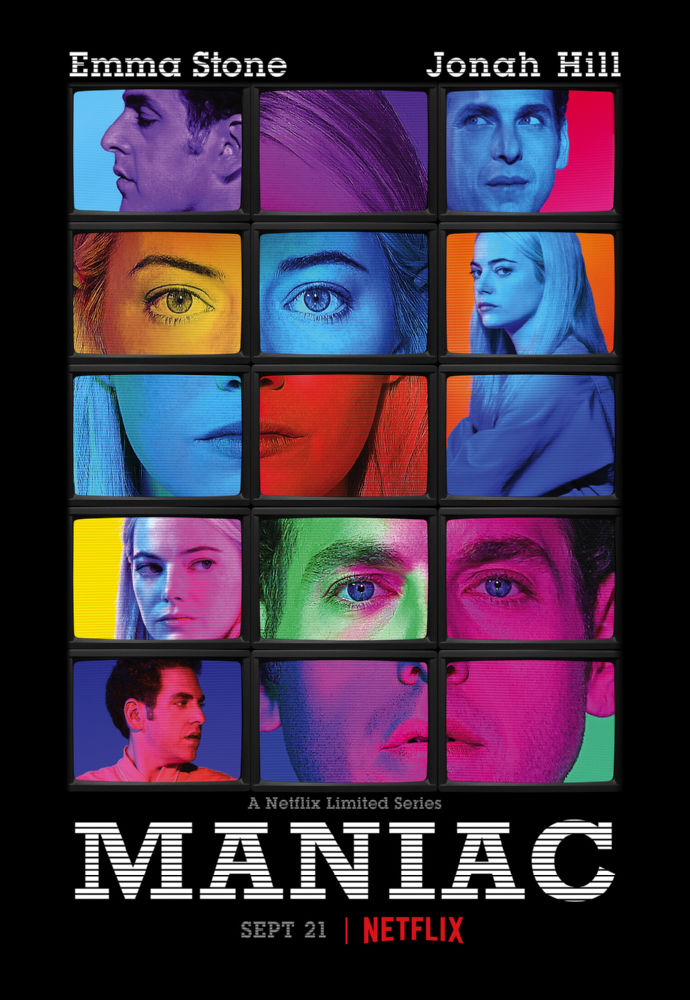



 TV · 2018
Maniac
Two strangers join a pharmaceutical trial that promises to erase their traumas with three experimental pills and no side effects. Shared surreal hallucinations and a failing lab force them to confront what the drugs cannot fix.
Maniac follows Annie Landsberg and Owen Milgrim as they separately volunteer for a secretive three-pill trial at Neberdine Pharmaceutical Biotech. Annie carries crushing guilt tied to her sister and a pattern of self-sabotage; Owen lives with schizophrenia, a controlling family, and the belief he may be chosen for something larger. Scientists James Mantleray and Fujita oversee the study while an aging computer system named GRTA is supposed to guide subjects through therapeutic fantasies. The first pill drops Annie and Owen into linked dream worlds that remix their memories into heists, espionage, and domestic crises. Lab malfunctions and the subjects’ unresolved pain quickly turn the controlled experiment chaotic. Their real-world sessions and the invented realities begin to bleed together.
Inside the shifting scenarios Annie and Owen keep finding each other, first as reluctant partners then as the only people who recognize the artifice. Owen’s brothers and father press him toward a conventional life he cannot sustain; Annie’s history of loss keeps rewriting itself into new forms of abandonment and rage. Mantleray’s own mother issues and Fujita’s efforts to keep GRTA stable add further fractures on the lab floor. Later pills push the pair through darker confrontations with the exact wounds the trial claimed it would dissolve. They must decide whether connection outside the drug is possible once the fantasies collapse. The final stretch returns them to the hospital wards and the ordinary city, changed but still unfinished.
Oops! Is this show WOKE?
Only an account holder or member can file. Cite a scene, a line, or a pattern. Other account holders +1 or −1 that argument, once each. The show is not WOKE until enough of them have given a +1. Enough −1s remove the write-up, and it is no longer shown.
Sign in to file a woke label. One of each criterion per member.
Comments and reviews
Report a mistake
Same rule as woke labels: one report, a written reason, and the community +1 or −1 it — once per member. A net +5 applies the change. Editors can hold it for review, or apply it immediately.
No mistake reports yet.
Sign in to report a mistake. One report per field, per member.
Member review
Peg Harlan Member
Oct 19, 2026
★★★★★★★★★★I put on Maniac one night when I wanted something that wasn’t the usual network comfort food, and it held me longer than most half-season runs do. Annie and Owen walk into that pharmaceutical trial separately, each carrying enough private wreckage that a three-pill promise of clean slate sounds almost reasonable. The show never pretends the pills are magic cure-alls. Shared dream sequences remix their memories into heists, spy games, and ordinary domestic messes, and those sequences feel less like gimmicks and more like the only language left when ordinary talk fails. You watch two people who would never meet outside the lab get forced into the same mental room, and the friction is what keeps it honest.
Emma Stone and Jonah Hill do the heavy lifting without winking at the camera. Stone’s Annie moves through guilt the way some people move through a room full of furniture they keep bumping into—she knows every corner and still can’t stop the bruises. Hill’s Owen has that quiet sense that he might be meant for something bigger while his family treats him like a problem to manage. Their scenes together, even the ones that are pure fantasy, feel lived-in rather than performed. I kept thinking about how rarely two leads get to bounce off each other this way without the script turning them into a couple just because the camera likes their faces. The connection stays stranger and more useful than romance.
The lab side could have been pure sci-fi wallpaper, but the failing computer system and the two scientists running the trial give it weight. You see the whole experiment fraying at the edges while the subjects are still inside the dreams, and that mismatch between what the pills are supposed to do and what actually happens is where the show earns its keep. Trauma doesn’t vanish because a machine says the session is over. The pills open doors; they don’t sweep the rooms clean. I liked that the series never lectured about mental health or big pharma. It just let the mess sit there and trusted you’d notice which parts couldn’t be fixed by chemistry.
They used to make short runs like this more often—ambitious, a little jagged, willing to look ridiculous in service of something that stuck. Maniac has that same nerve. The production design jumps decades and genres inside a single episode without asking permission, and somehow it never feels like showing off. One minute you’re in a neon heist, the next you’re watching two people try to have a normal conversation in a waiting room that might not even be real. The shifts keep you slightly off-balance, which is exactly the right place for a story about people who already feel off-balance in their own heads.
What stayed with me after the last episode wasn’t a tidy moral or a big twist. It was the ordinary stubbornness of both characters. Annie keeps sabotaging herself even when she can see the pattern. Owen keeps hoping the world will finally match the private story he tells himself. The trial doesn’t resolve either of those habits; it just forces them into the open. I finished the series feeling like I’d spent time with two people who were still unfinished, and that felt more true than most tidy endings. The supporting cast around the lab adds texture without stealing focus—everyone seems one bad day away from their own private collapse, which fits the tone.
I rated it four because the ambition sometimes outruns the clarity. A couple of the dream threads stretch longer than they need to, and the final stretch leans on imagery that is striking but a little foggy about what it wants you to carry away. Still, those are the kinds of flaws that come from swinging hard rather than playing it safe. Most shows this year settle for being clever or pretty or “important.” Maniac tries to be all three at once and mostly gets there. It respects the audience enough not to explain every symbol, and it respects its characters enough not to turn their pain into a branding exercise.
I’ve gone back to a couple of episodes just to sit with the quieter lab scenes again. There’s a particular stillness when the machines are failing and no one knows what the subjects are seeing that feels more tense than any of the chase sequences. That stillness is what I keep recommending when people ask why they should bother. It’s not perfect, and it doesn’t pretend the world can be fixed with the right dosage. It just lets two damaged people share the same strange weather for a while and then sets them back down in their own lives a little more awake. That was enough for me. Four stars feels right—strong enough to remember, human enough that I don’t mind the rough edges.