
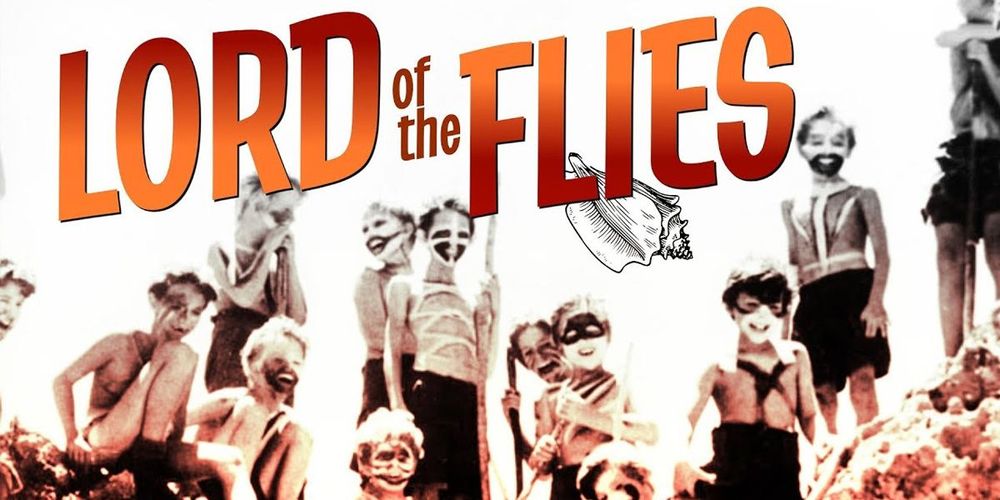



 MOVIE · 1963
Lord of the Flies (1963)
The story of thirty English schoolboys stranded on an uncharted island at the start of the "next" war, Lord of the Flies is a seminal film of the New American Cinema and a fascinating anti-Hollywood experiment. In his daring translation of William Golding's novel, director Peter Brook found the cinematic "evidence" of the author's terrifying thesis: there is a beast in us all.
Oops! Is this show WOKE?
Only an account holder or member can file. Cite a scene, a line, or a pattern. Other account holders +1 or −1 that argument, once each. The show is not WOKE until enough of them have given a +1. Enough −1s remove the write-up, and it is no longer shown.
Sign in to file a woke label. One of each criterion per member.
Comments and reviews
Report a mistake
Same rule as woke labels: one report, a written reason, and the community +1 or −1 it — once per member. A net +5 applies the change. Editors can hold it for review, or apply it immediately.
No mistake reports yet.
Sign in to report a mistake. One report per field, per member.
Member review
June Pell Member
Oct 16, 2026
★★★★★★★★★★I put on the 1963 Lord of the Flies on a quiet weeknight mostly because the idea of it had been sitting in the back of my head for years. Not the later color version, the black-and-white one Peter Brook made. I knew the basic setup from the book years ago—English schoolboys, plane, uncharted island, the war that is supposed to be starting somewhere far away—but I had never actually sat with this particular film. What surprised me first was how little it behaves like a regular movie. It feels closer to someone leaving a camera running in a place where the usual adult fences have been removed and then refusing to tidy up what comes next.
Brook used real boys rather than polished child actors, and that choice still carries a lot of the weight. Their faces are ordinary. Their voices crack or go flat at the wrong moments. When the order they brought with them starts to fray, you believe it because nothing about them looks rehearsed for the camera. The island itself is not sold as paradise. It is just rocks, scrub, heat, and the ocean that will not help them. The early attempts at meetings and rules feel thin almost immediately, the way real group decisions often do when nobody has actual power behind the words. I found myself watching the small physical shifts more than the dialogue—the way someone stands a little apart, the way a stick gets picked up and kept.
There is a stretch in the middle where the film seems content to simply observe the slide. Hunts begin. The painted faces appear. The idea of the beast moves from joke to necessity. I am not going to walk through every beat because the power sits in the accumulation rather than any single shock. What Brook seems after is evidence, almost documentary-style, for Golding’s claim that the darkness does not arrive from outside. It was already packed in the luggage. That thesis lands harder here than it might in a smoother production. Hollywood polish would have sanded the edges and given us clearer heroes and clearer villains. This version keeps the edges ragged on purpose. You can feel the experiment in every frame: anti-Hollywood in the sense that it refuses the usual comforts of craft and star power.
I wandered off for a minute while watching, thinking about how the “next war” framing must have sat with audiences in the early sixties. The Cold War was already the air people breathed. A story about civilized boys becoming something else on an empty island probably felt less like distant allegory and more like a nervous look in the mirror. That context still clings to the images. When the conch loses its force and the choir’s discipline turns into something else entirely, the film does not need to underline the point with music or speeches. The camera just stays close enough that you cannot look away cleanly.
At the same time, the same rawness that makes it fascinating also keeps it from climbing higher for me. Some of the performances stay flat in places where a little more precision might have cut deeper. Long passages of the boys simply existing on the island can drift. I never got bored exactly, but I did feel the length in my shoulders a couple of times. The central idea is strong enough that the film does not collapse, yet the execution is uneven in the way real experiments often are. You get the proof of the thesis, but you also get the cost of the method—moments that feel caught rather than shaped. I kept thinking a tighter hand on the pacing might have made the final movement hit harder without changing what the movie is trying to be.
Still, the thing stays with you after the lights come up. Not because every scene is perfect, but because the core observation refuses to leave. There is a beast, and it does not need a special invitation. Watching ordinary boys discover that fact under the pressure of isolation and fear feels more honest than a dozen slicker thrillers that announce the same idea with louder tools. I have seen people treat the story as a simple warning about groupthink or about the thinness of manners. Fair enough, but Brook’s version is quieter and meaner than that. It suggests the manners were never the real barrier. Something older was waiting underneath, and the island just gave it room.
I landed at 3.5 because the experiment succeeds more than it fails, yet the rough patches and the occasional drag keep it from feeling complete. It is the kind of film that makes you glad someone tried it this way, even when you can see the seams. I will probably think about those painted faces and the sound of the conch for a while. That is more than most movies manage, even the ones that look a lot prettier and cost a lot more. The 1963 Lord of the Flies remains a strange, stubborn piece of work—less entertainment than demonstration—and I respect it for refusing to soften what it found out there on the rocks.