
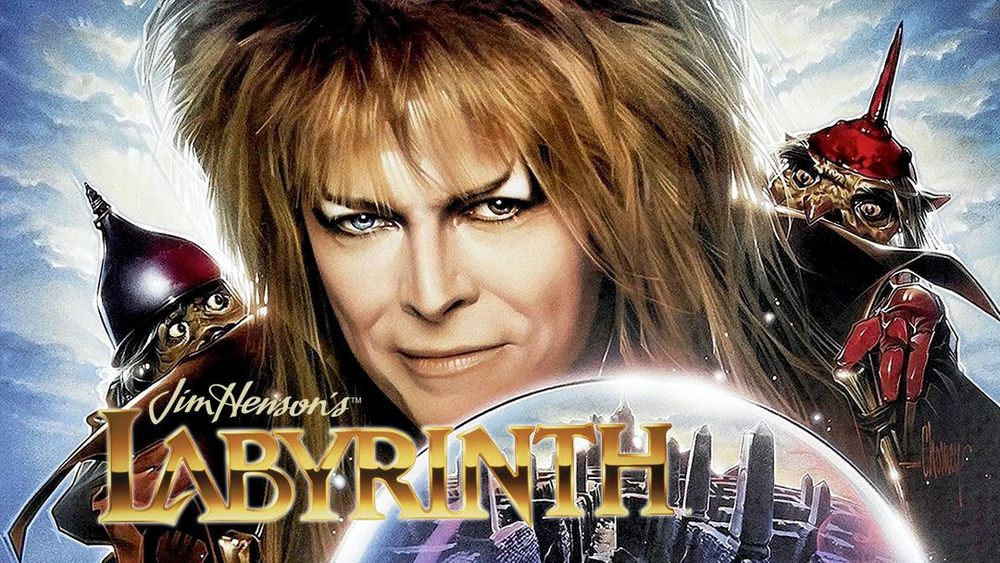



 MOVIE · 1986
Jim Henson's Labyrinth (1986)
Sixteen-year-old Sarah is given thirteen hours to solve a labyrinth and rescue her baby brother Toby when her wish for him to be taken away is granted by the Goblin King Jareth.
Babysitting infant stepbrother Toby on a weekend night isn't young Sarah's (Connelly) idea of fun. Frustrated by his crying, she secretly imagines the Goblins from her favorite book, Labyrinth, carrying Toby away.
When her fantasy comes true, a distraught Sarah must enter a maze of illusion to bring Toby back from a kingdom inhabited by mystical creatures and governed by the wicked Goblin King.
Oops! Is this show WOKE?
Only an account holder or member can file. Cite a scene, a line, or a pattern. Other account holders +1 or −1 that argument, once each. The show is not IS WOKE until enough of them have given a +1. Enough −1s remove the write-up, and it is no longer shown.
Sign in to file a woke label. One of each criterion per member.
Comments and reviews
Report a mistake
Same rule as woke labels: one report, a written reason, and the community +1 or −1 it — once per member. A net +5 applies the change. Editors can hold it for review, or apply it immediately.
No mistake reports yet.
Sign in to report a mistake. One report per field, per member.
Member review
Peg Harlan Member
Oct 16, 2026
★★★★★★★★★★Labyrinth is one of those movies I can put on and know roughly what I’m getting, which is both its strength and why it sits at 3.5 for me rather than higher. They used to make them like this—practical creatures, a real sense of place that doesn’t lean on computer gloss, and a story that trusts a teenage girl to walk into trouble without a committee of writers explaining every feeling out loud. Sarah starts the night stuck babysitting her baby brother and ends up owning a reckless wish. The Goblin King grants it, and she has thirteen hours to get him back through a maze that keeps changing the rules on her. That setup still works.
Jennifer Connelly carries a lot for someone that young. She plays the frustration and the stubbornness without turning Sarah into a pure victim or a pure hero. You see her make mistakes, dig in her heels, and slowly figure out that the world she half-invented from her storybook isn’t going to hand her the easy way through. David Bowie as Jareth is exactly the strange, magnetic figure the part needs. The hair, the costumes, the way he looms and then vanishes—it’s theatrical in a way that fits a goblin kingdom better than any attempt at grit would have. Some of the songs have stuck with me for years; others feel more like period flavor than something I’d seek out alone. Either way, the music doesn’t try to modernize itself for later audiences, and I’m glad it doesn’t.
The real draw is the world Jim Henson’s people built. The labyrinth itself feels lived-in and unfair. You get talking rocks, a helpful worm who gives bad directions with complete sincerity, the cleaners that come barreling down the corridors, Ludo with his boulder-calling, and Sir Didymus charging into every fight like the stakes are personal. Those sequences still look better than a lot of later fantasy that spent ten times the money. There’s weight and texture to the puppets and sets. When Sarah falls down a shaft full of hands or faces the ballroom sequence, you feel the physicality instead of watching someone act against a green screen. That craft is why I keep returning even when the story softens.
What keeps it from a higher mark is the middle stretch and the occasional thinness of the stakes. Once the novelty of each new creature settles, some of the obstacles start to feel like set pieces strung together rather than a tightening noose. The clock is ticking, yet the film sometimes wanders into side bits that are charming more than urgent. I don’t need every fantasy to be grim, but a little more pressure on Sarah’s choices would have helped the later acts. The friendship that forms with the creatures is warm without turning syrupy, and I appreciate that the movie lets her rely on them without making her helpless. Still, a few scenes play longer than they need to, and the resolution lands cleanly but without the full emotional punch it could have had.
I also like what it doesn’t do. It doesn’t lecture. Sarah’s coming-of-age isn’t framed as a lesson about systems or identity checklists. She wants her brother back, she has to grow up enough to admit she was wrong and keep going anyway, and the goblin kingdom tests her with riddles, traps, and temptation rather than speeches. Jareth is a proper antagonist—seductive, unfair, and theatrical—without the film turning ordinary masculinity into the root of every problem. The whole thing stays inside its own fairy-tale logic. That restraint is rarer than it should be.
Rewatching it now, the practical work holds up better than I expected. The lighting in the stone corridors, the way the walls shift, the expressive faces on creatures that shouldn’t be able to emote that well—those details reward another look. Connelly’s performance has a natural quality that later teen-hero roles sometimes sand down into pure competence. Bowie’s presence is still the odd charm that sells the danger and the glamour at the same time. I don’t pretend it’s flawless storytelling. The pacing dips, a couple of songs feel like they belong more to the soundtrack album than the plot, and the labyrinth’s logic is more dreamlike than airtight. But the imagination is genuine, the craft is honest, and it leaves you with images that stick.
For me it lands in that comfortable middle-high spot: worth keeping, worth recommending with a couple of caveats, not something I rank among the untouchable classics. It’s a movie that knows what kind of evening it’s offering—strange, a little dark around the edges, full of rubber and foam and practical wonder—and mostly delivers on that promise. When the credits roll I usually feel like I’ve been somewhere, even if the map was crooked. That’s enough to keep the rating at 3.5 and enough to make me put it on again when the mood hits for something that doesn’t apologize for being a fantasy first.