




 MOVIE · 2023
Killers of the Flower Moon IS WOKE
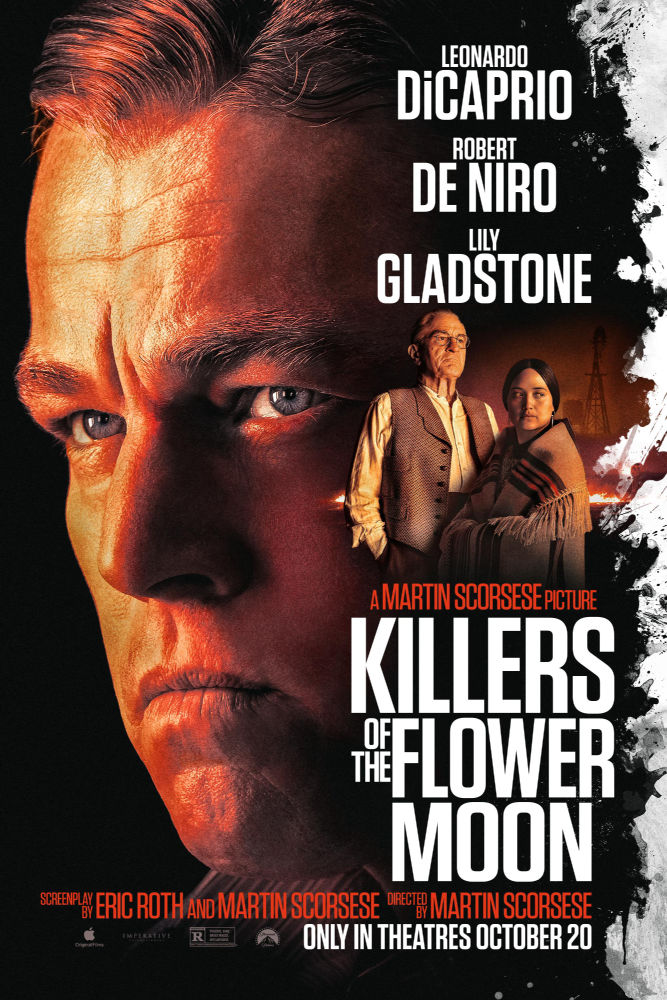
When oil is discovered in 1920s Oklahoma under Osage Nation land, the Osage people are murdered one by one - until the FBI steps in to unravel the mystery.
A murder mystery surrounding members of the Osage tribe unfolds in 1920s America. The Native-American tribe, who reside in Oklahoma, were targeted after oil was discovered on their ancestral land.
The case marks one of the first major investigations by the new Federal Bureau of Investigation (FBI) and shines a light on the notorious J. Edgar Hoover.
WHAT CRITERIA MAKES IT WOKE?



Oops! Is this show WOKE?
Only an account holder or member can file. Cite a scene, a line, or a pattern. Other account holders +1 or −1 that argument, once each. The show is not WOKE until enough of them have given a +1. Enough −1s remove the write-up, and it is no longer shown.
Sign in to file a woke label. One of each criterion per member.
Comments and reviews
Report a mistake
Same rule as woke labels: one report, a written reason, and the community +1 or −1 it — once per member. A net +5 applies the change. Editors can hold it for review, or apply it immediately.
No mistake reports yet.
Sign in to report a mistake. One report per field, per member.
Member review
June Pell Member
Sep 30, 2026
★★★★★★★★★★I went into Killers of the Flower Moon already knowing the broad outline from the book, so I wasn’t waiting for twists so much as watching how Scorsese would sit with the rot. He sits with it a long time. That is both the point and the problem. Three and a half hours is a real ask, and there are stretches where the film feels like it is circling the same moral drain just to make sure you haven’t looked away. I didn’t need every beat repeated. Still, I never felt the whole thing was empty. It has weight, and that weight is earned more often than not.
Ernest is a weak man who knows he is weak and keeps choosing the easy money anyway. Leonardo plays him with this slack, almost pained face that some people found distracting. I found it useful. He looks like someone who has already surrendered and is only waiting for the paperwork. You can hate him without effort. That is not a small achievement. De Niro’s Hale is the colder instrument—the friendly neighbor who never raises his voice while he rearranges an entire family’s future. The two of them together create a kind of domestic crime that feels closer to a family business than a gangster picture, even though the structure keeps reminding you of older Scorsese work. Wealthy man buys protection, uses softer hands to do the dirty parts, discards people when the light gets too bright. Here the commodity is simply headrights and oil instead of booze or gambling. Same machinery, different product.
Lily Gladstone is the reason the movie holds together for me. Mollie is not written as a symbol or a lecture. She is a woman who loves someone she should not fully trust, who gets sick, who keeps trying to protect what is left of her family while the ground under her keeps disappearing. The performance is quiet in the way real grief is quiet. She does not have to announce the stakes; you feel them every time she looks at Ernest and decides, again, to stay. I kept thinking about how rare that kind of centered presence still is in big American movies. The Osage language and the care around the community details also matter. They keep the story from floating off into pure white-guilt pageantry, even though the production is obviously a big Hollywood machine.
I do have mixed feelings about the framing. There is a version of this story that stays tighter on the investigation and the community’s own response. Scorsese and Roth chose the intimate betrayal angle, which puts a lot of screen time on Ernest’s slow corruption and Hale’s paternal mask. It works dramatically, but it also means we spend hours watching the predators more closely than the world they are dismantling. That choice will bother some people, and I understand why. At the same time, I am glad the film exists at all. This particular American theft was easy to file under “forgotten regional tragedy.” Putting it on this scale makes forgetting harder. That is not nothing.
Technically it is almost unfairly accomplished. The look of the land, the interiors, the score, the way scenes breathe and then tighten—none of it feels accidental. Thelma Schoonmaker’s cutting keeps a long film from collapsing into pure drift, even when the script itself is willing to meander. I never got bored exactly, but I did get tired. There is a difference. Fatigue is part of the design; the crimes are repetitive by nature, and the movie refuses to jazz them up into thriller set pieces. That refusal is admirable and also the reason you check the clock.
I am not someone who needs every historical film to be a civics lesson or a redemption arc. What I wanted here was a clear sense of how ordinary greed and local power can hollow out a people while everyone pretends it is just business and bad luck. The movie gives you that. It also gives you too many scenes of Ernest looking miserable in the same chair. I rated it four because the craft and Gladstone and the stubborn seriousness of the subject outweigh the bloat and the occasional wooden patch of dialogue. It is a Hollywood awards object, no question—slick, long, carefully mounted—but it is not hollow Oscar bait. Something real is being chewed on.
One small side thought: watching DiCaprio play a man this fundamentally small is oddly refreshing after years of more heroic or tragic-cool roles. He is not cool here. He is a hanger-on who confuses appetite with destiny. That choice alone kept me engaged when the runtime started to feel like a dare. I would not call the film perfect, and I would not sit through it again next week, but I am glad I saw it once with attention. Some stories need the long form even when the long form tests patience. This one mostly justified the test.