
 MOVIES
 TV
 VIDEO GAMES
 PODCASTS
 VIDCASTS


 STAND-UP
John Branyan
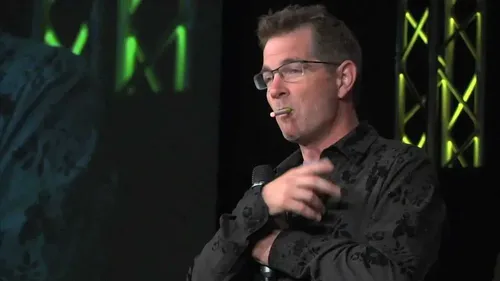
John Branyan delivers clean, high-energy storytelling comedy built on ornate language, physical exaggeration, and playful retellings of familiar tales. Audiences show up for wholesome wordplay and theatrical bits rather than shock or lectures.
John Branyan works as a theatrical storyteller whose sets revolve around elaborate language, precise timing, and full-body physical comedy. He frequently takes well-known children’s stories or everyday observations and stretches them into long, escalating monologues packed with archaic vocabulary and mock-serious delivery. A typical performance builds slowly, layering verbal flourishes and facial reactions until the room is laughing at the sheer density of the wordplay. He keeps the material family-friendly and PG-13 clean, favoring clever misdirection over punch-down or topical rage. Crowds come expecting a craftsman who treats the stage like a one-man play rather than a rant platform. The pacing rewards patience: setups are long, payoffs are verbal and physical at once, and the persona stays warm and slightly professorial.
He returns often to the joy of language itself—Shakespearean twists on fairy tales, over-precise descriptions of ordinary life, and the comic gap between elevated speech and silly content. The jokes are aimed at multi-generational rooms that want shared laughter without edge or agenda; parents and kids can sit together. The feel in the room is bright and participatory, with audible delight when a long bit finally lands. Nothing in the available material frames masculinity as toxic, inserts quota identity lectures, or sneers at faith; the focus stays on craft, timing, and the pleasure of a well-told yarn. Sets end on high energy rather than moral summation, leaving the audience with the memory of linguistic acrobatics and physical commitment.
Oops! Is this show WOKE?
Only an account holder or member can file. Cite a scene, a line, or a pattern. Other account holders +1 or −1 that argument, once each. The show is not IS WOKE until enough of them have given a +1. Enough −1s remove the write-up, and it is no longer shown.
Sign in to file a woke label. One of each criterion per member.
Comments and reviews
Report a mistake
Same rule as woke labels: one report, a written reason, and the community +1 or −1 it — once per member. A net +5 applies the change. Editors can hold it for review, or apply it immediately.
No mistake reports yet.
Sign in to report a mistake. One report per field, per member.
Member review
Wes Calder
Oct 9, 2026
8/10I spent the better part of an evening clicking through John Branyan clips, the short ones that keep stacking if you let them. Three Little Pigs in pieces, the alphabet bit, something about Flippin Arkansas, a few longer stretches where he just talks. He does not rush. That is the first thing you notice. Most comics these days hit the punchline like they are late for a bus. Branyan builds the sentence first, then the next one, and by the third layer of vocabulary you realize the laugh is already forming before he finishes the thought. The language is the point. He treats ordinary stories like they need the full Elizabethan treatment. A children’s tale becomes a mock-serious monologue packed with words you half-remember from high school and facial reactions that sell every flourish. He leans into the physical side too—shoulders, eyebrows, the whole posture shifting as if the story has its own weather. It is theatrical without turning into a costume party. You can see the craft in the timing. He lets a phrase hang just long enough for the room (or the comments section, in my case) to catch up, then piles on another. Clean material the whole way. No cheap shots, no lectures, no attempt to prove he is smarter than the audience. Just wordplay and exaggeration that stay family-friendly without feeling soft. I kept going because the bits reward consecutive viewing. One short of the pigs leads to the next part, then something about daily life in the Midwest, travel frustrations, the kind of ordinary annoyances that become funny once someone decides to narrate them like a classical oration. There is a stretch where he works a uniquely named town and the sounds that wake you at night; another where marriage quirks and faith get the same ornate treatment. Nothing mean. He finds the absurdity and stretches it until the density of the language itself becomes the joke. That is rarer than it should be. Plenty of comics can do a clean set. Fewer can make the clean set feel like a performance that was built rather than assembled from spare parts. What stays with me is the control. He knows exactly how long to stay in the mock-serious register before the physical beat lands. Crowds in the clips sound like they came for exactly that—wholesome theatrical bits instead of shock or rage. You hear the laugh build in waves rather than single barks. I am not usually one for long storytelling bits; they can drift. His do not. The vocabulary keeps the energy high even when the premise is simple. Retelling a familiar tale becomes an exercise in how many flourishes the sentence can carry before it tips over into laughter. He does it without winking too hard. The persona is consistent: a craftsman who enjoys the sound of a well-turned phrase and is willing to look slightly ridiculous to land it. There is an interview clip mixed in where he talks about learning the craft and writing jokes. It tracks with what you see on stage. Nothing accidental. The escalation is planned. Everyday observations—competition, travel, the small frictions of living in the middle of the country—get the same treatment as the fairy tales. He makes the case, without ever stating it, that ordinary life is already strange enough if you look at it with the right amount of formality. That approach ages better than topical material. You can watch these pieces years later and the jokes still sit where he put them. I walked away from the stack of clips thinking about how little he relies on the usual crutches. No identity lectures, no forced edge, no attempt to make the audience feel sophisticated for laughing. Just dense wordplay and full-body commitment to the bit. The alphabet routine is a good example: pure structure and sound, and somehow still funny because of how seriously he treats the nonsense. Same with the pigs. By part four or five you are locked into the rhythm. He does not need to raise his voice. The language does the heavy lifting. If you only know the short clips, the longer monologues reward the extra minutes. The builds are slower and the payoffs sit deeper. Physical comedy fills the gaps between verbal peaks so the set never goes flat. It is the kind of work that makes you notice how much modern comedy has thinned out its vocabulary. Branyan still treats words like tools with weight. That alone is worth the time. I am not handing out perfect scores for clean comedy just because it is clean; the craft has to hold. Here it does. The jokes land one after another without needing a safety net of outrage or confession. You finish the run of clips a little more aware of how a sentence can be built, and that is rarer than a good punchline. He keeps the door open for people who want laughs without the aftertaste. That is not a small thing. Most of what I watched stayed light on its feet even when the stories stretched. I will probably go back to the pigs sequence again when I need something that does not demand I agree with the comic on anything except the value of a well-timed flourish. Solid work. Understated in the best way—he never begs for the laugh, he just keeps stacking the words until it arrives.