



 STAND-UP · 1976
Jeff Dunham
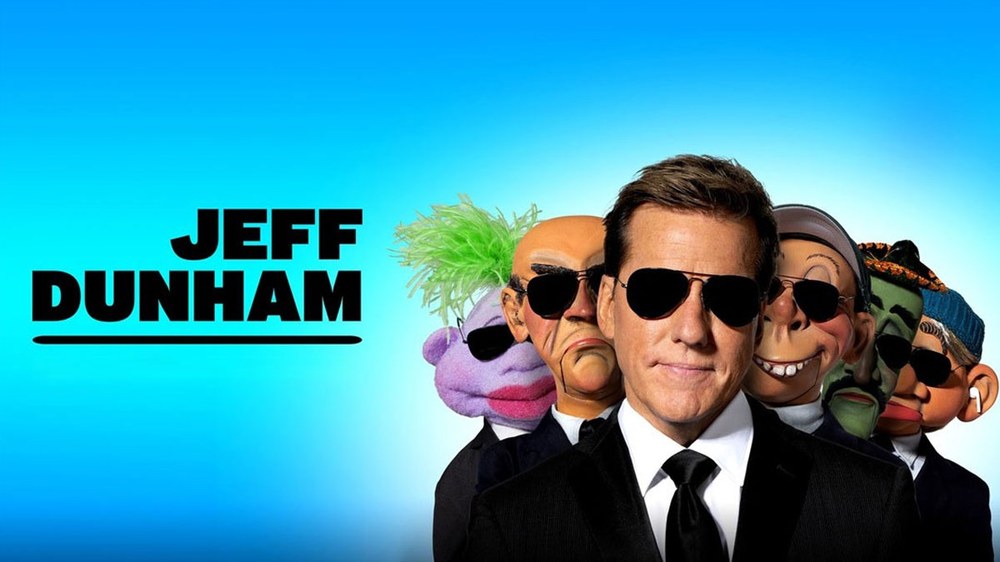
Jeff Dunham delivers high-energy ventriloquist stand-up built around a suitcase full of abrasive puppet alter-egos, rapid insult banter, and deliberately unfiltered crowd-pleasing bits. Audiences show up for the multi-voice chaos, catchphrase timing, and classic arena-comedy pacing rather than monologue storytelling.
Jeff Dunham works as a dressed-down arena ventriloquist whose entire set revolves around bringing out a rotating “suitcase posse” of puppets and letting them trade barbs with him and the crowd. The persona is affable everyman host mixed with sharp-tongued foil; once a character appears, the jokes shift into that voice’s fixed worldview—deadpan, angry, lecherous, or clueless—while Dunham plays straight man and trigger. Pacing is brisk and theatrical: short setups, quick switches between puppets, repeated catchphrases, and direct audience call-outs keep the room locked on the next reveal. Topics stay broad—relationships, everyday annoyances, pop-culture jabs, and the puppets’ own outrageous personalities—delivered in the style of a more digestible Don Rickles with multiple personality disorder. A typical night feels like a live variety act rather than a single confessional arc, with each puppet segment functioning as its own mini-routine before the next figure is pulled out.
What the room consistently returns for is the reliable chemistry between Dunham and his established characters, the permission to laugh at blunt, politically careless punchlines, and the spectacle of seamless ventriloquism under bright stage lights. Jokes circle back to the same well-worn foils and their signature attitudes, giving regulars the comfort of knowing exactly which voice will deliver the next insult. The material favors working-class and mainstream comedy crowds who want loud, accessible laughs and clear villain/idiot targets rather than intimate storytelling or moral instruction. Energy stays high and presentational from open to close; silence is rare because the puppets fill every beat. Fans leave having watched a polished, repeatable circus of voices rather than a narrative special about one man’s life.
Creator: Michael Simon
Oops! Is this show WOKE?
Only an account holder or member can file. Cite a scene, a line, or a pattern. Other account holders +1 or −1 that argument, once each. The show is not IS WOKE until enough of them have given a +1. Enough −1s remove the write-up, and it is no longer shown.
Sign in to file a woke label. One of each criterion per member.
Comments and reviews
Report a mistake
Same rule as woke labels: one report, a written reason, and the community +1 or −1 it — once per member. A net +5 applies the change. Editors can hold it for review, or apply it immediately.
No mistake reports yet.
Sign in to report a mistake. One report per field, per member.
Member review
Becky Soto Member
Oct 9, 2026
★★★★★★★★★★I spent a stretch of the evening bouncing through Jeff Dunham clips, one character after another, the way you do when the algorithm keeps handing you the same suitcase of puppets. It is not subtle work. He walks out as the mild host, opens the case, and suddenly the room is arguing with a skeleton, a purple whatever Peanut is, a beer-soaked Bubba J, or Walter the permanently disappointed old man. That setup still has a strange pull. You know exactly what is coming and you watch anyway to see how cleanly he switches voices and faces without the mouth moving.
What stuck with me most was a Walter stretch where the old guy just keeps undercutting every polite thing Jeff tries to say. The timing is tight. Jeff sets up something almost gentle, Walter cuts it off with that flat, sandpaper voice, and the laugh comes less from the punch line itself than from how fast the air leaves the room. I caught myself smiling at a couple of those exchanges even when the material felt like it had been worked for years. Achmed still gets the big reaction clips too—the deadpan “I keel you” rhythm, the pause, the way Jeff lets the silence sit just long enough. People have heard it a hundred times and still lean forward for the catchphrase. That part of the craft is real. The multi-voice chaos is the entire product, and he has refined the handoffs until they feel automatic.
At the same time, sitting through several bits in a row made the formula feel thinner than I wanted it to. Once a puppet is out, the worldview is locked. Peanut is manic and loud. Bubba J is slow and proud of it. Walter hates everything. Achmed is the death threat with a grin. The jokes then become variations on that fixed dial rather than new observations. After a while the insult banter starts to sound like the same three gears turning. The crowd call-outs land because the room already knows its part, not because the line is especially sharp that night. I kept waiting for a turn that surprised me, and mostly I got the reliable arena pacing instead: short setup, puppet switch, catchphrase, bigger laugh, next puppet. It is engineered to keep an arena locked, and it does that job. It just did not leave me with much once the clips ended.
There is also the dressed-down everyman bit Jeff plays against his own cast. He is the patient straight man who lets the puppets say the abrasive thing, then reacts like a slightly embarrassed dad. That contrast is the engine. When it works, it is efficient and weirdly charming. When it stalls, you notice how little the host himself is saying that you have not heard in earlier specials. A couple of the newer-sounding bits about modern life and what comedians are supposedly allowed to joke about felt more like throat-clearing than actual jokes. The room laughs because the puppets are already loud and the rhythm is familiar, not because the observation is fresh. I liked the skill on display—the lip control, the quick character drops, the way he can still make a foam head feel like a separate person in the chair next to him. Skill is not the same as wanting another half hour of it.
I keep thinking about how the suitcase itself is the show. He does not build long monologue stories. He cycles the posse, trades barbs, resets, and does it again. For some nights that is exactly what people showed up for. For me, watching clip after clip, the repetition wore the edges down. A Peanut dating bit that should have been ridiculous just felt busy. A Bubba J accent gag that the crowd loved still played like a well-rehearsed button rather than a live discovery. Even the moments that clearly did not go the way he expected in the room—those little recovery laughs—have been polished so many times that the surprise is mostly theatrical now. I am not angry at any of it. It is competent crowd-pleasing ventriloquism that knows its lane. I just walked away feeling like I had already heard the best versions of these characters years ago, and the new runs were mostly re-skinning the same insults.
There is a small pleasure in watching someone still sell the bit with full commitment. Jeff never looks bored with his own puppets, and that sells a lot of mediocre lines. Walter’s permanent scowl still reads. Achmed’s stillness still sells the deadpan better than most comics manage with their own faces. Those are the pieces that lingered for me after I closed the tab. Everything else blurred into the same rapid-fire switch pattern. High energy, yes. Deliberately unfiltered, sure, in the old arena-comedy way. But the multi-voice chaos that used to feel like a full carnival now feels like a reliable set list I already know by heart. I gave it two stars because the craft is still visible and a few beats genuinely made me laugh out loud, yet the overall experience felt dated and thin once the novelty of the puppets wore off again. Friendly, practiced, and ultimately not something I am eager to dive back into tomorrow.