



 MOVIE · 1990
Jacob's Ladder (1990)
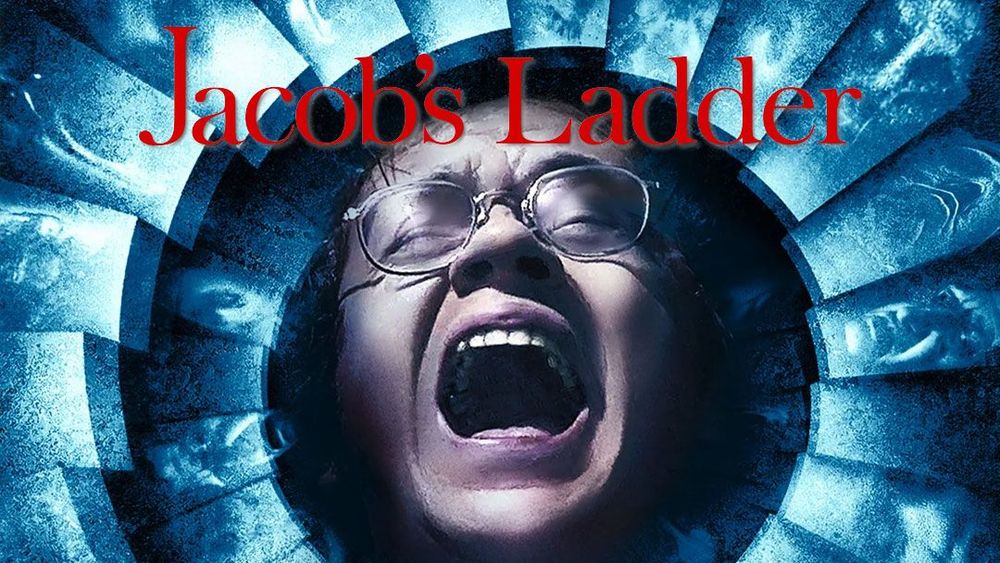
A Vietnam War veteran, now a New York City postal worker, struggles with flashbacks and hallucinations. With the help from his new bride, he fights to keep sane while his brain fluctuates between reality and delusion.
Creator: Charles Kiselyak · IMDb
Oops! Is this show WOKE?
Only an account holder or member can file. Cite a scene, a line, or a pattern. Other account holders +1 or −1 that argument, once each. The show is not WOKE until enough of them have given a +1. Enough −1s remove the write-up, and it is no longer shown.
Sign in to file a woke label. One of each criterion per member.
Comments and reviews
Report a mistake
Same rule as woke labels: one report, a written reason, and the community +1 or −1 it — once per member. A net +5 applies the change. Editors can hold it for review, or apply it immediately.
No mistake reports yet.
Sign in to report a mistake. One report per field, per member.
Member review
Ray Okonkwo Member
Oct 16, 2026
★★★★★★★★★★Jacob’s Ladder hits you in a weird way if you’ve ever had nights where your own head won’t shut up. I sat with it again last week, not hunting for every twist, just letting a handful of stretches settle. Tim Robbins plays Jacob Singer like a guy who’s already half gone when the movie starts—postal worker in New York, Vietnam still stuck under his skin, and these flashes that don’t care whether you’re ready. The film doesn’t explain itself early, and I like that it trusts you to feel the off-balance first.
One stretch that still gets me is the subway ride. Ordinary car, ordinary noise, then the faces start sliding wrong and the light turns sick. No big monologue, just the sense that the world is peeling. Another is the party sequence where Jezebel is dancing and suddenly the room isn’t safe anymore. Bodies twist, eyes go black, and the music keeps going like nothing’s wrong. Those moments work because they stay physical. You feel the heat and the crowd before the horror fully registers. The hospital scenes later do something similar—long corridors, gurneys that move too smooth, doctors who look like they stepped out of a bad dream. It’s less jump-scare and more “your body knows before your brain does.”
The marriage piece with Elizabeth Peña gives the movie a pulse that pure nightmare stuff usually lacks. She’s not just the supportive wife standing there looking concerned. She pushes back, gets frustrated, tries to pull him into the present. Their apartment feels lived-in—mail on the counter, leftover takeout, the kind of small mess that tells you these two actually share space. When Jacob starts slipping, you see what it costs her without the film turning it into a speech. Danny Aiello as the chiropractor buddy brings a different kind of calm. The adjustments, the talk about demons and energy, it could have gone full woo-woo, but it stays grounded in the way a friend tries to help even when he doesn’t fully get it.
I keep thinking about how the movie handles the war memories. They’re not glossy flashbacks. They’re chopped up, sweaty, full of that specific confusion of not knowing which way the fire is coming from. The chemical angle gets floated without turning into a lecture. You feel the betrayal more than you get a history lesson. That restraint is what keeps it from aging into pure period piece. The city itself—grimy stations, flickering lights, people who look past you—feels like it’s working with the hallucinations instead of just decorating them.
Where it loses me a little is the middle stretch when the conspiracy threads start multiplying. Lawyers, missing files, shadowy men in suits. Some of it lands, some of it feels like the plot is spinning plates to keep you guessing. I didn’t need every loose end tied; the disorientation was already doing the job. A couple of the creature effects look more rubber than terrifying now, though the practical grit still beats a lot of modern slickness. The ending revelation is the part people argue about forever. I won’t spoil it, but it recontextualizes everything in a way that feels earned if you’ve been paying attention to the small human beats, not just the freak-outs. It’s sad more than clever, and that sadness sticks.
Watching it, I kept measuring it against other mind-fracture stories. It doesn’t rely on a single gimmick or a big twist drop. It stays with the daily grind of trying to stay upright when your own senses are lying. The score helps—quiet, uneasy, never overselling. Editing jumps without warning, the way real panic does. Robbins carries a lot of it in his posture and the way his eyes keep checking exits. You believe this guy is exhausted before the first demon shows up.
It’s not a perfect film. Pacing dips when it chases too many explanations, and a few supporting faces feel underwritten. But the core experience—that slow erosion of what’s real—still works. I came away thinking about how thin the line is between memory and invention, and how people around you try to hold the rope even when you’re the one swinging. For a movie from 1990 that leans this hard into psychological dread, it holds up better than I expected. Three and a half stars feels right: strong enough to revisit when the mood hits, not quite the flawless nightmare some claim. It leaves you quieter than when you started, which is more than most horror manages.