
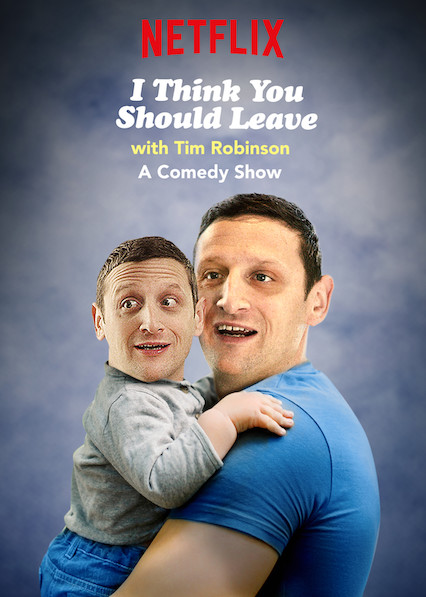



 TV · 2019
I Think You Should Leave - with Tim Robinson
Tim Robinson anchors short sketches in which ordinary conversations, errands, and parties spiral into surreal social disasters. Guest stars join him as each scene doubles down on awkward denial and farcical escalation.
I Think You Should Leave with Tim Robinson follows Tim Robinson through a run of self-contained sketches in which he plays salesmen, coworkers, party guests, and other ordinary figures who refuse to leave a bad situation alone. A simple compliment, a product pitch, or a casual workplace chat becomes a public scene as Robinson’s characters double down, invent rules, and drag bystanders into the mess. Recurring bits include men who will not exit a party, salespeople who will not drop a pitch, and friends who turn a small slight into a full confrontation. Guest performers fill the other roles in each sketch, matching Robinson’s intensity as the premise stretches past normal manners. The comedy stays in the moment of the interaction rather than building a continuous plot across episodes.
Later sketches keep the same pattern while swapping settings: remodels, contests, offices, and public events where someone insists everything is fine while the room falls apart. Robinson’s characters invent slogans, demand apologies, or rewrite what just happened so they can stay in control of the bit. Supporting players push back, freeze, or join the spiral, which lets each short piece end on a harder punchline than the last. Relationships inside a sketch are temporary—boss and employee, host and guest, seller and customer—yet they drive the conflict until the cut. The series returns to that structure week after week: an everyday setup, a refusal to de-escalate, and a final image of social collapse that never resolves into a season-long arc.
Oops! Is this show WOKE?
Only an account holder or member can file. Cite a scene, a line, or a pattern. Other account holders +1 or −1 that argument, once each. The show is not WOKE until enough of them have given a +1. Enough −1s remove the write-up, and it is no longer shown.
Sign in to file a woke label. One of each criterion per member.
Comments and reviews
Report a mistake
Same rule as woke labels: one report, a written reason, and the community +1 or −1 it — once per member. A net +5 applies the change. Editors can hold it for review, or apply it immediately.
No mistake reports yet.
Sign in to report a mistake. One report per field, per member.
Member review
June Pell Member
Oct 19, 2026
★★★★★★★★★★I Think You Should Leave sits in a weird little pocket of comedy that I keep returning to even when I am not in the mood for anything loud. Tim Robinson drops into short sketches as salesmen, coworkers, husbands, strangers, and the whole thing turns on those tiny social missteps that ordinary people try to paper over. A meeting that should have ended five minutes ago. A product pitch nobody asked for. A party conversation that refuses to die. Everyday rooms and cars become pressure cookers of denial and over-explanation, and the cast around him either matches the energy or tries and fails to shut it down. That is the whole engine, and it runs clean for a sketch show.
What I like most is how consistently it lands the absurdity of modern anxiety without turning into a lecture about manners. You recognize the exact feeling of wanting to leave a situation and then inventing three more reasons to stay and dig the hole deeper. Robinson’s characters do not learn. They escalate. The sketches rarely connect into one plot, which is a relief; each one ends when the awkwardness has nowhere left to go. I have watched some of them three or four times and still catch a new beat of physical comedy or a throwaway line that hits harder the second time. It is one of the more consistent sketch series I have seen in a long stretch, and it did make Robinson someone a lot of people suddenly wanted to watch overnight. The guest stars and recurring collaborators help, because they treat the premise seriously enough that the farce never feels like a wink at the audience.
I will admit I sometimes put an episode on while doing something else and then end up fully stopped, staring, because the spiral got too specific. There is a salesman bit where the pitch keeps mutating and the hosts keep trying polite exits that only feed the machine. There is the refusal-to-leave energy that starts from almost nothing and becomes a full standoff. Those pieces stick. They are quotable without needing a catchphrase factory. Friends will drop a half-remembered line into a group chat and everyone knows exactly which scene it is. That kind of shared shorthand is rare for short-form comedy that does not lean on catchy music or big production tricks.
A short side path: I used to think sketch comedy had to either be mean or soft. Mean meant punching down for a laugh; soft meant everyone hugged it out. This show does neither. It just lets people be wrong in public and keeps the camera there until the wrongness becomes its own weather system. That feels closer to how actual social friction works than a lot of polished half-hour comedies. You walk away a little embarrassed for the characters and a little relieved it was not you, which is a useful mix.
I rated it a four because it is not perfect and I do not need it to be. Some sketches peak early and coast on the same gag a beat too long. A couple of guest turns feel like they arrived already knowing the joke and therefore sand off the edge. The format also means you can burn through a season fast and then feel the gaps more sharply when a weaker bit lands in the middle of a strong run. None of that ruins the experience. It just keeps me from pretending every single short is a classic. The best ones are sharp enough that I forgive the ones that only get me halfway there.
What holds it together is the writing’s refusal to explain the joke. Nobody steps out and tells you why the situation is untenable. The characters keep talking as if the next sentence will fix everything, and that next sentence makes it worse. Conference rooms, living rooms, passenger seats—all of them become stages for people who cannot stop performing competence they do not have. I find that funnier, and more honest, than comedy that announces its themes. It also ages better. Social anxiety and status panic are not going away, so the material stays current without chasing trends or current events.
I have recommended it to people who claim they “don’t like sketch,” and a surprising number come back saying they watched two episodes in a row because the rhythm got under their skin. That is the real test for me. Not whether a show is important, but whether it creates its own little weather you want to stand in again. This one does. I still catch myself replaying certain exits in my head when I am stuck in a dull meeting of my own. That is probably not healthy, but it is accurate.
If you want tidy resolutions or characters who grow, look elsewhere. If you want short, self-contained collapses of ordinary life into escalating farce, this delivers without pretending to be more than it is. Four stars feels right: strong, rewatchable, occasionally uneven, and very good at the specific thing it set out to do. I will keep it in the rotation.