



 TV · 2016
Hyena Road
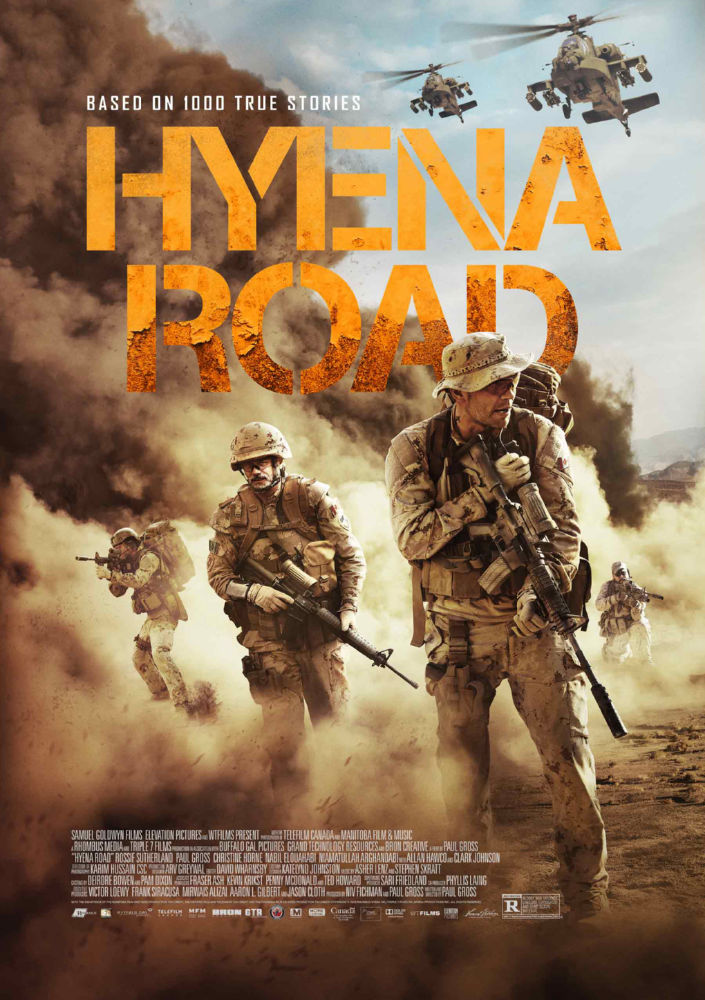
Canadian troops fight to open a deadly supply road through Taliban heartland in Kandahar while wrestling with trust, betrayal, and the murky ethics of modern war.
Hyena Road follows Captain Pete Mitchell as he leads a Canadian battle group tasked with carving a secure route—later called Hyena Road—through the most dangerous stretch of Kandahar province. Beside him, Warrant Officer Ryan Sanders and other soldiers from a Western Canada regiment based on Princess Patricia’s Canadian Light Infantry push construction under constant ambush threat. The mission forces Mitchell to balance kinetic raids against the need for local cooperation, while Sanders grapples with the human cost of each patrol. Afghan fighters and interpreters become uneasy partners whose loyalties shift with every village and every IED. The film tracks how small decisions about who to trust can decide whether the road opens or the unit is cut off.
As the route advances, Mitchell’s relationships with Afghan counterparts deepen and fray under pressure from Taliban shadow networks that treat the road as both prize and trap. Sanders and the enlisted men confront the gap between official strategy and the fluid morality of night raids, civilian casualties, and deals struck in dust and blood. Personal bonds form and break across the cultural divide, revealing how occupation and resistance warp everyone involved. The campaign’s true stakes emerge not in set-piece battles but in the quiet moments when soldiers must decide whether an ally is still an ally. By the time the road nears completion, the cost in trust and lives has already rewritten what victory means for the men who built it.
Click any of the following icons below to rent or stream it!
Oops! Is this show WOKE?
Only an account holder or member can file. Cite a scene, a line, or a pattern. Other account holders +1 or −1 that argument, once each. The show is not WOKE until enough of them have given a +1. Enough −1s remove the write-up, and it is no longer shown.
Sign in to file a woke label. One of each criterion per member.
Comments and reviews
Report a mistake
Same rule as woke labels: one report, a written reason, and the community +1 or −1 it — once per member. A net +5 applies the change. Editors can hold it for review, or apply it immediately.
No mistake reports yet.
Sign in to report a mistake. One report per field, per member.
Member review
Omar Quill Member
Oct 21, 2026
★★★★★★★★★★I put Hyena Road on after a long stretch of ranked matches that left me wanting something slower but still tense. It is a Canadian film about troops trying to carve out a supply route through Taliban territory in Kandahar, and that basic setup already felt different from the usual American war stories I bump into. Captain Pete Mitchell runs the battle group. Warrant Officer Ryan Sanders is right there with him, along with guys from a Western Canada regiment that draws on the Princess Patricia’s Canadian Light Infantry. Their job is to open what becomes known as Hyena Road while everything around them wants it closed.
What pulled me in was the constant question of trust. You have Afghan fighters and interpreters working alongside the Canadians, yet loyalties shift from village to village. One day someone points out a safe path. The next an IED is waiting because the same person or someone close to them flipped. Mitchell has to decide when a kinetic raid is necessary and when talking to locals might actually open the road safer. Sanders feels the weight of every patrol that comes back short or not at all. That back-and-forth between force and cooperation is the whole spine of the movie. It never pretends either choice is clean.
I play a lot of tactical shooters where you clear a compound and the objective marker updates. Here the objective is the road itself, and progress is measured in meters that cost lives. The ambushes land hard because they feel sudden rather than staged. Dust, radio static, vehicles taking hits, guys calling out positions that keep changing. It reminded me of those late-game raids where your squad composition is solid on paper but one bad call on who covers the flank ruins the clear. The difference is these characters do not get a respawn. The film lets that sink in without turning every death into a big speech.
The slower stretches are where my rating settles at 3.5. Building a road under threat means a lot of waiting, negotiating, and second-guessing. Some of those scenes run long. I get why they are there. The grind is the point. Still, coming off games that keep the pressure tight, I felt my attention drift a couple of times. Not enough to quit, but enough that I noticed the clock. When the tension snaps back with another threat on the route, it lands better because of that quiet, yet I wish a few of the middle conversations had been trimmed.
Sanders stuck with me more than anyone. He is the one who carries the human cost in his posture and the way he talks after a patrol. Mitchell has the broader view and the harder calls about who to arm or who to cut loose. Together they show two layers of the same problem. The supporting soldiers fill the frame without needing big backstories. You just see tired faces, practical gear, and the small habits that keep people functional under constant ambush risk. It feels like a unit rather than a collection of types.
The road becomes more than dirt and gravel. Opening it is supposed to lock down a dangerous stretch and keep supply moving. Every meter forward depends on whether the last deal with a local elder holds or whether the interpreter is still on your side when the convoy rolls. Small decisions stack up until they decide if the whole effort holds. I liked that the movie does not resolve that into a neat lesson. It just shows the mess and lets you sit with it.
Production is steady without looking expensive. Locations feel right for the heat and the dust. The kit looks used rather than polished for camera. Dialogue stays close to the ground. No one monologues about higher purpose. They talk about the next sector, the next meeting, the next possible betrayal. That plainness worked for me. It kept the focus on the practical nightmare of trying to build something permanent in a place that treats permanence as a target.
I finished it in one sitting on a weeknight after school and a couple hours of grinding. It held me more than I expected once the trust problems started compounding. The combat never turns into pure spectacle, which is a relief. At the same time the quieter logistics and negotiation parts test patience if you came looking for constant movement. That mix is exactly why 3.5 feels honest. It is solid on the murky ethics and the real cost of each patrol. It is less tight when it lingers on process. If you want a war story that treats the gray areas as the main fight rather than a side note, this one is worth the time. Just know the road itself is slow work, and the film matches that pace more often than a pure action clock would allow.