



 TV · 2023
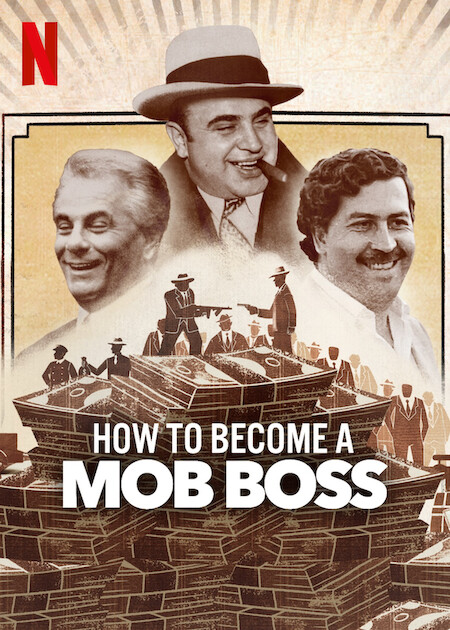
How to Become a Mob Boss
This darkly satirical how-to-guide explores the rise and fall of history's most notorious mob bosses and their tactics for success.
Explore the clandestine world of notorious crime mob bosses in Netflix's 2023 series, "How to Become a Mob Boss." Narrated by Peter Dinklage, the six-part documentary unravels shocking revelations about the cunning tactics employed by legendary figures like Al Capone and Frank Lucas.
Delving into their secretive enterprises, the series unveils a riveting narrative, emphasizing the necessity for an unwavering facade of strength. While wealth opens doors, the true currency lies in fear and power, shaping the defining elements of their illicit "careers." Join this gripping exploration of the ruthless dynamics that propelled these criminal masterminds to the pinnacle of organized crime.
Click any of the following icons below to rent or stream it!
Oops! Is this show WOKE?
Only an account holder or member can file. Cite a scene, a line, or a pattern. Other account holders +1 or −1 that argument, once each. The show is not WOKE until enough of them have given a +1. Enough −1s remove the write-up, and it is no longer shown.
Sign in to file a woke label. One of each criterion per member.
Comments and reviews
Report a mistake
Same rule as woke labels: one report, a written reason, and the community +1 or −1 it — once per member. A net +5 applies the change. Editors can hold it for review, or apply it immediately.
No mistake reports yet.
Sign in to report a mistake. One report per field, per member.
Member review
Peg Harlan Member
Oct 7, 2026
★★★★★★★★★★How to Become a Mob Boss caught my eye because the title sounds like pure gimmick, and sometimes that is exactly what you get with these true-crime packages. What they actually put together is a series that leans into the gimmick on purpose and turns it into the whole point. It plays like a tongue-in-cheek instruction manual for running an underworld outfit, walking through the careers of men who built real empires out of fear, money, and careful image work. Al Capone, Frank Lucas, Salvatore Riina, John Gotti, Whitey Bulger, Pablo Escobar—the usual heavy hitters show up, and each one gets broken down as if he were a CEO who just happened to deal in blood instead of quarterly reports.
The dry narration sells the approach. It never winks too hard or turns into pure comedy. It just lays out the steps these guys took: how they handled rivals, how they kept their own people in line, how they managed the public face when the heat came down. You start noticing the same patterns across different decades and different cities. Calculated violence when it served a purpose, discipline that looked almost military, and a weird kind of brand management so the street and the politicians both knew who was in charge. Then the show circles back to the same truth every time—once you sit at the top of that kind of world, the whole thing is temporary. Somebody younger or hungrier or just luckier is already watching for the first slip.
I liked that angle more than I expected. It treats the criminal enterprise like a twisted version of regular business without pretending the two are the same. The money flows, the loyalty is enforced, the expansion has rules, and the collapse usually comes from inside or from overreaching. Watching it, I kept thinking about how cleanly some of the older crime documentaries used to lay out the same mechanics without needing to dress them up as moral lectures. This one stays close to that spirit. It does not apologize for looking at ruthless men on their own terms, and it does not spend half the runtime telling you how to feel about them. You see the rise, you see the methods, you see the inevitable crack-up. That is enough.
Not every episode lands with the same weight. A couple of the profiles feel a little thinner, like the producers had less fresh footage or fewer sharp details to work with, so the step-by-step structure starts to repeat itself. The Capone hour and the Escobar material held me tighter because the public story is already so big that the show can dig into the lesser-known management choices underneath it. The Whitey Bulger stretch worked for me too—the mix of neighborhood control and quiet deals with authorities makes the “corporate” framing feel less like a joke and more like an actual description. When the series sticks to those concrete moves—who gets paid, who gets eliminated, how the money is cleaned—it stays interesting. When it drifts into broader summary, the energy drops a notch.
Still, the overall idea keeps it from becoming just another parade of famous mug shots. By forcing everything into leadership lessons, it makes you notice the practical coldness that built these outfits. Public relations mattered. Timing mattered. Knowing when to be visible and when to disappear mattered. The show never claims these men were geniuses in any clean sense; it just shows how far pure will and terror can carry someone before the structure turns on them. That fragility comes through clearly. Absolute power in that world looks impressive right up until the day it does not.
I watched it over a couple of evenings and never felt talked down to. The tone stays even. It does not need to invent modern parallels or turn every boss into a symbol for something else. It just puts the careers side by side and lets the pattern do the work. Some nights that is exactly what I want from a crime series—clear-eyed enough to be useful, dark enough to stay honest, and light enough on the sermon that you can actually finish an episode without checking the clock. They used to make them like this more often, the ones that trusted the material instead of surrounding it with extra framing. This one mostly remembers how.
It is not perfect television. The formula can feel a little locked in once you have seen three or four of the profiles, and a sharper edit in a couple of places would have helped. But the core idea is sound, the narration stays out of its own way, and the focus on how these operations actually ran—rather than just how they ended—gives it a little more bite than the average true-crime dump. Three and a half stars feels right. Worth the time if the subject already interests you, and still worth sampling if you just want something that looks at power without dressing it up in today’s language. I will probably revisit a couple of the stronger episodes when the mood hits again.